wayground logo

Free Printable Worksheets

Font size

S
M
L
XL
Worksheets

Algebra Final Study guide

Total questions: 131

Worksheet time: 22hrs 50mins

Name
Class
Date
1.

Which list of fractions is ordered from LEAST to GREATEST?

a)

12,23, 14, 35\frac{1}{2},\frac{2}{3},\ -\frac{1}{4},\ -\frac{3}{5}

b)

23, 14, 35, 12\frac{2}{3},\ -\frac{1}{4},\ -\frac{3}{5},\ \frac{1}{2}

c)

14, 12,34, 23-\frac{1}{4},\ \frac{1}{2},-\frac{3}{4},\ \frac{2}{3}

d)

34, 14, 12, 23-\frac{3}{4},\ -\frac{1}{4},\ \frac{1}{2},\ \frac{2}{3}

2.

Which rational number best represents the letter A on the number line?

a)

511\frac{5}{11}

b)

35\frac{3}{5}

c)

78\frac{7}{8}

d)

710\frac{7}{10}

3.

Which number is the smallest?


19  ,   0.1    ,  212\frac{1}{9}\ \ ,\ \ \ -0.1\ \ \ \ ,\ \ -\frac{2}{12}  

a)

19\frac{1}{9}  

b)

0.1-0.1  

c)

212-\frac{2}{12}  

4.

 Order the following numbers from least to greatest.

Place the smallest number on the left. Add one space between each number. No commas. Type fractions using "/". Example:  14\frac{1}{4}  as 1/4


143 ,    5.1 ,  4-\frac{14}{3}\ ,\ \ \ \ -5.1\ ,\ \ -4  


(a)  

5.
5 = 7s - 9
a)
2
b)
6
c)
7
d)
8
6.
4a + 3 = 15
a)
2
b)
4
c)
1
d)
3
7.
Solve for y:
-5 - 7y = -20y + 34
a)
y = 3
b)
y = 1
c)
y = 0.67
d)
y = 46
8.
7(2x - 4) = 42
a)
x= 5
b)
x= 8
c)
x= 2
d)
x= 9
9.
Each month Kaden's phone company charges a flat fee of $12 plus $0.05 per minute. His bill for last month was $18. How many minutes did Luca talk on the phone last month?
a)
120
b)
100
c)
350
d)
600
10.
Solve for x:
19.2 x - 15 = 7.5x + 8.4
a)
x = 15.3
b)
x = 23.4
c)
x = 2
d)
x = 0
11.
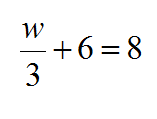
a)
2
b)
4
c)
6
d)
8
12.
Solve:
3(x - 2) = 18
a)
6.7
b)
4
c)
8
d)
-4
13.
Solve:
6(5x - 3) + 2 = 14
a)
2
b)
.5
c)
-1
d)
1
14.
Solve:
7x - 3x - 8 = 24
a)
8
b)
-8
c)
3.2
d)
4
15.
Solve:
2(2x + 3) = -6(x + 9)
a)
1.2
b)
6
c)
-6
d)
7.5
16.
Solve:
2(a + 4) = 2a - 8 + 4a
a)
3
b)
-3
c)
-4
d)
4
17.

Solve the equation.

12x+9=12x+11

a)

x=0

b)

No Solution

c)

x=1

d)

Infinite Solutions

18.

Solve the equation.

x-27= -(27-x)

a)

x= -1

b)

No Solution

c)

x=1

d)

Infinite Solutions

19.

Solve the equation

-11 + 3(x + 5) = 7

a)

x= 1

b)

x = -1

c)

No Solution

d)

x = -3

20.

6 + 2h > 30

a)

h < 24

b)

18 > h

c)

h > 12

d)

h < -12

21.
-4x + 14 ≤ 54
a)
x ≥ -10
b)
x ≤ -10
c)
x ≥ 10
d)
x ≤ 10
22.
-2(x+2) < 14
a)
x < - 5
b)
x > -5
c)
x < -9
d)
x > -9
23.
Solve 
-9h > (-63)
a)
h < 7
b)
h > 7
c)
h < -7
d)
h > -7
24.
-9x + 7 ≥ 25
a)
x ≥ -3.6
b)
x ≤ 2
c)
x ≥ -2
d)
x ≤ -2
25.
Are the equations parallel, perpendicular, or neither?
a)
Parallel
b)
Perpendicular
c)
Neither
26.
Are the equations parallel, perpendicular, or neither?
a)
Parallel
b)
Perpendicular
c)
Neither
27.
Are the equations parallel, perpendicular, or neither?
a)
Parallel
b)
Perpendicular
c)
Neither
28.
Are the equations parallel, perpendicular, or neither?
a)
Parallel
b)
Perpendicular
c)
Neither
29.
Are the equations parallel, perpendicular, or neither?
a)
Parallel
b)
Perpendicular
c)
Neither
30.

What is the slope parallel to the equation: y=4x+3

a)

-1/4

b)

4x

c)

4

d)

1/4

31.
For the equation
y - 3 = 2(x + 4),
the line has a slope of 2 and contains what point?
a)
(-4, 3)
b)
(3, -4)
c)
(-3, -4)
d)
(-4, -3)
32.
Write the equation in point-slope form of the line that passes through the given point and has the given slope.
(4, -7); m = -1/4
a)
y +7 = -1/4(x - 4)
b)
y - 4 = -1/4(x + 7)
c)
y + 4 = -1/4(x - 7)
d)
y - 7 = -1/4(x - 4)
33.
Write the equation in point-slope form of the line that passes through the given point and has the given slope:
 (-2, -1); m= -3
a)
y + 1 = -3(x - 2)
b)
y + 1 = -3(x + 2)
c)
y - 1 = 3(x - 1)
d)
y + 2 = -3(x + 1)
34.
Write the equation in point-slope form for the line that contains the points
(-2, -3), (4, 3)
a)
y - 3 = 1(x - 2)
b)
y + 3 = 1(x + 2)
c)
y -3 = -1(x + 2)
d)
y + 3 = -1(x - 2)
35.
Write an equation  
m = 5/4 through (-4, -3)
a)
y = 5/4x +2
b)
y = -5/4x + 2
c)
y = 2x - 5/4
d)
y = 3/4x + 2
36.

Which of the following lines is PARALLEL to the graph of y = -6x + 3 and goes through the point (-1,4)?

a)


y=6x 4y=-6x\ -4

b)

y=6x+2y=-6x+2

c)

y=6x2y=-6x-2

d)

y=6x+4y=-6x+4

37.

Which is the equation of the line that is parallel to the graph of y = 5x + 7 and has a y-intercept at (0, -2)?

a)

y = 5x - 2

b)

y = 5x-3

c)

y = 5x+2

d)

y = 5x+5

38.

Give the range of the set of ordered pairs: (2, 11), (9, -3), (7, 21), (-8, 6)

a)

{2, 9, 7, -8}

b)

{11, -3, 21, 6}

c)

-8 < x < 9

d)

-3 < y < 21

39.

Which set of ordered pairs is not a function?

a)

(1, 3), (2, 7), (3, 8), (4, 11)

b)

(2, 3), (4, 9), (3, 8), (4, 15)

c)

(1, 2), (3, 5), (6, 9), (7, 11)

d)

(-9, 4), (-6, 3), (-2, 8), (0, 21)

40.

For the function: f(x) = 7(x - 11), f (16) = _____

a)

5

b)

35

c)

16

d)

28

41.
For the function {(0,1), (1,-3), (2,-4), (-4,1)}, write the domain and range.
a)
D: {1, -3, -4,}
R: {0, 1, 2, -4}
b)
D:{-4, 0, 1, 2}
R:{-4, -3, 1}
c)
D:{0, 1, 2, 3, 4}
R:{1, -3, -4}
42.
Evaluate f(-2) if f(x) = x + 3
a)
-1
b)
1
c)
5
d)
-5
43.
Evaluate f(-2) if f(x) = x2+ 3
a)
-1
b)
1
c)
7
d)
-7
44.
Given f(x) = x2 - 7x
Find f(8).  
a)
f(8) = 8 
b)
f(8) = -3584
45.
Given h(x) = 5 - 9x
Find h(8). 
a)
h(8) = -360
b)
h(8) = -67
46.
Let w(x) = 3x - 7. If w(x) = 14, find x.
a)
7
b)
35
c)
2.33333
d)
-49
47.

What is the y - intercept?

a)

0

b)

5

c)

- 4

d)

4

48.
Which equation matches the table?
a)
y = x 
b)
y = 5x
c)
y = x - 4
d)
y = x + 4
49.

Write the equation that created this table.

a)

y = 3x - 9

b)

y = 3x + 3

c)

y = -3x + 3

d)

y = 6x + 5

50.

What is the equation for this table?

a)

y=2x+5

b)

y=2x+3

c)

y=-2x+5

d)

y=-2x+3

51.
If a system of equations has no solution, what does the graph look like? 
a)
intersecting lines
b)
parallel lines
c)
skew lines
d)
intersecting lines
52.
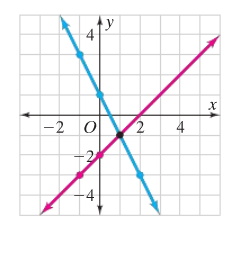
What is the solution?
a)
(1, -1)
b)
(-1, 1)
c)
(0, -2)
d)
(2, 0)
53.
Give the solution to the system.
a)
(3,1)
b)
(1,3)
c)
(-1,3)
d)
(1, -3)
54.
Solve for x and y
3x + 2y = 16
7x + y = 19
a)
(-2,5)
b)
(-2,-5)
c)
(2,-5)
d)
(2,5)
55.
Solve for x and y
y = 2x + 1
y = 4x - 1
a)
(1,3)
b)
(-1,-3)
c)
(-1,3)
d)
(3,1)
56.
Solve the system of equations.
x + 2y = -3
x - y = -12
a)
(-9, 3)
b)
(-7 ,5)
c)
(3, 15)
d)
(9, 6)
57.
5x + 3y = 6
x - 3y = 12
a)
(3,3)
b)
(-3,-3)
c)
(3,-3)
d)
(3,-2)
58.
x - 2y = 4
3x +2y = 4
a)
(-2,-1)
b)
(4,-1)
c)
(2,-1)
d)
(4,1)
59.

How many solutions does this system have?

y = -x + 3

y = -x + 5

a)

One solution

b)

No solutions

c)

Infinitely many solutions

60.

How many solutions does this system have?

y = 2x + 10

y = -2x + 10

a)

One solution

b)

No solutions

c)

Infinitely many solutions

61.

How many solutions does this system have?

y = x + 3

y = x − (-3)

a)

One solution

b)

No solutions

c)

Infinitely many solutions

62.

How many solutions does this system have?

y = -2x + 5

2y = -4x

a)

One solution

b)

No solutions

c)

Infinitely many solutions

63.
The school that Stefan goes to is selling tickets to a choral performance. On the first day of ticket sales the school sold 3 senior citizen tickets and 1 child ticket for a total of $38. The school took in $52 on the second day by selling 3 senior citizen tickets and 2 child tickets. Which equations represents the system that could be used? 
a)
1s + 3c = 38
2s + 3c = 52
b)
3s + 1c = 38
3s + 2c = 52
c)
s + c = 38
s + c = 52
d)
3s + 3c = 38
1s + 2c = 52
64.
On Monday Joe bought 10 cups of coffee and 5 doughnuts for his office at the cost of $16.50.  It turns out that the doughnuts were more popular than the coffee.  On Tuesday he bought 5 cups of coffee and 10 doughnuts for a total of $14.25.  Which equations could be used to determine the cost of the coffee? 
a)
10c + 5d = 14.25
5c + 10d = 16.50
b)
10c + 5d = 16.50
5c + 10d = 14.25
c)
c + d = 10
5c + 10d = 16.50
d)
c + d = 5
5c + 10d = 16.50
65.
A large pizza at Palanzio’s Pizzeria costs $6.80 plus $0.90 for each topping. The cost of a large cheese pizza at Guido’s Pizza is $7.30 plus $0.65 for each topping. Which system of equations could be used to find the number of toppings when both companies cost the same amount? 
a)
y = 6.80 + .65x
y=7.30+.90x
b)
x + y = 6.80
x + y = 7.30
c)
y = 6.80+.90x
y = 7.30 + .65x
d)
y + .90x = 6.80
y + .65x = 7.30
66.

What is the highest degree among terms in this polynomial?

6x2 + 7x4 + x3 + x

a)

1

b)

2

c)

3

d)

4

67.
Classify by the DEGREE:
2x2 - 5
a)
1
b)
2
c)
3
d)
4
68.
Classify by the DEGREE:
4x3 - 5x2 + 2x - 1
a)
1
b)
2
c)
3
d)
4
69.

Put the polynomial in standard form.


7xy - 12y2 + 8xz + 5x2

a)

5x2 + 7xy + 8xz - 12y2

b)

- 12y2 + 5x2 + 7xy + 8xz

c)

5x2 - 12y2 + 7xy + 8xz

d)

- 12y2 + 7xy + 8xz + 5x2

70.
Put in Standard Form.
12 - 3x3 - 10x - x2
a)
 - 3x3 - x2 - 10x + 12
b)
 3x3 - x2 + 10x + 12
c)
12 - 3x3 - 10x - x2
It is in Standard Form.
d)
12 - 10x - 3x3 - x2
71.

Simplify:

5(3x+2)

a)

3x+10

b)

15x+10

c)

15x-10

d)

3x-10

72.
(x +2)(x + 3)
a)
x2 + 5x + 6
b)
x2 + x + 6
c)
x2 + 5x + 5
d)
x2 + 6x + 6
73.
(x + 7)(x + 9)
a)
x2 + 63x + 16
b)
x2 + 16x + 63
c)
x2 + 79
d)
x2 + 16x + 2
74.
(x - 7)(x + 7)
a)
x2 + 7x - 49
b)
x2 - 7x + 49
c)
x2 - 49
d)
x2 + 49
75.
Find the product:
(3x + 2)(2x + 4)
a)
6x2 + 16x + 8
b)
5x2 +11x + 6
c)
5x2 + 16x + 6
d)
6x2 + 11x + 8
76.
Multiply:
(x-3)(x2+2x+7)
a)
x3-x2+x-21
b)
x3+5x+13x-21
c)
x3-3x2+7x-21
d)
x2+2x-3
77.
Multiply:
(5c-2)(3c2-5c+4)
a)
15c3-31c4+30c2-8
b)
15c3-19c2+10c-8
c)
15c3-31c2+30c-8
d)
15c3-31c2+30c+8
78.
Multiply:
(3a + 4)2
a)
6a2+12a+16
b)
9a2+24a+16
c)
9a2+12a+16
d)
9a2+16
79.
What is the greatest common factor of the monomials a2b5 and a3b3
a)
a2b3
b)
a2b5
c)
a3b3
d)
a3b5
80.
What is the Greatest Common Factor of the following polynomial?
12t3 + 30t2 + 48t
a)
12t
b)
6t3
c)
6t
d)
12t3
81.
What is the GCF of 18k and 15k3
a)
3k2
b)
3k3
c)
3k
d)
5k
82.
What is the GCF of the polynomial
24x9 - 36x6 + 60x3?
a)
6x
b)
6x3
c)
24x9
d)
24x
83.
Factor
k2+7x+10
a)
(k+2)(k+5)
b)
(k-2)(k-5)
c)
(k+10)(k+4)
d)
(k+2)(k-5)
84.
Factor
3v2 - 4v - 7
a)
(3v-7)(v+1)
b)
3(v-7)(v-1)
c)
(3v+1)(v-9)
d)
(3v+1)(v-10)
85.
Factor
5x2-28x+32
a)
(3x-10)(x+6)
b)
(x-8)(5x-4)
c)
(5x-8)(x-4)
d)
(5x-8)(x+7)
86.
Factor
3a2 + 4a + 1
a)
(7a-10)(a-8)
b)
Not factorable
c)
(3a+1)(a+1)
d)
(3a-1)(a-1)
87.
What is the vertex?
a)
(2, 4)
b)
(3, -1)
c)
(0, 8)
d)
(4, 2)
88.
What are the x- intercepts?
a)
x= 0 and x= -4
b)
x= 0 and x= 4
c)
y= 0
d)
x= 2
89.
The axis of symmetry of this parabola is...
a)
y = 4
b)
y = -4
c)
x = 4
d)
x = -4
90.
What is the domain of this quadratic function?
a)
All real numbers.
b)
x ≥ 4
c)
x < 2
d)
x ≤ 4
91.
What is the range of this quadratic function?
a)
All real numbers.
b)
y ≥ 4
c)
y < 4
d)
y ≤ 4
92.
What direction is the following equation opening?
y=-3x2-7x+8
a)
Up
b)
Down
c)
Left
d)
Right
93.
Find the vertex of 
f(x) = -x- 4x + 12
a)
(-2, 16)
b)
(2, 0)
c)
(2, 4)
d)
(-2, 4)
94.
Find the axis of symmetry for
f(x) = x2- 8x + 15.
a)
x = -4
b)
x = 4
c)
y = 4
d)
y = -4
95.

Give the vertex of the equation.

a)

(1, -6)

b)

(-1, -6)

c)

(-6, 1)

d)

(1, 6)

96.
How many solutions does this graph have?
a)
one
b)
two
c)
no solutions
d)
cannot be determined
97.
How many solutions does this graph have?
a)
one
b)
two
c)
no solutions
d)
cannot be determined
98.
How many solutions does this graph have?
a)
one
b)
two
c)
no solutions
d)
cannot be determined
99.

How many solutions are there?

a)

0

b)

1

c)

2

d)

Cannot be determined

100.

How many solutions are there?

a)

0

b)

1

c)

2

d)

3

101.

How many solutions are there?

a)

0

b)

1

c)

2

d)

3

102.

x24x7=0x^2-4x-7=0   Which example below uses the quadratic formula  correctly? 

BONUS QUESTION! DON'T WORRY IF YOU DON'T KNOW.

a)

(4)±(4)24(1)(7)2(1)\frac{-\left(4\right)\pm\sqrt{\left(-4\right)^2-4\left(1\right)\left(-7\right)}}{2\left(1\right)}  

b)

(4)±(4)24(1)(7)2(1)\frac{-\left(-4\right)\pm\sqrt{\left(-4\right)^2-4\left(1\right)\left(-7\right)}}{2\left(1\right)}  

c)

  (4)±(4)24(1)(7)2(1)\frac{-\left(-4\right)\pm\sqrt{\left(-4\right)^2-4\left(1\right)\left(7\right)}}{2\left(1\right)}  

103.

Solve Using the Quadratic Formula  x2 + 4x - 32 = 0

BONUS QUESTION! DON'T WORRY IF YOU DON'T KNOW.

a)
-10 & -4
b)
-4 & 10
c)
-8 & 4
d)
8 & -4
104.
Are the triangles similar?
a)
Yes
b)
No
105.
Are the triangles similar?
a)
Yes
b)
No
106.
Find the measure of the angle indicated. 
a)
139°
b)
66°
c)
138°
d)
116°
107.
Find the measure of the indicated angle. 
a)
26
b)
36
c)
85
d)
144
108.

Find the indicated angle. (What is ?)

a)

91°

b)

81°

c)

89°

d)

109°

109.
What is the measure of angle b?
a)
36o
b)
56o
c)
63o
d)
117o
110.

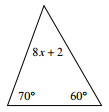
Solve for x

a)

60

b)

120

c)

40

d)

65

111.

<2 and <8 are ____________________.

a)

Alternate exterior angles

b)

Alternate interior angles

c)

Same side exterior angles

d)

Vertical angles

112.

Name a pair of alternate interior angles.

a)

<c & <d

b)

<a & <b

c)

<a & <c

d)

<a & <d

113.

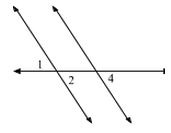
Name the relationship of <1 and <2

a)

Vertical angles

b)

Corresponding angles

c)

Supplementary angles

d)

Complementary angles

114.

<a and <f are _______________ angles

a)

Same side interior

b)

Alternate interior

c)

Same side exterior

d)

Alternate exterior

115.

Name a pair of same side interior angles.

a)

<3 and <4

b)

<3 and <6

c)

<2 and <7

d)

< 2 and <3

116.

Name a pair of corresponding angles.

a)

< a and <b

b)

<d and <f

c)

<g and <b

d)

<b and <c

117.

Determine the measure of <5 if <3 = 120*

a)

120*

b)

60*

c)

180*

d)

90*

118.

The measure of <g = 71*, what is the measure of <a?

a)

109*

b)

71*

c)

19*

d)

151*

119.

<3 and <6 are same side interior angles, if <6 = 60*, what is the measure of <3?

a)

60*

b)

180*

c)

150*

d)

120*

120.

Find the value of k.

a)

6666  

b)

5757  

c)

114114  

d)

2222  

121.
Solve for x.
a)
16
b)
11
c)
50
d)
6
122.

Angle 1 = 27o

Find the measure of angle 4.

a)

27o

b)

153o

c)

63o

d)

90o

123.

Solve for x.

a)

34

b)

9

c)

109

d)

7

124.
Solve for x.
a)
6
b)
8
c)
15
d)
13
125.

Find m∠B.

a)

150°

b)

67°

c)

54°

d)

57°

126.
Name the angle relationship.
a)
Alternate Interior
b)
Alternate Exterior
c)
 Correpsonding
d)
Vertical Angles
127.
What angle corresponds to angle 6?
a)
angle 2
b)
angle 4
c)
angle 7
d)
angle 8
128.
What angle is the same side interior angle to angle 4?
a)
angle 3
b)
angle 5
c)
angle 6
d)
angle 8
129.
Name a pair of alternate exterior angles.
a)
angle 1 & angle 2
b)
angle 2 & angle 7
c)
angle 1 & angle 7
d)
angle 1 & angle 8
130.
What are supplementary angles?
a)
Angles that add up to 180°
b)
Angles that add up to 90°
c)
Angles that are equal to each other
d)
Angles that are opposite of each other when lines intersect
131.
Find m ∠C.
a)
∠C=116°
b)
∠C=64°
c)
∠C=180°
d)
∠C=26°