
 Worksheets
Analytical Chemistry: Monoprotic Acid-Base Titration
Total questions: 15
Worksheet time: 30mins
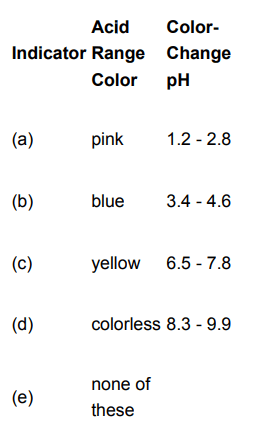
Which indicator could be used to titrate aqueous NH3 with HCl solution?
A
B
C
D
E
Which of the following statements about the equivalence point of an acid-base titration is true?
The equivalence point of an acid-base titration is the same as the indicator endpoint.
The equivalence point of an acid-base titration is the point where there is an equivalent amount of titrant and titrand.
The equivalence point of an acid-base titration is where the pH = 7.0 (neutral).
The equivalence point of an acid-base titration is where the entire volume of the buret has been used.
The equivalence point of an acid-base titration is the average value of the dissociation constants.
There are two types of metal hydroxides, soluble metal hydroxides and insoluble hydroxides, both of which are strong bases. Which of the following statements is NOT true for strong bases?
Dilute solutions are completely dissociated.
For strong base solutions with a concentration between 10^-6 and 10^-8 M, the pOH is determined using systematic equilibrium.
For strong base solutions with concentrations greater than or equal to 10^-6 M, the pOH is calculated from the concentration of the strong base.
For strong base solutions with concentrations less than or equal to 10^-8 M, the pOH is always 7.
Fe(OH)2 is a strong soluble base.
A(n) ___ is a compound with a physical property that changes abruptly near the equivalence point.
primary standard
titrant
analyte
indicator
masking agent
The pH of the equivalence point of strong acid - strong base titration is not equal to 7.00 at 40°C.
TRUE
FALSE
If you want to determine the total minerals dissolved in a well water (Ca and Mg), what type of titration must be done?
Acid-Base titration
Precipitation titration
Complexometric titration
Redox Titration
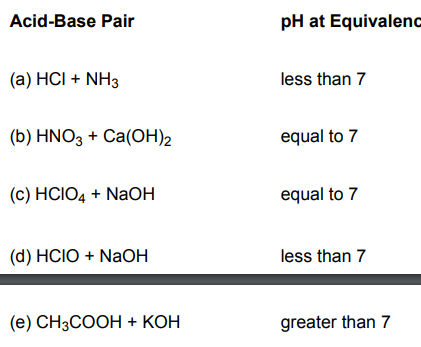
Consider the titrations of the pairs of aqueous acids and bases listed on the left. For which pair is the pH at the equivalence point stated incorrectly?
A
B
C
D
E
For the polyprotic acid H3A, which of the equilibria below is INCORRECT?
A3- = HA2- + OH-
Kb3 = Kw/Ka3
H2A- = HA2- + H+
Ka2 = K2
HA2- = A3- + H+
Ka3 = K3
H3A = H2A- + H+
Ka1 = K1
HA2- = H2A- + OH-
Kb2 = Kw/Ka2
Methyl red is a common acid-base indicator. It has a K equal to 6.3 x 10^-6 . Its un-ionized form is red and its anionic form is yellow. What color would a methyl red solution have at pH = 7.8?
blue
green
yellow
red
violet
The buffer needed for a capillary electrophoresis experiment must have a pH of 10.0. Which weak acid is the best choice for the buffer? Assume ionic strength is 0 M.
ammonium chloride pKa = 9.24
disodium phosphate pKa = 12.38
3-(Cyclohexylamino)propanesulfonic acid pKa = 10.40
sodium dihydrogen borate pKa = 12.74
cyclohexylaminoethanesulfonic acid pKa = 9.39
A compound available in high purity, does not decompose under ordinary storage conditions and stable while being dried by heating or vacuum is a:
primary standard
secondary standard
standard solution
indicator
titrant
Which of the following combinations cannot produce a buffer solution?
HNO2 and NaNO2
HCN and NaCN
HClO4 and NaClO4
NH3 and (NH4 )2SO4
NH and NH Br
For the graphical equivalence point determination for a titration analysis, which of the following is(are) TRUE?
I. The steepest slope of the titration curve is the equivalence point.
II. The equivalence point occurs where the first derivative of the titration curve reaches its largest value.
III. The equivalence point occurs where the second derivative of the titration curve equals zero.
None of the above.
25.0 mL of a 0.100 M solution of NH3 is titrated with 0.250M HCl. After 25.0 mL of the HCl has been added, the resultant solution is
Basic and before the equivalence point
Basic and after the equivalence point
Acidic and before the equivalence point
Acidic and after the equivalence point
Neutral and at the equivalence poin
Which of the following terms is INCORRECTLY defined?
titration error: the difference between the end point and the equivalent point
direct titration: titrant is added to analyte until reaction is complete
equivalent point: volume of titrant added in excess of the end point to change a physical property of the analyte solution
blank titration: titration performed without analyte to calculate titration error
standardization: titration of a known amount of analyte to determine the concentration of the titrant

