wayground logo

Free Printable Worksheets

Font size

S
M
L
XL
Worksheets

Year nine revision for summer assessment

Total questions: 36

Worksheet time: 19mins

Name
Class
Date
1.

What are the individual elements in the image called?

a)

Resolutions

b)

Pixels

c)

Sample frequency

d)

Images

2.

There are 448 individual elements in this image. What is this number called?

a)

Pixels

b)

Images

c)

Pictures

d)

Resolution

3.

This image allows two colours, therefore its colour depth is

a)

0

b)

1

c)

2

d)

11

e)

10

4.
A microphone converts the changes in air pressure into voltage changes which are then digitised.
a)
True
b)
False
5.
The following is true about sampling rates:
a)
They measure a number of snapshots of sound taken per second.
b)
They are not as important as bit rates.
c)
They are different for every song, depending on its loudness.
6.
A bitmap image is made up of
a)
Pixels
b)
Colours
c)
Sounds
d)
Samples
e)
Characters
7.
Which is NOT an effect of increasing the resolution in an image?
a)
More colours can be displayed.
b)
More binary will be required to create the image.
c)
Larger file size
d)
Higher quality image
8.
Most graphic formats create many colours from:
a)
Red, green, blue.
b)
Red, pink, yellow.
c)
Red, white, blue.
d)
Black, white, green.
9.

In a bitmap graphic each pixel is represented in _______

a)

Denary

b)

Binary

c)

Hexadecimal

d)

By letters

10.

An image with 4 colours will have a colour depth of:

a)

1

b)

2

c)

3

d)

4

11.

What is the colour depth of the image?

a)

colour depth of 1

b)

colour depth of 2

c)

colour depth of 4

d)

colour depth of 16

12.

A Byte consists of this many bits

a)

2

b)

4

c)

8

d)

16

13.

Which is larger?

a)

Bit

b)

Byte

14.

On an image each colour will have its own binary code?

a)

True

b)

False

15.

To calculate the file size of an image you:

a)

resolution (column * rows) *colour depth

b)

Number of colours used * resolution

c)

Resolution + colour depth

d)

Number of colours used + resolution

16.

The sample interval is

a)

The time gap between taking a sample .e.g sampled every 5 milliseconds

b)

How many samples are taken in a second. 44.1khz means 44,100 are taken per second

c)

How many bits are recorded for each measurement

17.

The sample rate is

a)

The time gap between taking a sample .e.g sampled every 5 milliseconds

b)

How many samples are taken in a second. 44.1khz means 44,100 are taken per second

c)

How many bits are recorded for each measurement

18.

File size for sound is calculated as:

a)

sampling rate + Sample size + duration of clip

b)

sampling rate * Sample size * duration of clip

c)

sampling rate / Sample size / duration of clip

19.

Standalone malware computer program that replicates itself in order to spread to other computers. Often, it uses a computer network to spread itself, relying on security failures on the target computer to access it.

a)

Malicious Code

b)

Computer Worm

c)

Anti Virus Software

d)

Computer Virus

20.

type of malicious software program (malware) that, when executed, replicates by reproducing itself (copying its own source code) or infecting other computer programs by modifying them.

a)

Computer Virus

b)

Computer Worm

c)

MyDoom

d)

Malicious Code

21.
What is software?
a)
Viruses on your computer
b)
Programs used by a computer
c)
Documents used to type information on
d)
Harmful information
22.
Malware is made to stop your device from running properly and sometimes to steal your information.
a)
True
b)
False
23.

Which are common types of malware?

a)

Adware

b)

Ransomware

c)

Key Logger

d)

Mouse Hacker

e)

Windows Breaker

24.
What is the definition of a brute force attack?
a)
Repeatedly trying usernames/passwords to access a system
b)
Physically threatening someone to give up personal information
c)
Physically breaking into a device to hack it
d)
Being a very strong hacker
25.

The technology and process that is designed to protect networks and devices from attack, damage, or unauthorized access

a)

Cyber Security

b)

White Hat Hacker

c)

Domain Name Server

d)

All of the above

26.

What are the motives behind cyber crime?

a)

Demanding ransom

b)

Propagating religious or political beliefs

c)

Financial loss to the target

d)

Information thefts and manipulating data

e)

All of the above

27.
What is the name of the law that makes hacking illegal?
a)
Data Protection Act
b)
Computer Misuse Act
c)
Copyright, Designs and Patents Act
d)
Hacking Act
28.
What is a variable?
a)
A box(memory location) where you store values
b)
a type of graphics
c)
Data type
d)
a type of memory
29.
What Python command lets the user enter an answer to a question?
a)
answer()
b)
open()
c)
print()
d)
input()
30.
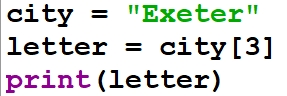
What letter will be printed on the screen after running this code:
a)
e
b)
x
c)
t
d)
Nothing prints
31.
In the following code, "city" is an example of a what?
a)
List
b)
Loop
c)
Variable
d)
Array
32.

If you want to create an empty list called colours in Python, which of the following is correct?

a)

colours = [ ]

b)

colours = ( )

c)

colours = { }

d)

colours = <>

33.
What is the position of the name "Robert" in the following list:
a)
0
b)
1
c)
2
d)
3
34.
What does the APPEND procedure do in the following code:
a)
Adds Liverpool to the beginning of the list
b)
Replaces Bristol with Liverpool
c)
Replaces Manchester with Liverpool
d)
Adds Liverpool to the end of the list
35.
Which two statements are used to implement iteration?
a)
IF and WHILE
b)
ELSE and WHILE
c)
FOR and WHILE
d)
IF and ELSE
36.

What is the final value of the variable 'number'?

(a)