wayground logo

Free Printable Worksheets

Font size

S
M
L
XL
Worksheets

Botany whole syllabus test 2

Total questions: 201

Worksheet time: 3hrs 40mins

Name
Class
Date
1.

Thin layer of cells that covers and protects plant parts such as leaves, stems and roots.

a)

parenchyma

b)

phloem

c)

epidermal tissue

d)

support and strengthening tissue

2.

What are the 3 basic parts that all cells share?

a)

cell wall, cytoplasm, and nucleus

b)

cell membrane, chloroplasts, and nucleus

c)

nucleus, cell membrane and cytoplasm

d)

cell wall, cell membrane, and cytoplasm

3.

What is transpiration?

a)

the intake of water through the roots

b)

the loss of water vapor through the leaves

c)

water pressure inside a cell

d)

movement of water through a plant

4.

What is the primary purpose of a flower?

a)

to produce nectar

b)

to make seeds for reproduction

c)

to scatter seeds

d)

to produce fruit

5.

Which structural tissue makes and/or stores food?

a)

cork

b)

epidermal

c)

support and strengthening

d)

parenchyma

6.

Protects and waterproofs woody stems

a)

support and strengthening tissue

b)

cork

c)

vascular cambium

d)

xylem

7.

Fibers that provide support for leaves, stems, and roots.

a)

support and strengthening tissue

b)

apical meristems

c)

xylem

d)

cork

8.

How many systems do plants have?

a)

1

b)

2

c)

3

9.

What two types of flowers make up this composite flower?

a)

bract and ray

b)

ray and catkin

c)

bract and disk

d)

ray and disk

10.

What do you call trees that lose their leaves each fall and remain bare through the winter?

a)

annuals

b)

deciduous

c)

herbaceous

d)

biennials

11.

Which plant family is most important in providing food to both man and animals?

a)

Mustard

b)

Grass

c)

Nightshade

d)

Parsley

12.

In addition to photosynthesis, plant cells also perform cellular respiration. What is cellular respiration?

a)

The process of storing energy

b)

the process of breaking down an energy source to release energy

c)

the process of converting sunlight into the stored energy of glucose

13.

A plant bending and growing toward the light is an example of a

a)

negative chemotropism

b)

negative geotropism

c)

positive hydrotopism

d)

positive phototropism

14.

What do you call a flower that lacks one of the four basic parts?

a)

complete

b)

monoecious

c)

staminate

d)

incomplete

15.

Fruits fall off the tree because of

a)

photoperiodism

b)

the formation of the abscission layer

c)

the ripening of the ovary

16.

A fruit that forms from one flower with one pistil is a(n)

a)

multiple fruit

b)

aggregate fruit

c)

simple fruit

17.

A fruit that forms from multiple flowers is a(n)

a)

multiple fruit

b)

aggregate fruit

c)

simple fruit

18.

A fruit that forms from one flower with multiple pistils is a(n)

a)

multiple fruit

b)

aggregate fruit

c)

simple fruit

19.

The primary function of the fruit is to

a)

produce seeds

b)

nourish seeds

c)

scatter seeds

20.

A simple fruit with a fleshy juicy ovary is called a

a)

pome

b)

drupe

c)

berry

d)

legume

21.

A simple fruit with a fleshy outer layer and an inner woody layer called a stone is a

a)

pome

b)

drupe

c)

berry

d)

legume

22.

A simple fruit with a fleshy outer layer and an inner papery core is called a

a)

pome

b)

drupe

c)

berry

d)

legume

23.

A simple fruit with small dry seeds and winglike structures is called a(n)

a)

achene

b)

samara

c)

legume

d)

grain

24.

A seed with a relatively thin shell is called a(n)

a)

achene

b)

grain

c)

legume

d)

nut

25.

A seed with a shell that can only be removed by milling is called a(n)

a)

achene

b)

grain

c)

legume

d)

nut

26.

A pod with seeds is called a(n)

a)

achene

b)

grain

c)

legume

d)

nut

27.

The three main parts of the seed are the

a)

plumule, radicle, and endosperm

b)

embryo, radicle and seed coat

c)

embryo, radicle and endosperm

d)

endosperm, seed coat, and embryo

28.

The three parts of the embryo are the

a)

plumule, radicle, and endosperm

b)

cotyledons, radicle, and endosperm

c)

plumule, radicle, and cotyledons

29.

Osmosis is

a)

a) the diffusion of water molecules across a semi permeable membrane.

b)

b) the movement of water molecules from an area of high concentration to an area of low concentration.

c)

c) the movement of a liquid across a semi permeable membrane

d)

both (a) and (b)

30.

As water exits the stomata of the leaves water is drawn upward through the plant by way of a force called

a)

capillarity

b)

transpiration pull

c)

osmosis

31.

Which of the following correctly describe the reproductive structures of a gymnosperm?

a)

Staminate cones are the woody female cones and pistillate cones are the shorter lived male cones.

b)

Pistillate cones are the shorter lived female cones and staminate cones are the woody, longer living male cones.

c)

Pistillate cones are the longer living, woody female cones and staminate cones are the shorter lived male cones.

32.

One of the oldest living organisms is a conifer called the

a)

sequoia

b)

coastal redwood

c)

blue spruce

d)

bristlecone pine

33.

Arranging organisms into groups based on observed similarities is called

a)

a) taxonomy

b)

b) declassifying

c)

c) classification

d)

d) both (a) and (c)

e)

none of the above

34.

Which of the following scientists is given credit for developing the modern classification system?

a)

Antonie van Leeuwenhoek

b)

Theodor Schwann

c)

Robert Hooke

d)

Carolus Linnaeus

35.

Which of the following has the levels of the classification system in the correct order from broadest to most specific?

a)

kingdom, genus class

b)

family, phylum, species

c)

phylum, genus, order

d)

class, family, species

36.

Which of the following is the correctly written name for the Tibetan blackbird?

a)

turdus maximus

b)

Turdus maximus

c)

Turdus Maximus

d)

Turdus maximus

37.

Green algae can be found in which of the following forms?

a)

unicellular

b)

colonial

c)

filamentous

d)

all of the above

38.

Which group of algae do diatoms belong to?

a)

green

b)

red

c)

yellow

d)

brown

39.

Which of the following feed on dead or live wood?

a)

rusts & smuts

b)

lichens

c)

shelf fungi

d)

yeast

40.
When plants go through the process of photosynthesis, they bring this gas into their cells
a)
carbon dioxide
b)
oxygen
c)
carbon 
d)
sulfur
41.
Food is made in the __________ and transported through the plant by the ____________.
a)
roots/xylem
b)
roots/phloem
c)
leaves/xylem
d)
leaves/phloem
42.
When the plant responds to gravity, it is called _______.
a)
Phototropism
b)
Emergence of a seedling
c)
Geotropism
d)
Photosynthesis
43.
Which is true of bryophytes?
a)
They have Xylem
b)
They have vascular tissue
c)
They draw up water by osmosis
d)
They don't need water
44.
Plants need carbon and oxygen to produce glucose during photosynthesis. How do most plants obtain these elements?
a)
They take in carbon dioxide dissolved in water through the roots and transport them using xylem.
b)
The take in carbon dioxide in the air through the stomata of the leaves.
c)
They absorb carbon monoxide (CO) through respiration.
d)
They absorb carbon (C) from the soil and oxygen (O2) from the air.
45.
How will glucose make its way from the leaves to the rest of the plant?
a)
through the stomata
b)
through openings on the leaves called chloroplasts
c)
through xylem tissue
d)
through phloem cells
46.
Which of the following statements best describes xylem's function in the plant?
a)
transpports water and minerals up from the roots to the rest of the plant
b)
transports food down from the leaves to the rest of the plant
c)
transports water and minerals down from the roots to the rest of the plant
d)
transports food up from the leaves to the rest of the plant
47.
What types of roots do dicots have
a)
Taproot
b)
Fibrous
c)
Dicots don't have roots
48.
Which of the following describes a monocot?
a)
two cotyledons
b)
circular vascular tubes lined up in pairs
c)
3 petals or multiples of 3
d)
wide leaves, branching veins
49.
Flower parts in dicots are in multiples of?
a)
4
b)
7
c)
 3
d)
2
50.
A period of a plant when is does NOT grow
a)
spore
b)
stamen
c)
nutrient
d)
dormancy
51.
Forms from hardening of outside layer of ovule 
a)
Seed Coat
b)
Endosperm
c)
Radicle
d)
Biology
52.
Seed structure that stores food or helps absorb food for the sporophyte of vascular seed plants. 
a)
Seed
b)
Stomata
c)
Cone
d)
Cotyledon
53.
pg. 120 What hormone speeds up the rate at which a plant's cells grow?
a)
hormone
b)
auxin
c)
darknessium
d)
visuals
54.
Which plant hormone is a gas?
a)
auxin
b)
gibberellin
c)
ethene
d)
cytokinin
55.
Which hormone promotes seed germination?
a)
abscisic acid
b)
ethene
c)
gibberellin
d)
auxin
56.
Hormone related to the growth of the plant in response to tropisms
a)
Auxin
b)
Cytokinins
c)
Ethene
d)
Absisic acid
57.
Breaks seed dormancy and promotes growth (can make fruit bigger)
a)
Auxin
b)
Gibberellin
c)
Cytokinins
d)
Ethene
58.
Which kingdoms contains members who are prokaryotic?
a)
Archaebacteria and Eubacteria
b)
Archaebacteria and Protista
c)
Eubacteria and Animalia
d)
Eubacteria  and Fungi
59.
Members of this kingdom never have a cell wall
a)
Animalia
b)
Plantae
c)
Archaebacteria
d)
Protista
60.
The 8 levels of classification, most broad to most specific.
a)
Domain, Genus, Family, Order, Class, Phylum, Kingdom, Species
b)
Domain, Species, Kingdom, Genus, Phylum, Family, Class, Order
c)
Domain, Kingdom, Phylum, Class, Order, Family, Genus, Species
d)
Order, Kingdom, Species, Domain, Phylum, Family, Class, Genus
61.
Cells that do not have a true nucleus are called....
a)
eukaryote
b)
prokaryote
c)
unicellular
d)
multicellular
62.
An illustration and a dichotomous key are given. What is the correct classification for this organism?
a)
dichotomous key
b)
Order Amblypygi
c)
Order Araneae
d)
Order Scorpiones
63.
Panthera leo and Panthera tigris belong to the same...
a)
species
b)
genus
64.
Staph, Strep, Bacilli, Cocci, Samonella, E. Coli all belong to what kingdom?
a)
Eubacteria
b)
Archeabacteria
c)
Fungi
d)
Protist
65.
Reasons that viruses are considered to be nonliving is because
a)
They are not cellular
b)
They cannot reproduce on their own
c)
They cannot make proteins
d)
all of the above
66.
Needs host cell to reproduce.
a)
Virus
b)
Bacteria
c)
Fungus
d)
Protozoan
67.
What is a pathogen?
a)
Bacteria
b)
Virus
c)
Anything that causes a disease or infection
d)
Protist
68.
How does a virus cause a person to develop the common cold?
a)
invades the host cell to reproduce
b)
removes energy from the host cell
c)
produces toxins in the host cell
d)
protects the host cell from bacteria
69.
What part of the phage is the DNA?
a)
A
b)
B
c)
C
d)
D
70.
What happens in the lysogenic cycle? 
a)
Virus goes in, reproduces, and leaves the host cell to cause an infection
b)
Virus quickly kills the host cell
c)
Virus inject the nucleic acid into the host cell, and the nucleic acid integrates into the host cell DNA, and stay dormant for a long time
d)
Bacteria injects DNA into a host cell
71.
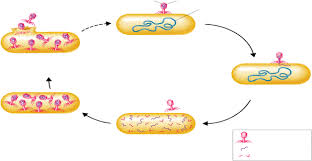
What process is this?
a)
phagocytosis
b)
lytic cycle
c)
lysogenic cycle
d)
formation of antibodies
72.
What is shown here?
a)
Lysogenic Cycle
b)
Lytic Cycle
c)
Binary Fission
d)
Conjugation
73.
Name this bacteria shape
a)
coccus
b)
bacillus
c)
spirillum
74.
Name this bacteria shape
a)
coccus
b)
spirillum
c)
bacillus
75.
The term "antibiotic resistance" refers to bacteria that 
a)
are resistant to a vaccine.
b)
evolve to survive in the presence of an antibiotic.
c)
are weakened and destroyed by antibiotics.
d)
are dead or altered.
76.
Bacteria reproduce asexually by 
a)
spores
b)
conjugation
c)
fixation
d)
binary fission
77.
A ___ is made by using pieces of deactivated viruses or dead pathogens.
a)
Flagella
b)
Vaccine
c)
Spore
d)
Antibodies
78.
A bacterial infection __________ be treated using an antibiotic.  A viral infection __________.
a)
can; also can
b)
can; cannot
c)
cannot; can
d)
cannot; also cannot
79.
When conditions get inhospitable, bacteria form a(n)____________.
a)
nucleic acid
b)
nucleus
c)
endospore
d)
antibiotic
80.
Fission, budding, and regeneration are all examples of what kind of reproduction? 
a)
Asexual Reproduction 
b)
Sexual Reproduction 
81.
Conjugation is what type of reproduction?  
a)
Sexual Reproduction 
b)
Asexual Reproduction 
82.
How does this protist move? 
a)
Pseudopods 
b)
Cilia 
c)
Flagellum
83.
How does this protist move? 
a)
Flagellum
b)
Cilia 
c)
Pseudopods
84.
Fine hairs that allow protist to move is called what? 
a)
Pseudopods 
b)
Euglena 
c)
Flagella 
d)
Cilia 
85.
How are protist classified? 
a)
How the eat
b)
How they reproduce 
c)
Where they live
d)
How they move
86.
What type of cells are protists?
a)
Prokaryotic 
b)
Eukaryoitc 
87.
Plant-like protists are called ________
a)
algae
b)
slime molds
c)
protozoa
d)
zooplankton
88.
animal-like protists are called _______
a)
protozoa
b)
algae
c)
slime molds
d)
phytoplankton
89.
fungus-like protists are called _________
a)
algae
b)
slime molds
c)
protozoa
d)
euglena
90.
This is the structure used to pump excess water out of the cell.
a)
Contractile vacuole
b)
Macronucleus
c)
Food Vacuole
d)
Chloroplast
91.
What human activity affects the environment in such a way that algae blooms increase?
a)
agriculture
b)
fertilizer run off increases nutrients in ground water
c)
people contaminating fresh water sources
d)
all of the above
92.
The majority of fungus-like protists get nutrients by
a)
photosynthesis
b)
living as an animal parasite
c)
absorbing them from dead or decaying matter
d)
none of the above
93.

This protist belongs to the phylum

a)

sarcodina

b)

ciliophora

c)

zoomastigina

d)

sporozoa

94.

This protist belongs to the phylum

a)

sarcodina

b)

ciliophora

c)

zoomastigina

d)

sporozoa

95.
Which protozoan phylum lacks independent movement?
a)
protozoa
b)
sarcomastigophora
c)
apicomplexa
d)
ciliophora
96.
structure that controls the cell functions in a paramecium
a)
macronucleus
b)
micronucleus
97.
Fungi are like animals because...
a)
they all reproduce sexually.
b)
they get their food from other organisms.
c)
they can move from one place to another.
d)
They are not like animals.
98.
What part of a fungus is described as long, thread-like structures that absorb nutrients?
a)
roots
b)
fruit body
c)
hyphae
d)
spores
99.

Fungi can be

a)

decomposers or producers

b)

parasites or producers

c)

parasites or saprophytes

d)

consumers or autotrophs

100.
Any method of reproducing that create offspring identical to the single parent. 
a)
asexual
b)
budding
c)
sexual
d)
sporogenesis
101.
Fungi that feed on and HELP the host.
a)
saprophytic
b)
parasitic
c)
symbiotic
102.
What do fungi use to reproduce?
a)
Hyphae
b)
Branches
c)
Spores
d)
They split apart
103.
An antibiotic made from a species of thread-like fungus.
a)
lichen
b)
mold
c)
penicillin
d)
asprin
104.
Fungi cells walls are made of a material called ____.
a)
cellulose
b)
fibers
c)
hyphae
d)
chitin
105.

Mycorrhizae are a fungus that have a ______ relationship with ______.

a)

commensalistic; arthropods

b)

mutualistic; plant roots

c)

mutualistic; algae

d)

parasitic; animals

106.

Lichens are a _______ relationship between _____ and a fungus.

a)

commenalistic; animal

b)

mutualistic; algae

c)

parasitistic; fungus

d)

mutualistic; root

107.

Structure in a mushroom that stores and releases spores

a)

gills

b)

mycellium

c)

conidiophores

d)

ascus

108.

The phylum responsible for the reduction of the frog population

a)

Zygomycota

b)

Basidiomycota

c)

Ascomycota

d)

Chytridiomycota

109.

Vascular tissue that carries water from the roots

a)

cambium

b)

xylem

c)

phloem

d)

stoma

110.
Vascular tissue that carries dissolved sugars throughout a plant
a)
xylem
b)
phloem
c)
cambium
d)
stoma
111.
These plants die after one season and need to be replanted the next season.
a)
annuals
b)
biennials
c)
perennials
112.
This word means cone-bearing
a)
angiosperm
b)
vascular
c)
gymnosperm
d)
nonvascular
113.
Which of the following is a non-vascular seedless plant?
a)
rose
b)
pine tree
c)
fern
d)
moss
114.
All plant cells have this structure to give them support.
a)
cell wall
b)
chloroplasts
c)
nucleus
d)
stoma
115.

A waxy, protective layer on leaves, stems, and flowers

a)

Cuticle

b)

Cell wall

c)

Palisade Mesophyll

d)

Spongy Mesophyll

116.

Tubelike cells that transport water AND nutrients in some plants

a)

Vascular tissue

b)

Nonvascular tissue

c)

Sieve tube cells

d)

Xylem

117.

What are the two products of photosynthesis? (What come out?)

a)

Water

b)

Carbon Dioxide

c)

Oxygen

d)

Glucose

118.

Which of the following reproduce with spores?

a)

Seedless plants

b)

Seed plants

c)

Grasses

d)

Flowers

119.

What is the function of the stomata?

a)

To perform photosynthesis

b)

To produce sugar

c)

To allow water into the leaf

d)

To enable gases to enter and leave leaf

120.

Which is an angiosperm?

a)

Fern

b)

Moss

c)

Pine

d)

Tulip

121.

Guard cells control the size of the opening of the

a)

Cambium

b)

Cotyledon

c)

Stomata

d)

Xylem

122.
These have leaves with branched veins
a)
moncots
b)
dicots
123.
These have flowers in multiples of three.
a)
moncots
b)
dicots
124.
The main job of this plant part is photosynthesis.
a)
roots
b)
stems
c)
leaves
d)
flowers
125.
Identify the type of angiosperm as a dicot or monocot.
a)
monocot
b)
dicot
126.
Identify the type of angiosperm as a dicot or monocot.
a)
monocot
b)
dicot
127.
#5 the long stalk of the stamen 
a)
filament
b)
anther
c)
pistil
d)
style
128.
#6 the top of the stamen which produces the pollen
a)
filament
b)
anther
c)
pistil
d)
style
129.
The male part of the flower which contains the filament and anther
a)
stigma
b)
style
c)
stamen
d)
stomata
130.
#8 The tube of the female part of the flower
a)
pistil
b)
stigma
c)
style
d)
ovary
131.
#1 The top of the female part of the flower that is sticky and collects the pollen
a)
pistil
b)
stigma
c)
style
d)
ovary
132.
#4 The bottom of the female part of the flower where eggs are developed into seeds or fruit
a)
pistil
b)
stigma
c)
style
d)
ovary
133.
The female part of the flower that contains the stigma, style, ovary, and ovules.
a)
pistil
b)
stamen
c)
petals
d)
sepal
134.
#2 the brightly colored part of the flower that attracts pollinating insects
a)
petal
b)
sepal
c)
pistil
d)
stamen
135.

What type of tissue makes up the epidermis?

a)

dermal tissue

b)

vascular tissue

c)

ground tissue

d)

kleenex tissue

136.

Primary growth is the result of growth of cells made by the ..

a)

cork cambium.

b)

vascular cambium.

c)

primary xylem.

d)

apical meristems.

137.
What is the name of the organelle in the leaves of plants that absorbs the Sun's energy?
a)
roots
b)
chlorophyll
c)
chloroplast
d)
stomata
138.
The two structures that limit transpiration  are known as
a)
Guard cells and xylem
b)
Stomata and guard cells
c)
xylem and phloem
d)
stomata and phloem
139.

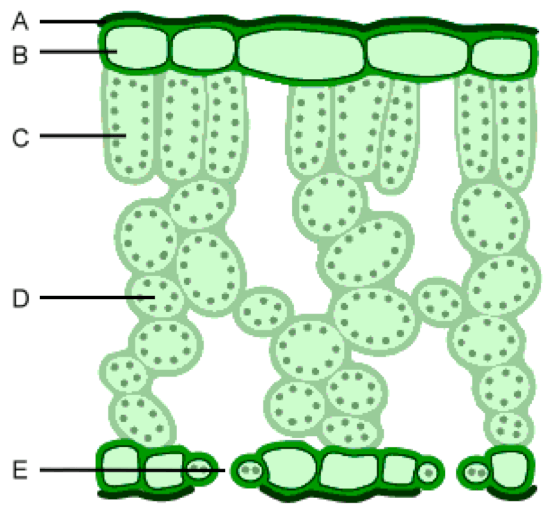
What is A pointing to?

a)

spongy mesophyll

b)

stomata

c)

upper epidermis

d)

cuticle

140.
Identify this plant.
a)
Ginkgo biloba / Ginkgo
b)
Liquidambar styraciflua / Sweetgum
c)
Acer palmatum / Japanese Maple
d)
Acer rubrum / Red Maple
141.
The process by which water evaporates out of a leaf is called...
a)
Transpiration
b)
Absorption
c)
Transport
d)
Vascular tissue
142.
The tip of the root is called the ...
a)
Root force
b)
Root guard
c)
Root shield
d)
Root cap
143.
What is an example of a vascular seedless plant?
a)
Fern
b)
Moss
c)
Pine Tree
d)
Rose Bush
144.
Hormone related to the growth of the plant in response to tropisms
a)
Auxin
b)
Cytokinins
c)
Ethene
d)
Absisic acid
145.

Which tissue supports the young plants and woody plants?

a)

collenchyma tissue

b)

parenchyma tissue

c)

sclerenchyma tissue

d)

xylem tissue

146.

The most abundant type of plant cell that stores a large amount of starch are called ____.

a)

Sieve-tube cells

b)

Tracheids & vessel cells

c)

Parenchyma cells

d)

Collenchyma cells

e)

Sclerenchyma cells

147.
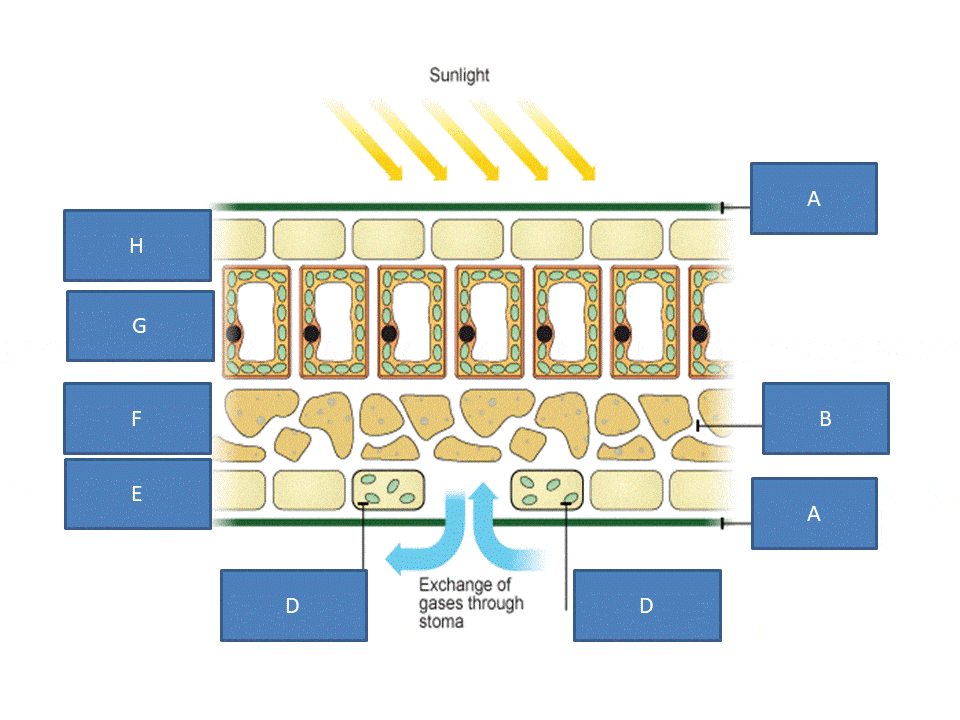
What is the name of part G?
a)
Palisade mesophyll
b)
Guard cell
c)
Spongy Mesophyll
d)
Lower epidermis
148.
A leaf with one main vein and little veins coming off that one vein is called...
a)
palmate venation
b)
spike venation
c)
pinnate venation
d)
vascular explosion
149.

What type of leaf arrangement is this?

a)

Compound

b)

Whorled

c)

Opposite

d)

Alternate

150.
I have long and feathery stigma that sticks out of the flower. How am I likely to be pollinated by?
a)
By wind 
b)
By insects 
c)
By water 
d)
By explosive action
151.
The process of the male part (pollen) traveling to the female part (egg) to create seeds
a)
life cycle
b)
fruit
c)
pollination
d)
pollen
152.
The type of plant that makes seeds
inside of cones
a)
conifer
b)
egg
c)
flowering plant
d)
embryo
153.
What type of tropism response to touch? 
a)
Geotropism
b)
Phototropism
c)
Thigmotropism
d)
Hydrotropism
154.
What is this an image of
a)
thigmatropism
b)
gravitropism
c)
phototropism
d)
photoperiodism
155.

CAM plants have a different adaptation to what climate

a)

cold and wet

b)

arid (very hot/dry)

c)

hot and wet

d)

none of the above

156.

Why do CAM plants open their stomata at night?

a)

To gather sunlight

b)

To take in oxygen

c)

To collect Carbon Dioxide

d)

None of the above

157.
Why might some plants that grow on the shady rain forest floor have large leaves?
a)
to stay safe from predators
b)
to attract different animals
c)
to survive harsh winters with heavy snowfall
d)
to take in as much sunlight as possible
158.
Reasons that viruses are considered to be nonliving is because
a)
They are not cellular
b)
They cannot reproduce on their own
c)
They cannot make proteins
d)
all of the above
159.
Needs host cell to reproduce.
a)
Virus
b)
Bacteria
c)
Fungus
d)
Protozoan
160.
How does a virus cause a person to develop the common cold?
a)
invades the host cell to reproduce
b)
removes energy from the host cell
c)
produces toxins in the host cell
d)
protects the host cell from bacteria
161.
What happens in the lysogenic cycle? 
a)
Virus goes in, reproduces, and leaves the host cell to cause an infection
b)
Virus quickly kills the host cell
c)
Virus inject the nucleic acid into the host cell, and the nucleic acid integrates into the host cell DNA, and stay dormant for a long time
d)
Bacteria injects DNA into a host cell
162.
The term "antibiotic resistance" refers to bacteria that 
a)
are resistant to a vaccine.
b)
evolve to survive in the presence of an antibiotic.
c)
are weakened and destroyed by antibiotics.
d)
are dead or altered.
163.
A ___ is made by using pieces of deactivated viruses or dead pathogens.
a)
Flagella
b)
Vaccine
c)
Spore
d)
Antibodies
164.
When conditions get inhospitable, bacteria form a(n)____________.
a)
nucleic acid
b)
nucleus
c)
endospore
d)
antibiotic
165.
How are protist classified? 
a)
How the eat
b)
How they reproduce 
c)
Where they live
d)
How they move
166.
What human activity affects the environment in such a way that algae blooms increase?
a)
agriculture
b)
fertilizer run off increases nutrients in ground water
c)
people contaminating fresh water sources
d)
all of the above
167.

This protist belongs to the phylum

a)

sarcodina

b)

ciliophora

c)

zoomastigina

d)

sporozoa

168.
Which protozoan phylum lacks independent movement?
a)
protozoa
b)
sarcomastigophora
c)
apicomplexa
d)
ciliophora
169.
Fungi are like animals because...
a)
they all reproduce sexually.
b)
they get their food from other organisms.
c)
they can move from one place to another.
d)
They are not like animals.
170.
An antibiotic made from a species of thread-like fungus.
a)
lichen
b)
mold
c)
penicillin
d)
asprin
171.

Structure in a mushroom that stores and releases spores

a)

gills

b)

mycellium

c)

conidiophores

d)

ascus

172.

The phylum responsible for the reduction of the frog population

a)

Zygomycota

b)

Basidiomycota

c)

Ascomycota

d)

Chytridiomycota

173.
Which of the following is a non-vascular seedless plant?
a)
rose
b)
pine tree
c)
fern
d)
moss
174.

Primary growth is the result of growth of cells made by the ..

a)

cork cambium.

b)

vascular cambium.

c)

primary xylem.

d)

apical meristems.

175.
What is an example of a vascular seedless plant?
a)
Fern
b)
Moss
c)
Pine Tree
d)
Rose Bush
176.
The biggest planet with the most moons is________
a)
Saturn
b)
Jupiter
c)
Uranus
d)
Neptune
177.
The world biggest gold producer is ____________.
a)
China
b)
Mexico
c)
South Africa
d)
Chile
178.
Name the longest reptile in the world.
a)
Viper
b)
King Cobra
c)
Alligator lizard
d)
Anaconda snake
179.

How many Emirates make up the UAE

a)

Six

b)

Sixty

c)

Seven

d)

Eighteen

180.

How many straight edges does a cube have?

a)

8

b)

4

c)

16

d)

12

181.

Which country does volleyball originate from?

a)

Brazil

b)

Mexico

c)

USA

d)

UAE

182.

Which planet is the smallest:

a)

Neptune

b)

Mars

c)

Mercury

183.

How many questions does a four year old child ask on average every day?

a)

100 questions

b)

200 questions

c)

300 questions

d)

400 questions

184.

______________and humans share 50% of the same DNA

a)

mice

b)

bananas

c)

pigs

d)

gorillas

185.

Name the largest animal currently living on this planet

a)

elephant

b)

dinosaur

c)

blue whale

d)

giraffe

186.

At the start of a chess game, who moves first?

a)

Black

b)

White

c)

Rock, Paper, Scissors

d)

Doesn't matter

187.

Which state is the biggest in the US? (land not population)

a)

Texas

b)

Florida

c)

Alaska

d)

California

188.

What is the fastest four-legged animal in the world?

a)

Cheetah

b)

Lion

c)

Tiger

d)

Horse

189.

Which bird cannot fly?

a)

Peacock

b)

Owl

c)

Crane

d)

Ostrich

190.

Largest Desert in the world is?

a)

Arabian Desert

b)

Sahara Desert

c)

Gobi Desert

d)

Thar Desert

191.

The Statue of Liberty was a gift from which country?

a)

France

b)

Belgium

c)

Canada

d)

Great Britain

192.

What chemical element are diamonds made from?

a)

Gold

b)

Carbon

c)

Graphite

d)

Coal

193.

What is the capital of Germany?

a)

Frankfurt

b)

Berlin

c)

Munich

d)

Hamburg

194.
"Opera" is an art began in _______ in the 1500s.
a)
France
b)
Europe
c)
Italy
d)
Greece
195.
"A metal ball and a rubber ball of the same size is dropped in the same time"
Which ball reaches the ground first?
a)
Metal ball
b)
Rubber ball
c)
Both balls
d)
No ball 
196.

How long should a child and an adolescent exercise each day?

a)

45 minutes

b)

30 minutes

c)

60 minutes

d)

70 minutes

197.

Which country does not have a rectangular flag?

a)

Nepal

b)

Mongolia

c)

China

d)

India

198.

Which is the smallest city in the world?

a)

London

b)

Belfast

c)

Vatican City

d)

Brussels

199.

Which is the largest river on Earth?

a)

Amazon

b)

Mississippi

c)

Congo

d)

Nile

200.

Which two countries is Mount Everest located in?

a)

China / Nepal

b)

India / Nepal

c)

China / India

d)

Bhutan / Nepal

201.

What is the second largest country (in size) in the world?

a)

USA

b)

Canada

c)

Russia

d)

China