
Font size
 Worksheets
Biochemistry: Nucleic Acids
Total questions: 206
Worksheet time: 2hrs 9mins
What is the primary function of nucleic acids in cells?
Structural support
Storage and transmission of genetic information
Energy production
Hormone regulation
Which nitrogenous bases are purines?
Cytosine and Thymine
Uracil and Cytosine
Adenine and Guanine
Thymine and Uracil
What sugar is found in DNA?
Glucose
Deoxyribose
Ribose
Sucrose
Which of the following bases is found only in RNA?
Thymine
Uracil
Adenine
Cytosine
What kind of bond links nucleotides in a strand of DNA or RNA?
Hydrogen bond
Phosphodiester bond
Peptide bond
Glycosidic bond
The base pairing rule states that in DNA, adenine pairs with:
Cytosine
Thymine
Uracil
Guanine
Guanine pairs with cytosine via:
Two hydrogen bonds
Three hydrogen bonds
One hydrogen bond
Ionic bonds
DNA strands are described as being:
Parallel
Antiparallel
Orthogonal
Symmetric
What structural feature allows proteins to bind specific sequences in DNA?
Helical core
Major groove
Sugar backbone
Ribose
Which RNA molecule carries amino acids to the ribosome?
rRNA
mRNA
tRNA
miRNA
Which RNA has enzymatic activity in the ribosome?
mRNA
rRNA
tRNA
lncRNA
What is the function of miRNA?
Codes for proteins
Silences gene expression by binding mRNA
Transports amino acids
Replicates DNA
What is a nucleosome composed of?
DNA and RNA
mRNA and ribosomes
DNA wrapped around histone proteins
Lipids and DNA
In DNA replication, what enzyme synthesises the new DNA strand?
RNA polymerase
DNA polymerase
Ligase
Topoisomerase
DNA polymerase can only add nucleotides in what direction?
3’ to 5’
5’ to 3’
2’ to 4’
1’ to 2’
What is the role of primase in DNA replication?
Seals fragments
Synthesises RNA primers
Unwinds DNA
Adds nucleotides
Which enzyme unwinds the DNA double helix at the replication fork?
Ligase
Helicase
Primase
Nuclease
Which strand is synthesised continuously during replication?
Lagging
Leading
Template
Coding
The small fragments formed during lagging strand synthesis are called:
Leading fragments
Okazaki fragments
Replicons
Replication bubbles
What removes RNA primers in lagging strand synthesis?
Helicase
DNA polymerase I
Ligase
SSBs
What enzyme seals the nicks between Okazaki fragments?
DNA helicase
DNA ligase
Topoisomerase
Nuclease
Which type of mutation introduces a premature stop codon?
Missense
Nonsense
Silent
A mutation that does not change the amino acid is called:
Missense
Nonsense
Silent
Insertion
A point mutation that changes one amino acid to another is a:
Frameshift
Missense
Nonsense
Splice mutation
What type of mutation shifts the reading frame of a gene?
Nonsense
Frameshift
Missense
Duplication
Which of the following can cause a frameshift mutation?
Base substitution
Insertion or deletion of one or two bases
Silent mutation
Inversion of a codon
Which enzyme relieves supercoiling during DNA replication?
DNA ligase
Topoisomerase
Helicase
DNA polymerase
What is the role of single-stranded binding proteins (SSBs)?
Synthesize primers
Stabilize unwound DNA strands
Link Okazaki fragments
Cut RNA
What type of bond connects base pairs across DNA strands?
Covalent
Phosphodiester
Hydrogen
Ionic
In RNA, what base pairs with adenine?
Thymine
Uracil
Guanine
Cytosine
What is the function of RNA polymerase during transcription?
Add DNA bases
Splice introns
Synthesize RNA from DNA template
Activate ribosomes
What process removes introns from pre-mRNA?
Translation
Replication
Splicing
Transcription termination
What is the term for the start signal on an mRNA transcript?
Stop codon
Start codon (AUG)
Promoter
Operator
Which type of RNA contains the codon sequence?
tRNA
mRNA
rRNA
snRNA
What is the anticodon complementary to the start codon AUG?
UAC
UAC on tRNA
CUA
GUA
What is the function of the poly-A tail on mRNA?
Promote translation
Protect mRNA from degradation
Remove introns
Bind ribosome
What modification is added to the 5’ end of eukaryotic mRNA?
(a)
Which type of RNA is most abundant in the cell?
mRNA
tRNA
rRNA
miRNA
What is the coding strand of DNA also called?
Template strand
Sense strand
Antisense strand
Replicated strand
What is the function of telomerase?
Repair DNA damage
Remove primers
Extend telomeres at chromosome ends
Pack DNA
What type of cells have active telomerase?
Mature neurons
Germ cells and stem cells
Skin fibroblasts
Liver cells
In prokaryotic DNA replication, what enzyme removes primers?
DNA ligase
DNA polymerase I
DNA polymerase III
Primase
Which DNA repair mechanism corrects mismatched base pairs post-replication?
Base excision
Mismatch repair (MMR)
Nucleotide excision
Homologous recombination
What kind of damage does nucleotide excision repair fix?
Cytosine deamination
UV-induced thymine dimers
Single-strand breaks
Which enzyme detects and removes damaged bases in base excision repair?
DNA ligase
Polymerase β
DNA glycosylase
Helicase
What disease is associated with defective nucleotide excision repair?
Huntington’s disease
ALS
Xeroderma pigmentosum
Fragile X syndrome
What is the role of DNA ligase in DNA repair?
Add RNA primers
Seal nicks in sugar-phosphate backbone
Detect mismatches
Replicate DNA
What causes thymine dimers in DNA?
Chemical mutagens
UV radiation
Ionizing radiation
Acetylation
Which enzyme synthesises new DNA during repair?
DNA helicase
DNA polymerase
Primase
Telomerase
What is a replication fork?
Stop codon
Y-shaped region where DNA is unwound and replicated
rRNA structure
Histone
What initiates the opening of the replication fork?
Ligase
Helicase activity breaking hydrogen bonds between bases
Polymerase binding
RNA primer degradation
What region of DNA does transcription begin at?
Intron
Promoter
Terminator
Enhancer
What DNA sequence signals RNA polymerase to stop transcription?
Promoter
Origin
Terminator
Exon
What component of the ribosome catalyses peptide bond formation?
tRNA
rRNA (peptidyl transferase activity)
Protein enzyme
mRNA
What type of mutation involves swapping one base for another?
Inversion
Substitution (point mutation)
Frameshift
Duplication
What is DNA supercoiling?
A type of repair
Additional twisting of the DNA double helix
Binding to proteins
RNA processing
Which type of RNA plays a central role in translation?
miRNA
tRNA
snRNA
siRNA
What is the consequence of a mutation in a start codon?
Enhanced gene expression
Failure to initiate translation
Faster replication
Telomere extension
What enzyme adds dNTPs during DNA synthesis?
(a)
What type of bonds hold the sugar-phosphate backbone together?
Hydrogen bonds
Covalent phosphodiester bonds
Ionic bonds
Hydrophobic interactions
In eukaryotic cells, where does transcription occur?
Cytoplasm
Nucleus
Mitochondria
ER
Where does translation occur in eukaryotes?
Nucleus
Cytoplasm or on rough ER
Golgi
Nucleolus
What is the template strand used for in transcription?
Makes ribosomes
Acts as the DNA strand RNA polymerase uses to synthesize RNA
Translates proteins
Synthesizes dNTPs
What ensures that only correct tRNA binds to mRNA during translation?
Base stacking
Codon-anticodon base pairing
Ligase recognition
Helicase unwinding
What is the role of the 3' poly-A tail in mRNA?
Blocks transcription
Increases mRNA stability and assists in nuclear export
Prevents tRNA binding
Catalyses translation
What kind of bond forms between ribose and a base in a nucleotide?
Phosphodiester
Glycosidic bond
Hydrogen
Which nitrogenous base has a single ring structure?
Adenine
Cytosine (pyrimidine)
Guanine
Hypoxanthine
What makes DNA more chemically stable than RNA?
Extra methyl group
Absence of 2’-OH on deoxyribose
Adenine pairing
Guanine bonds
What does semiconservative replication mean?
Uses random strand pairing
Each new DNA contains one original and one new strand
One new, one mutant strand
Keeps both strands intact
What is a replication origin (Ori)?
Gene transcription site
Specific sequence where replication begins
Splice site
Telomeric repeat
What is a gene?
An RNA fragment
A DNA segment that encodes a functional product
Telomere
Only exons
What are exons?
Noncoding regions
Coding sequences in mRNA
Introns
Regulatory promoters
What is alternative splicing?
RNA polymerase switching strands
Generation of different proteins from the same gene
tRNA mismatching
DNA replication error
What is a plasmid?
mRNA fragment
Circular DNA molecule in bacteria
Viral RNA
Protein coding exon
What do histones do?
Transcribe DNA
Package and organise DNA into nucleosomes
Synthesize proteins
Link Okazaki fragments
What charge do histone proteins carry at physiological pH?
Neutral
Negative
Positive (due to lysine and arginine residues)
Depends on ATP
What allows DNA to wrap tightly around histones?
Hydrophobic interactions
Electrostatic attraction between negatively charged DNA and positively charged histones
Covalent bonding
Phosphorylation
What enzyme modifies histones to regulate gene expression?
DNA polymerase
Histone acetyltransferase (HAT)
Telomerase
Ligase
What is the effect of histone acetylation on gene expression?
Silences transcription
Loosens chromatin and activates transcription
Compacts DNA
Blocks ribosome binding
What is euchromatin?
Inactive, dense DNA
Lightly packed, transcriptionally active chromatin
Methylated telomeres
Chromosome centromere
81. What is heterochromatin?
A tightly packed form of DNA
A type of RNA
A protein complex
A cellular organelle
What epigenetic modification often leads to gene silencing?
Acetylation
DNA methylation (especially at CpG islands)
Histone phosphorylation
Deacetylation of RNA
Which enzyme adds methyl groups to cytosine residues?
Acetylase
DNA methyltransferase (DNMT)
Histone kinase
Exonuclease
What is a CpG island?
DNA repeat sequence
Region rich in CG dinucleotides, often found in gene promoters
Exon-intron boundary
Telomeric DNA
What is a single nucleotide polymorphism (SNP)?
Large chromosomal deletion
Variation at a single DNA base among individuals
RNA error
Protein tag
What is a gene mutation that occurs after fertilisation called?
Inherited mutation
Somatic mutation
Germline mutation
Silent mutation
Which repair pathway is activated by double-strand DNA breaks?
Mismatch repair
Homologous recombination or non-homologous end joining (NHEJ)
Base excision repair
Spliceosome
What is the role of the p53 protein in response to DNA damage?
Forms mRNA
Halts the cell cycle and initiates repair or apoptosis
What is the name of the region of DNA that codes for ribosomal RNA?
Telomere
Promoter
Nucleolar organiser region (NOR)
Splice site
What structure is formed at the ends of linear eukaryotic chromosomes?
Centromere
Telomere
Nucleosome
Enhancer
What is the function of the 5’ UTR in mRNA?
Codes for proteins
Regulates translation initiation
Splice introns
Forms exons
What is the 3’ UTR responsible for?
Coding peptide chains
Introns
mRNA stability, localisation, and translation regulation
DNA packaging
What kind of RNA participates in mRNA degradation and silencing?
rRNA
tRNA
miRNA (microRNA)
snRNA
What is the origin of microRNAs in cells?
DNA polymerase
Endogenous transcription from miRNA genes
Protein degradation
Intron splicing
What RNA molecule guides modification of other RNAs in the nucleolus?
siRNA
snoRNA (small nucleolar RNA)
mRNA
tRNA
What technique can detect mutations in DNA sequences?
ELISA
PCR and DNA sequencing
SDS-PAGE
Centrifugation
What does PCR stand for?
Protein chain reaction
Polymerase chain reaction
Phosphodiester cleavage reaction
Photo-chromosomal regulation
What is the role of DNA primers in PCR?
Unwind DNA
Provide a starting point for DNA polymerase
Degrade DNA
Add phosphate
What temperature is used for DNA denaturation in PCR?
45°C
94-95°C
72°C
37°C

What are 2 types of nucleic acids?
Fatty Acids and Glycerol
DNA and RNA
Amino Acids and Enzymes
Monosaccharides and Polysaccharides
Which of the following is NOT part of a nucleotide?
Nitrogenous Base
Phosphate Group
Pentose Sugar
Fatty Acid
What sugar is found in DNA?
Glucose
Ribose
Deoxyribose
Fructose
What is the shape of DNA?
Double Hyperbola
Paraolic
Double Helix
Linear

Which of the following best describes the shape of DNA?
globular
fibrils


A nucleotide is composed of
A phosphate, sugar and nitrogenous base
A protein, sulfur and guanine
A phosphate, lipid and a base
A protein, sugar and nitrogenous base
What are the 4 nitrogenous bases?
sugar, phosphate and a base

The bonds that join nucleotides to form DNA and RNA are called:
Glycosidic Bonds

What forms the backbone of the DNA ladder?
nitrogenous bases
deoxyriboses and phosphates
genes & chromosomes
RNA

What makes up the rungs (steps) of a DNA ladder?
sugars & phosphates
nitrogen bases
sugars
genes & chromosomes
How is RNA different from DNA? Select all that apply.
RNA contains the base thymine.
RNA contains the sugar ribose.
RNA contains the sugar deoxyribose.
RNA contains the base uracil.
RNA is single-stranded
Which statement, A to D, describes the function of DNA polymerase?
break the hydrogen bonds between complementary bases
make phosphodiester bonds between adjacent nucleotides
make phosphodiester bonds between polynucleotides
make the hydrogen bonds between complementary bases

Which of the following nucleotides contains uracil?
A
B
C
C
DNA is made up of two polynucleotide chains.
Which of the bonds, A to D, forms between two nitrogenous bases holding the two polynucleotide chains together?
phosphodiester
ionic
covalent
hydrogen

The following table describes the approximate percentage mass of different chemical elements in organic polymers.
Which of the rows, A to D, is correct?
A
B
C
D

DNA is formed from three main groups of molecules: pentose sugars, phosphate groups and nitrogenous bases. The bases can be divided into purines and pyrimidines.
Identify the two purines below
A
B
C
D
DNA carries the genetic code which is non-overlapping and degenerate.
Which of the options, A to D, contains the correct definitions for non-overlapping and degenerate code?
Each nucleotide is only part of one triplet of bases and the molecule breaks down easily.
The genes follow straight after each other and the molecule breaks down easily
Each nucleotide is only part of one triplet of bases and more than one triplet codes for a specific amino acid
The genes follow straight after each other and more than one triplet codes for a specific amino acid
Which of the statements, A to D, shows that the genetic code is degenerate?
CCA and CCT code for proline
rRNA is manufactured in the nucleolus
tRNA is not complementary to DNA
uracil is not found in DNA
The following statements are about the structure of DNA. Which of the following statement(s) is / are true?
Statement 1:
Purine bases pair with pyrimidine bases.
Statement 2:
Phosphodiester bonds link adjacent nucleotides.
Statement 3:
There are always equal amounts of adenine and guanine.
1, 2 and 3
Only 1 and 2
Only 2 and 3
Only 1

An anticodon sequence of five successive tRNA molecules involved in protein synthesis was analysed and found to have the following percentage base composition. Adenine 40; Cytosine 27; Guanine 13; Thymine 0; Uracil 20 %
Which row shows the percentage base composition of the template strand of the original DNA molecule?
Row A
Row B
Row C
Row D

A length of DNA has the base sequence AATCGCGGTCGCTCA.
Select the row that shows the correct complementary DNA strand and the sequence of mRNA made during transcription of the DNA sequence above
Row A
Row B
Row C
Row D
Enzymes are capable of affecting the metabolism and structure of whole organisms. Which of the following enzymes will have the greatest effect on the development of an organism as a whole?
Methyltransferase: adds methyl groups to DNA allowing genes to be switched on or off.
Reverse transcriptase: generates complementary DNA from an RNA template
Deoxyribonuclease: digests free DNA molecules outside of the nucleus
Telomerase: lengthens ends of chromosomes by adding DNA sequences, preventing them from being degraded
Which of the following statements is/are evidence that DNA replication is semiconservative?
1- After one replication, the number of adenine nucleotides is equal to the number of guanine nucleotides.
2- After two replications, two DNA molecules have one original and one new strand, and two DNA molecules have two new strands.
3- After three replications, there are eight DNA molecules, only two of which have strands from the original DNA.
1, 2 and 3
Only 1 and 2
Only 2 and 3
Only 1
Which of the following processes occur during DNA replication?
1- breakage and (re)formation of phosphodiester bonds
2- breakage and (re)formation of hydrogen bonds
3- alignment of free nucleotides with their complementary bases
1, 2 and 3
Only 1 and 2
Only 2 and 3
Only 1
A standard method can be used to extract DNA from the nuclei of cells in kiwi fruit. The statements below list some of the steps involved in this method. Which statement is not correct?
chop the kiwi fruit to break open cell membranes
add detergent to dissolve nuclear membranes
add protease to digest histone proteins
pour ice cold ethanol onto filtrate to precipitate DNA

A sample of DNA containing only one isotope of nitrogen, 15N, was incubated with nucleotides containing only the 14N isotope along with the enzymes needed for replication. Which of the following diagrams would represent the resulting DNA after one round of replication?
Diagram A
Diagram B
Diagram C
Diagram D
DNA is responsible for
Creating ribosomes
Storing genetic information
Relaying genetic information to other parts of the cell
Building proteins
What is the monomer that make up nucleic acids?
Monosaccarides
Fatty Acids
Amino Acids
Nucleotides
ribose sugar and phosphate
deoxyribose sugar and the bases
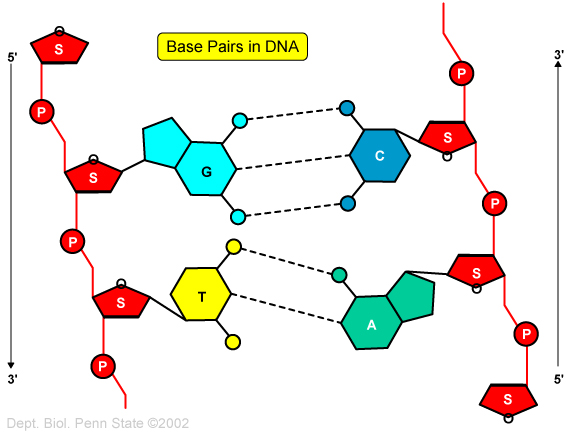
In prokaryotes, DNA
is linearly arranged.
is located in the ribosomes.
floats freely in the cytoplasm.
is located in the nucleus.
The bonds that join nucleotides together in DNA and RNA are called:
Peptide Bonds
Ester Bonds
Glycosidic Bonds
Phosphodiester Bonds

anti-parallel
deoxyribosic
helical
semi-conservative

The picture below shows the steps of DNA replication beginning with step one and ending with step three.
Because you are reusing the old, or parent, DNA strand DNA replication is said to be
Semi- Conservative
Semi-discontinuous
Continuous
Fully-Conserveative

The picture below shows an enzyme unwinding and unzipping DNA.
What is the name of this enzyme?
DNA Helicase
DNA Ligase
DNA polymerase
RNA Polymerase
Which enzyme joins the Okazaki fragments together?
Helicase
Polymerase
Ligase
Primerase
Which organelle is the location where protein is made?
Ribosome
Nucleus
Cytoplasm
Nucleotide
Where are chromosomes located inside the cell?
The ribosome
The nucleus
The nuclear membrane
The cell wall
What is a monomer of nucleic acids made of 3 parts, a 5-carbon sugar, a phosphate group and a nitogenous base
DNA
Nucleotide
Deoxyribose
RNA
ATG TGA CAG
ATG TGA CAG
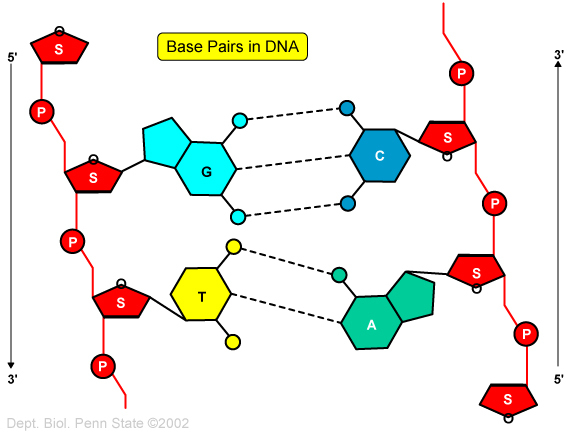

Primary functions of DNA are (mark all that apply)
Transmit information on heredity from one generation to the next
Control cellular respiration
Regulate homeostasis
Provide a blueprint for making proteins
Which of the following are purines?
adenine
cytosine
guanine
thymine
uracil

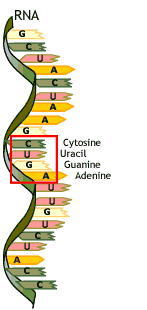
What are long chains of nucleotides called?
Polyneucleotides
Polysaccharides
Long chains
Polyaminoacids
What are the three components of a nucleotide?
Pentose Sugar, Nitrogenous base, Phosphate Group
Deoxyribose, Uracil, Guanine
Ribose Sugar, Adenine, Cytosine
Thymine, Purines, Phosphodiester Bond
Which component of a nucleotide can be either ribose or deoxyribose?
Nitrogenous base
Phosphate group
Purines
Pentose sugar
Where are nitrogenous bases attached in a nucleotide?
Second carbon of sugar
Third carbon of sugar
First carbon of sugar
Fourth carbon of sugar
How many types of nitrogenous bases are there in nucleotides?
1
2
3
4
Which of the following is a purine nitrogenous base?
Cytosine
Thymine
Adenine
Uracil
Which nitrogenous base pairs with thymine (or uracil) with two hydrogen bonds?
Cytosine
Guanine
Adenine
Purines
How many hydrogen bonds are formed between cytosine and guanine?
1
2
3
4
What is the combination of a nitrogenous base and a pentose sugar called?
Nucleotide
Phosphodiester Bond
Nucleoside
Purine
How many phosphate groups can a nucleotide have?
One
Two
Three
Four
How are two or more nucleotides attached to each other?
Disulphide Bond
Hydrogen Bond
Ionic Bond
Phosphodiester Bond
With what do the nitrogenous bases of nucleotides form bonds?
Phosphate Groups
Pentose Sugar
Complementary Bases
Purines
What is the primary function of ATP in a cell?
DNA formation
RNA formation
Energy currency
Protein synthesis
What is the primary function of DNA in a cell?
Energy storage
Protein synthesis
Transfer of genetic information
ATP production
What is the primary function of RNA in a cell?
Energy storage
Transfer of genetic information
ATP production
Protein synthesis
What are the two broad categories of nucleic acids?
Adenine and Guanine
DNA and RNA
Pentose Sugar and Phosphate Group
Purines and Pyrimidines
What is the type of sugar that DNA is made up of?
Deoxyribose
Ribose
Adenine
Guanine
What type of sugar is RNA made up of?
Ribose
Deoxyribose
Adenine
Guanine
What is the precursor of ATP?
Ribose Sugar
Adenosine diphosphate
Phosphate Groups
Nucleoside
What type of molecule is ATP?
Protein
Nucleotide
Carbohydrate
Organic
What type of nitrogenous base is adenine?
Purine
Pyrimidine
Thymine
Cytosine
Which of the following is not a pyrimidine base?
Uracil
Thymine
Cytosine
Guanine
What is the role of nucleic acids in living cells?
Energy storage
Movement
Controlling cell processes
Cell structure
How many phosphate groups does ATP have?
One
Two
Three
Four
What is the sugar component of ATP?
Deoxyribose
Ribose
Adenine
Thymine
Which of the following is not involved in DNA formation?
Deoxyribose
Adenine
Guanine
Uracil
What type of bond connects two or more nucleotides?
Covalent bond
Hydrogen bond
Ionic bond
Phosphodiester bond
Which nucleotide base pairs with guanine using three hydrogen bonds?
Adenine
Cytosine
Thymine
Uracil
Which component of a nucleotide forms the backbone of DNA and RNA?
Nitrogenous base
Phosphate and sugar groups
Adenine
Purines
What is the building block of nucleic acids?
Amino acids
Nucleosides
Nucleotides
Carbohydrates
Which nitrogenous base is unique to RNA and not found in DNA?
Adenine
Guanine
Cytosine
Uracil
What is the function of a nucleotide with one phosphate group?
Energy storage
Protein synthesis
Genetic information transfer
Cell structure
What is the difference between DNA and RNA?
One has a pentose sugar
One is made of nucleotides
One is not a nucleic acid
One is single stranded

