
 Worksheets
O.H. Final Review
Total questions: 66
Worksheet time: 37mins
These types of flowers are used to fill empty space and tie things together (a)
These types of flowers are used to create the main design
Line
Form
Massing
Filler
These types of flowers are used to create an accent or focal point
Line
Form
Massing
Filler
These types of flowers are used to create the basic framework for the arrangement
Line
Form
Massing
Filler

Identify the florist tool:
Ribbon Shears
Florist knife
Florist Shears
Diagonal pliers

Identify the florist tool:
Ribbon Shears
Florist knife
Florist Shears
Diagonal pliers

Identify the florist tool:
Ribbon Shears
Florist knife
Florist Shears
Diagonal pliers

Identify the florist tool:
Ribbon Shears
Florist knife
Florist Shears
Diagonal pliers
What colors create create feelings of excitement?
Bright Yellow, Greens and muted Light Tan
Warm Reds, yellow and oranges
Cool blues, greens and purples
What are some safety considerations when working with flowers?
Be careful not to sniff the flowers too much
Watch for insects in the flowers
Be careful with angry customers
Be careful around sharp objects and tools
A tool used to help designers to understand the theory behind using color in arrangements.
Balance
Color Wheel
Focal Point
Massing Flowers
A basic principle of design; when flower size and container flow and compliment each other.
flow
symmetry
balance
proprotion
To maintain relative size and space in the design
flow
symmetry
balance
proprotion
Made up of exactly similar parts, facing each other, or around an axis.
flow
symmetry
balance
proprotion
The size of your arrangement should be in proportion to where the arrangement is sitting.
scale
symmetry
balance
proprotion
Using flowers or color to call or catch the eye of the viewer
scale
symmetry
balance
Focal Point
What is the rule of thumb for floral arrangements?
One and a half to two times the height or width of the container
8 times the height of your flower pots
None, just do your thing
Warm reds, oranges, yellows create feeling of _____
Calm
Excitement
None of these
The living things that break down organic matter and recycle them into the environment are called ___
Homing
Metamorphosis
Proboscis
Decomposers
A positively charged ion (+) is called a ____
ion
anion
cation
none of these
The capacity of colloidal particles to attract positively charged ions and exchange them for one another is also called _________
cation exchange
green manure
photosynthesis
organic matter
The Ph value of 3 considered ____
alkaline
acid
neutral
none of these
The Ph value of 9 considered ____
acid
alkaline
neutral
none of these
The Ph value of 7 considered ____
acid
alakine
neutral
none of these
The element oxygen (O) is considered an essential element
True
False
The element Zinc (Zn) is an essential element for plants
True
False
The element silica (Si) is an essential element for plants
True
False
What soils are considered colloidal?
clay soils
loam soils
sandy soils
silty soils
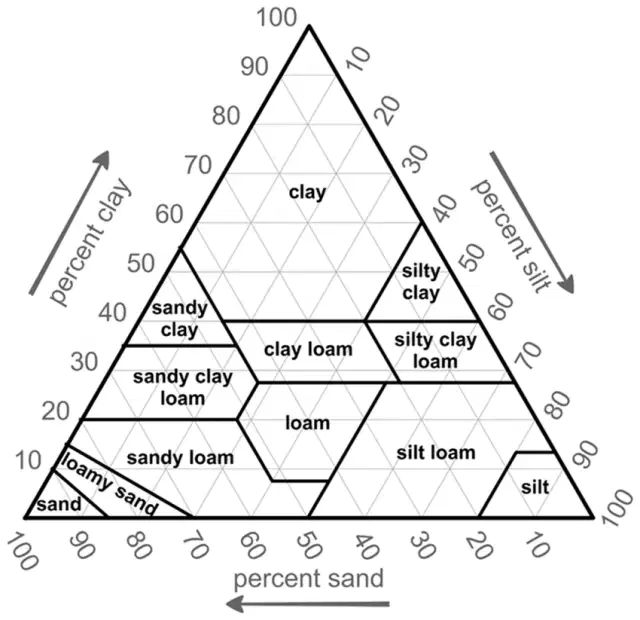
A soil that is 40% sand, 40 % silt and 20% clay is called a __
sandy
clay loam
sandy clay
loam
The smallest of the soil particles is _____
sand
silt
clay
gravel
The relative proportions of sand, silt and clay in a soil describes the _______
soil texture
humus
green manure
organic matter
The LARGEST of the soil particles is _____
gravel
clay
sand
silt
Sedentary soils ___
soils transported by the action of ICE
soils transported by the action of water
soils transported by the action of wind
soils that remain in place
Soils formed by the movement of ICE are called ____
glacial
alluvial
colluvial
aeolian
Soils that are moved or carried by the action of wind are called ____
aeolian
colluvial
glacial
alluvial
These soils are moved /carried by the action of water
alluvial
glacial
colluvial
aeolian
These soils are moved by gravity.
alluvial
glacial
colluvial
aeolian
Where does organic matter in soils come from?
from photosynthesis
from the decomposition of plant and animal matter
from insects
from humans
Plowed-under green plants which is also considered organic matter is also called _____
organic manure
green manure
blood meal
bone meal
The cross-sectional slice of the earth's crust is called a ---
a soil profile
a personal profile
a slice of crust
a picture of soils
The organic component of soil, formed by the decomposition of leaves and other plant material is called _____
humus
a soil profile
soil
humans
SOIL IS--
the home of insects
the organic component of soils
the outer layer of the Earth’s crust, including living and non-living organisms and organic matter
where photosynthesis happens in plants
A soil with 10% clay, 60% silt, and 30% sand will be called a ___
silt loam
clay loam
sandy clay
loam
A soil with 10% clay, 60% silt, and 30% sand will be called a ___
silt loam
clay loam
sandy clay
loam
A soil with 30% clay, 30% silt, and 40 % sand is called a _____
silt loam
clay loam
sandy clay
loam
Pick the items below that are considered organic fertilizers (a) (b) (c)
The three numbers on the front of fertilizer bags are the amounts of what 3 essential plant elements?
Oxygen, Iron, and Sodium
dried sewage sludge
N, P, & K
none of these
Nutrient additives applied to the soil to maintain crop productivity are also called _________.
fertilizers
pesticides
herbicides
nutrients
A negatively charged ion (-) is called a
ion
cation
anion
none of these
When water moves through soil is called ____
porosity
infiltration
decomposing
erosion
When all pores are filled with water, meaning the water content is equal to the porosity of the soil, it is considered ______.
saturated
full
sandy clay loam
porosity
There are ____ different soil horizons.
7
4
9
6
The lowest soil horizon is the ___ horizon.
E horizon
A horizon
O horizon
R horizon
Without ______, dead plants and animals would continuously pile up on the surface of the earth
animals
humans
decomposers
plants
Bacteria, fungi and other living things in soils that help turn organic matter into soil are all called _____
decomposers
bacteria
earthworms
animals
Pick the living thing from the choices below that has a SYMBIOTIC relationship with trees?
earthworms
fungi
mushrooms
decomposers
Pick all of the important functions of soils from the choices below. (3)
(a) (b) (c)
Pick out the 2 important soil processes which help make nitrogen available to plants from the choices below.
(a) (b)
In a regular 100 pound bag of fertilizer, the NPK numbers read 60 - 20 - 20. What is the amount of Potassium (K) in the fertilizer?
60
20
40
80
In a regular 100 pound bag of fertilizer, the NPK numbers read 40 - 60 - 0. What is the amount of Nitrogen (N) in the fertilizer?
60
20
40
80
Intensive industrial agriculture growing the same crops in the same place year after year quickly depleting the soil of nutrients describes a ______.
decomposer
ornamental horticulture
farming operation
monoculture
The draining away of water and the substances in it from the surface of the soil is called _______.
runoff
ammonification
decomposing
photosynthesis
The process by which water reaches
the plant roots in soils is called _____.
decomposers
photosynthesis
runoff
permeability
Some soil organisms become less efficient as it warms up, so scientists are not sure what effects _____ will have on soils and decomposition as the climate changes
porosity
climate change
decomposers
photosynthesis
The process by which water reaches
the plant roots in soils is called _____
green
manure
porosity
organic matter
permeability
The relative size of the pores
(spaces) in soils is its’ ____.
porosity
erosion
photosynthesis
runoff

