
NEW
Font size
S
M
L
XL
 Worksheets
NC Biology Essential Standard 3.5
Total questions: 20
Worksheet time: 17mins
Name
Class
Date
1.

Use the phylogenetic tree. Which hypothetical organism is the most recent ancestor for Organisms A and G?
a)
1
b)
2
c)
3
d)
4
2.
Which domain includes all multicellular plants and animals?
a)
Archaea
b)
Eukarya
c)
Eubacteria
d)
Protista
3.
Panthera leo, the scientific name for a lion, is a member of which species?
a)
leo
b)
Animalia
c)
Panthera
d)
mammalia
4.
An organism identified with binomial nomenclature includes which two taxa?
a)
class and order
b)
family and genus
c)
genus and species
d)
kingdom and phylum
5.
Canis lupus, the scientific name for a wolf, is in which genus?
a)
Canis
b)
lupus
c)
Animalia
d)
mammalia
6.
Which two organisms are least closely related?
a)
two organisms from the same kingdom
b)
two organisms from the same order
c)
two organisms from the same family
d)
two organisms from the same genus
7.

The table shows some characteristics of four kingdoms.
Which characteristics would a taxonomist use to classify organisms as Archaebacteria or as Eubacteria?
Which characteristics would a taxonomist use to classify organisms as Archaebacteria or as Eubacteria?
a)
the internal organization of the cell
b)
the number of cells in an individual
c)
the chemical composition of the cell wall
d)
the nutritional requirements of the organism
8.

Examine the dichotomous key.
What features does a Platyspiza have?
What features does a Platyspiza have?
a)
stout and heavy beak with a curved lower beak
b)
long, slender beak with a flat and straight lower beak
c)
flat and straight beak with a bend in the lower edge of the upper beak
d)
long and slender beak with the lower edge of the upper beak being flat
9.
The 8 levels of classification, most broad to most specific.
a)
Domain, Genus, Family, Order, Class, Phylum, Kingdom, Species
b)
Domain, Species, Kingdom, Genus, Phylum, Family, Class, Order
c)
Domain, Kingdom, Phylum, Class, Order, Family, Genus, Species
d)
Order, Kingdom, Species, Domain, Phylum, Family, Class, Genus
10.
Which organisms are most closely related?
a)
Equus caballas (Horse) & Equus burchellii (Zebra)
b)
Cyanea artica (Jellyfish) &
Ctenodiscus crispatus (Mud Starfish)
Ctenodiscus crispatus (Mud Starfish)
c)
Naja naja (cobra) & Glycine max (soya bean)
d)
Ophiocomina nigra (black brittle star) & Brassica nigra (black mustard)
11.
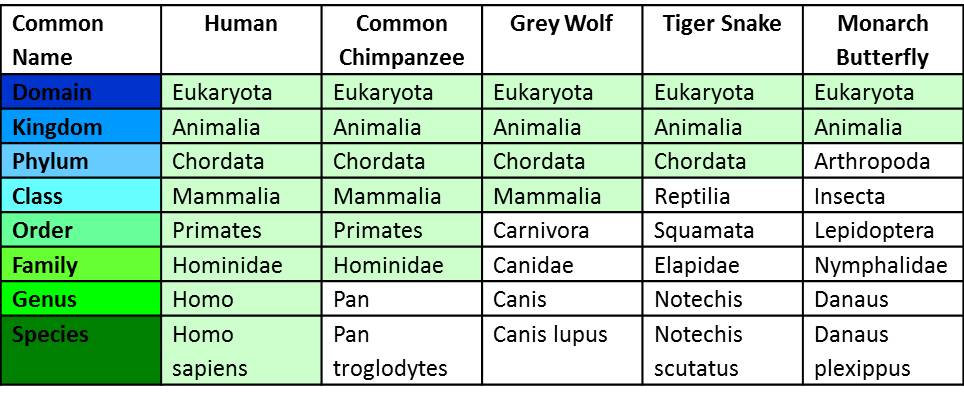
Which organism in the table is least closely related to the chimpanzee?
a)
human
b)
grey wolf
c)
tiger snake
d)
monarch butterfly
12.
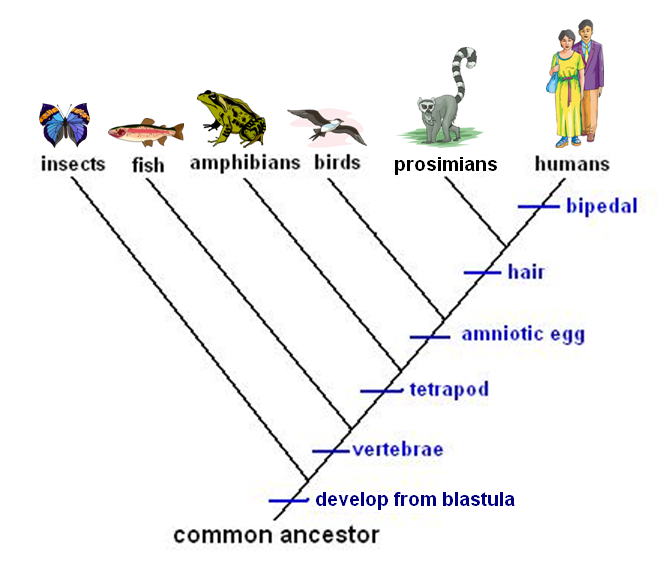
Which organisms pictured on the cladogram have hair?
a)
prosimians only
b)
prosimians and humans
c)
humans only
d)
prosimians and birds
13.

Which organism in the table shown is most closely related to the common dolphin?
a)
human
b)
killer whale
c)
giant kelp
d)
bat star
14.

An illustration and a dichotomous key are given. What is the correct classification for this organism?
a)
Class Insecta
b)
Order Amblygygi
c)
Order Araneae
d)
Order Scorpiones
15.

Which 2 organisms would be able to reproduce and produce fertile offspring?
a)
2 organisms in the same class
b)
2 organisms in the same family
c)
2 organisms in the same genus
d)
2 organisms in the same species
16.
This organism is found in pond water. It has a nucleus, is microscopic, unicellular and can perform photosynthesis. What kingdom does it belong in?
a)
protista
b)
eubacteria
c)
archaebacteria
d)
plantae
17.

I am prokaryotic and am found everywhere. What kingdom do I belong to?
a)
Eubacteria
b)
Archaebacteria
c)
Fungi
d)
Protista
18.
This organism is multicellular, autotroph, that has a cell wall made of cellulose.
a)
animalia
b)
plantae
c)
fungi
d)
eubacteria
19.
What is Cilia?
a)
A tail like structure that help protist move
b)
Hair like fibers that help protist move
c)
A place where spores are kept
d)
A fake foot that help protist move
20.
What is a pseudopod?
a)
A tail like structure that help protist move
b)
Hair like fibers that help protist move
c)
A place where spores are kept
d)
A fake foot that help protist move
Reset

