wayground logo

Free Printable Worksheets

Font size

S
M
L
XL
Worksheets

Sci 10 Bio Review

Total questions: 223

Worksheet time: 4hrs 19mins

Name
Class
Date
1.
Which sequence of DNA bases would pair with this partial strand
ATG TGA CAG
a)
ATG TGA CAG
b)
TAC ACT GTC
c)
GTA AGT GAC
d)
CAT TCA CTG
2.
Which of the following best describes a DNA molecule?
a)
double helix
b)
contains ribose
c)
made of amino acids
d)
contains Uracil
3.
Which of the following units are repeatedly joined together to form a strand of DNA?
a)
amino acids
b)
nucleotides
c)
fatty acids
d)
polysaccharides
4.
In a molecule of double-stranded DNA, the amount of Adenine present is always equal to the amount of
a)
cytosine
b)
guanine
c)
thymine
d)
uracil
5.
Guanine bonds with ______________.
a)
Adenine
b)
Guanine
c)
Cytosine
d)
Thymine
6.
Why is DNA important?
a)
it is very small and very complicated
b)
it's in everything
c)
it serves as the blueprint for traits of all living things
d)
because we eat it every day for energy
7.
Which 2 molecules form the sides (backbone) of the DNA ladder?
a)
deoxyribose sugar and adenine
b)
deoxyribose sugar and a hydrogen bond
c)
deoxyribose sugar and the nucleus
d)
deoxyribose sugar and phosphate
8.
Watson and Crick were the first to suggest that DNA is _____
a)
a short molecule
b)
the shape of a double helix
c)
a protein molecule
d)
the genetic material
9.
Which organelle is DNA usually found in?
a)
cell membrane
b)
vacuole
c)
chloroplast
d)
nucleus
10.
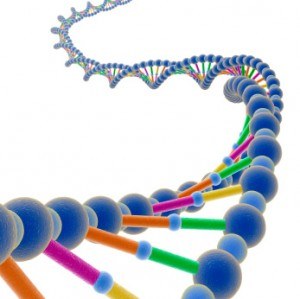
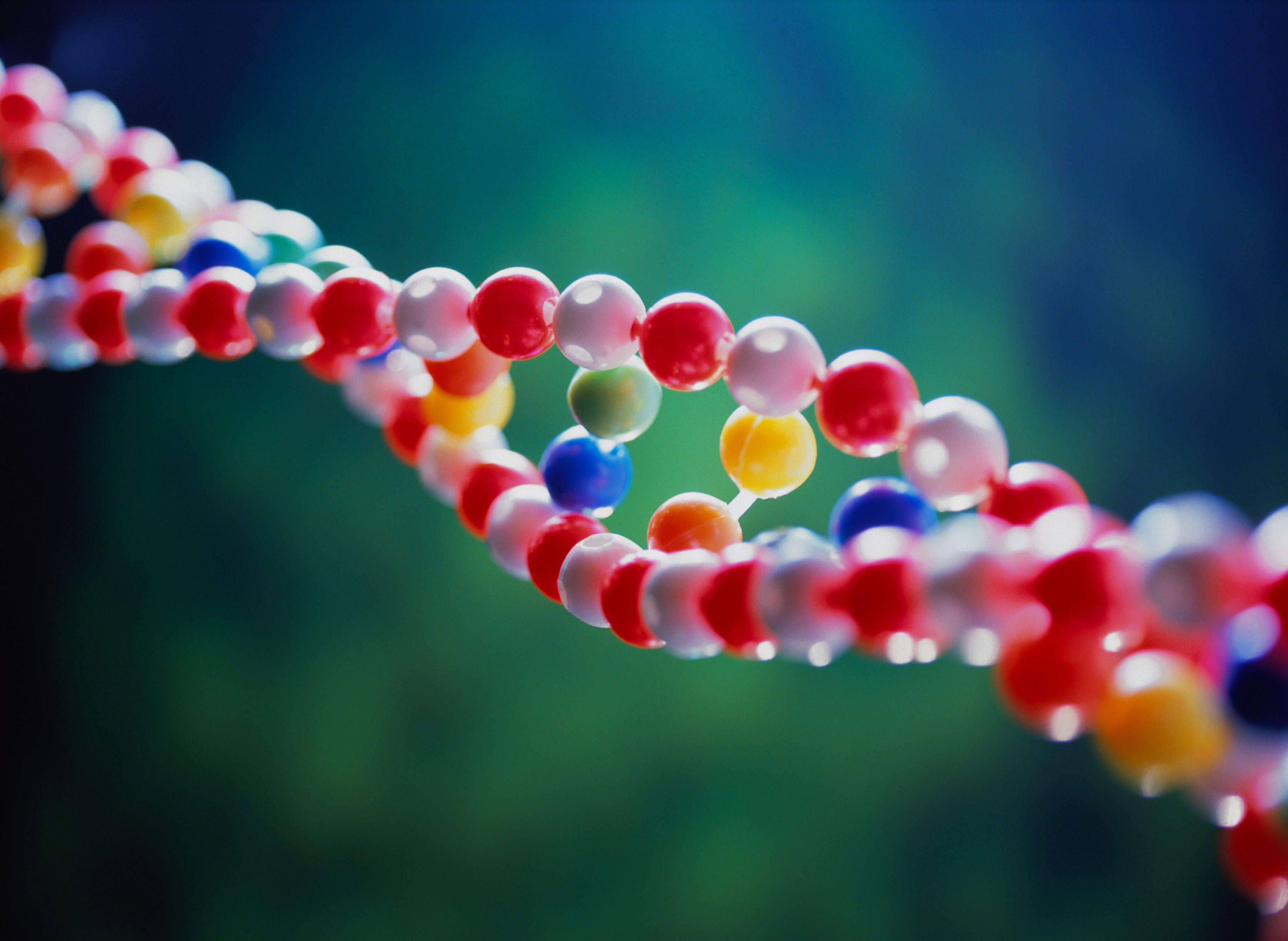
Name this structure
a)
double helix
b)
nucelotide
c)
twisted ladder
d)
hydrogen bond
11.
Nitrogenous bases are joined by which type of bond?
a)
polar bonds
b)
ionic bonds
c)
covalent bonds
d)
hydrogen bonds
12.
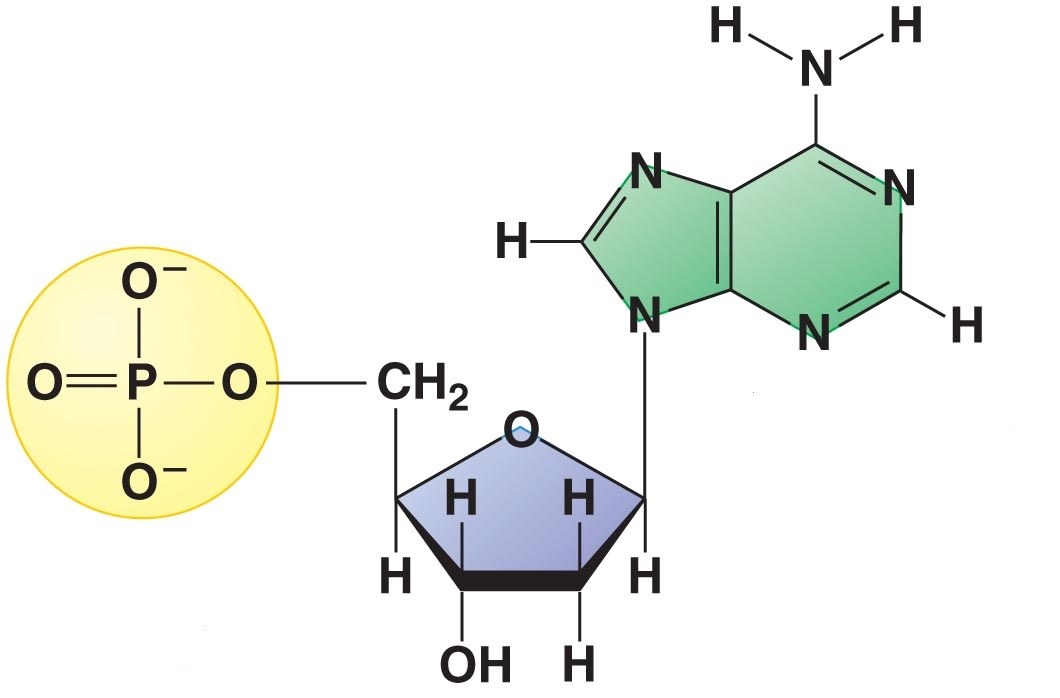
Nucleotides are made up of a sugar, phosphate, and..?
a)
nitrogenous base
b)
nucleic acid
c)
cholesterol
d)
fatty acid
13.
What does DNA stand for?
a)
Deoxyribonucleic acid
b)
Denitrogenous acid
c)
Deribonucleic acid
d)
Diribonucleic acid
14.
Who is responsible for producing this image (taken by X-ray chrystallography)?
a)
Francis Crick
b)
James Watson
c)
Rosalind Franklin
d)
Watson and Crick
15.
What part of DNA is different between individuals?
a)
Sugar
b)
Phosphate
c)
Order of nitrogen bases
16.

Aa

a)

Genotype

b)

Phenotype

17.

AA

a)

Genotype

b)

Phenotype

18.

aa

a)

Genotype

b)

Phenotype

19.

Two of the same allele

a)

Genotype

b)

Phenotype

20.

Two different alleles

a)

Genotype

b)

Phenotype

21.

One allele for brown eyes and one allele for blue eyes

a)

Genotype

b)

Phenotype

22.

Three of chromosome 21

a)

Genotype

b)

Phenotype

23.

Blue eyes

a)

Genotype

b)

Phenotype

24.

Curly hair

a)

Genotype

b)

Phenotype

25.

Colorblind

a)

Genotype

b)

Phenotype

26.

Six feet tall

a)

Genotype

b)

Phenotype

27.
Which of the following is heterozygous
a)
FF
b)
tt
c)
Gg
d)
RR
28.
Which of the following is homozygous recessive?
a)
rr
b)
AA
c)
TT
d)
Ff
29.
Which of the following is homozygous dominant?
a)
Jj
b)
Rr
c)
MM
d)
ee
30.
How many letters does a genotype contain?
a)
1
b)
2
c)
3
d)
4
31.
The physical appearance of a trait is known as the-
a)
genotype
b)
phenotype
c)
characteristics
d)
intelligence
32.
Mark is heterozygous. If B is for brown hair, and b is for blonde hair, what is Mark's phenotype?
a)
Brown Hair
b)
Blonde Hair
c)
Brown and Blonde Hair
d)
Black Hair
33.
Mark is heterozygous. If B is for brown hair, and b is for blonde hair, what is Mark's genotype?
a)
BB
b)
bb
c)
Bb
d)
bB
34.
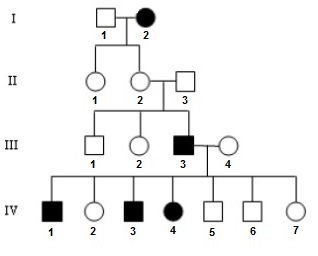
What does a filled in square represent?
a)
Not affected Female
b)
Not affected Male
c)
Affected Male
d)
Affected Female
35.
How many generations are shown in this pedigree?
a)
1
b)
2
c)
3
d)
4
36.
How many kids did the mother and father from the first generation have?
a)
2
b)
4
c)
5
d)
6
37.
This pedigree represents the inheritance of hemophilia in this family. How many of the females have the hemophilia trait?
a)
8
b)
5
c)
2
d)
3
38.
What does an open circle represent?
a)
Not Affected Male
b)
Not Affected Female
c)
Affected Male
d)
Affected Female
39.
Is this trait (the shaded individuals) dominant or recessive?
a)
dominant
b)
recessive
40.
In the second generation-how many people are carriers of the trait?
a)
2
b)
3
c)
5
d)
6
41.
How many people in this whole pedigree have the trait/disease?
a)
2
b)
3
c)
4
d)
6
42.
How many females are in this pedigree?
a)
3
b)
4
c)
6
d)
7
43.

In this pedigree, which gender can be carriers of colorblindness and not have it?

a)

Just males

b)

Just females

c)

Both genders

44.
What is this?
a)
Pedigree
b)
Karyotype
c)
Venn diagram
d)
Punnett Square
45.
Give the genotype for person II-1, for this autosomal trait.
a)
GG
b)
Gg
c)
gg
d)
we cannot be 100% sure of the genotype
46.
If a trait SKIPS a generation, it is an indication that the trait is....
a)
dominant
b)
recessive
c)
incompletely dominant
d)
co-dominant
47.
If this pedigree shows an autosomal recessive disorder, what MUST the genotype of individual II-3 be?
a)
HH
b)
Hh
c)
hh
d)
None of the above
48.

Objective #13

This is a pedigree that follows blue eyes which is a recessive trait. What is the genotype of the father (square) in generation 1?

a)

Aa

b)

AA

c)

aa

d)

A?

49.

In this pedigree, the shading represents people in the family with dark hair while the unshaded represents blondes. Is dark hair controlled by a dominant or recessive allele?

a)

Dominant

b)

Recessive

50.

Individuals that are shaded in have premature hair whitening. Is this trait dominant or recessive? How do you know?

a)

Dominant because it skips generations

b)

Dominant because it is present in every generation

c)

Recessive because it skips generations

d)

Recessive because it is present in every generation.

51.
How are individuals III-2 and II-4 related?
a)
Cousins
b)
Dad and Daughter
c)
Uncle and Niece
d)
Grandpa and Granddaughter
52.

Huntington's Disease is a dominant trait.

What is the correct genotype for individual I-2?

a)

HH

b)

Hh

c)

hh

d)

H?

53.
Parents and children share traits. Which of these is NOT an inherited trait?
a)
eye color
b)
liking spicy foods
c)
left-handedness
d)
ear shape
54.
What is the difference between inherited traits and learned behaviors?
a)
Inherited trait are something you get from your sister and learned behaviors come from experience.
b)
Inherited traits are something you get from your parents and learned traits are things like eye color.
c)
Inherited traits are something you get from your parents such as hair type and learned behaviors are something you learn to do with practice or past event.
55.
Identify the SUBSTITUTION mutation from the following DNA sequence: 
ATG CCA AAT
a)
ATG TCA AAT
b)
ATG CCT AAA T
c)
ATC CA  AT
d)
ATG CCA AAT
56.
How can a person's muscle cells have the same exact DNA sequences as their nerve cells even though the look and perform completely different?
a)
The two different cells become mutated
b)
The proteins expressed in each cell are different
c)
They actually have different DNA in the two types of cells.
d)
The genome of the different cells changes
57.
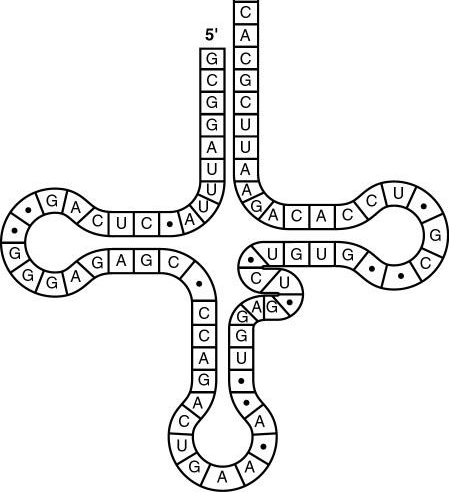
What structure of this molecule binds with the mRNA molecule?
a)
Amino Acid
b)
tRNA
c)
Anticodon
d)
Codon
58.
In RNA, Uracil pairs with ______. 
a)
cytosine
b)
adenine
c)
guanine
d)
thymine
59.
The mRNA leaves the ________ to find the ribosome to make proteins.
a)
cell
b)
nucleotide
c)
nucleus
60.

DNA holds the code for making

a)

lipids

b)

carbohydrates

c)

proteins

d)

sugars

61.

Choose the sequence of the mRNA strand that would be match up with to the following strand:

GTAGTCA

a)

UATUAGA

b)

ACGACTG

c)

CAUCAGU

d)

CATCAGT

62.
The main function of tRNA is to...
a)
carry a message that, when translated, forms proteins
b)
form a portion of ribosomes
c)
string together complementary RNA and DNA strands
d)
bring amino acids from the cytoplasm to the ribosomes
63.
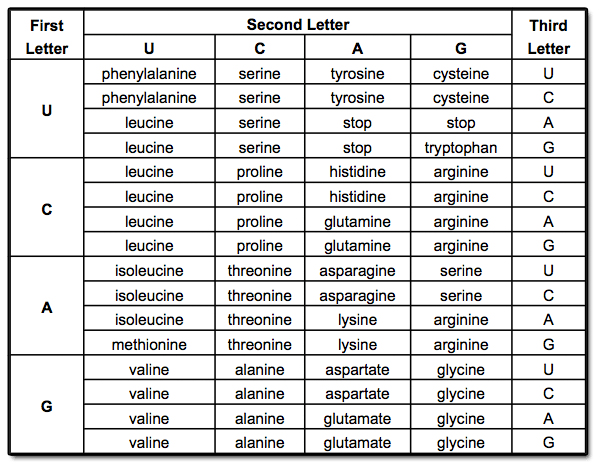
What amino acid is represented by the codon UUA?
a)
Phenylalanine
b)
Tyrosine
c)
Leucine
d)
Stop codon
64.

What is the correct amino acid sequence for the mRNA code AUGCCAGUAUGA

a)

Met-Pro-Ala-Val

b)

Met-Pro-Val

c)

Tyr-Gly-His

d)

Tyr-Gly-Arg-His

65.

Which is the mRNA molecule that would be created from this DNA template:

TGGCAAGTACGT

a)

ACCGTTCATGCA

b)

UGGCAAGUACGU

c)

UCCGUUCUUGCU

d)

ACCGUUCAUGCA

66.
Contains the bases adenine, uracil, cytosine and guanine
a)
DNA
b)
RNA
c)
Both
67.
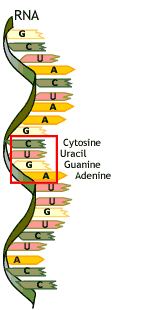
What part of protein synthesis does this diagram represent?
a)
mRNA
b)
tRNA
c)
rRNA
d)
RNA
68.
Guanine bonds with ______________.
a)
Adenine
b)
Guanine
c)
Cytosine
d)
Thymine
69.
DNA travels outside of the nucleus.
a)
true
b)
false
70.
Messenger RNA carries a copy of the DNA code.
a)
true
b)
false
71.
Where do cells get the information to make proteins?
a)
RNA
b)
DNA
c)
phosphate group
72.

In what process is mRNA synthesized?

a)

Transcription

b)

Translation

c)

DNA Replication

d)

Mitosis

73.

Where does TRANSCRIPTION occur?

a)

Nucleus

b)

Ribosome

c)

Cytoplasm

d)

Mitochondria

74.

Why must transcription occur where DNA can be found?

a)

because DNA can't leave

b)

because ribosomes are in the nucleus

c)

because DNA polymerase is found there

d)

because helicase unzips the DNA

75.

How many codons equals 1 amino acid?

a)

1

b)

2

c)

3

d)

4

76.

How many nucleotides equal 1 amino acid?

a)

1

b)

2

c)

3

d)

4

77.

TRANSCRIBE this DNA sequence: TACGTTACT

a)

AUGCAAUGA

b)

ATGCAATGA

c)

AUGGATUGA

d)

TACGTTACT

78.

Which of the following are differences in the structure between RNA and DNA

a)

DNA uses deoxyribose sugar, RNA uses sugar ribose

b)

DNA pairs Adenine with Uracil, RNA pairs Adenine with Thymine

c)

DNA is a double helix, RNA is a single helix

d)

DNA pairs Adenine with Thymine, RNA pairs Adenine with Uracil

79.

Which organelle is the location where protein is made?

a)

Ribosome

b)

Nucleus

c)

Cytoplasm

d)

Nucleotide

80.

When these bond together, they form a protein

a)

Amino Acids

b)

Peptide Bonds

c)

Ribose

d)

Nucleotides

81.
What is the term for a three-nucleotide sequence that codes for an amino acid?
a)
base
b)
codon
c)
amine
d)
serine
82.
The process to go from DNA to mRNA is _______
a)
translation
b)
transcription
c)
replication
83.
The process to go from mRNA to a protein is called ____
a)
transcription
b)
rRNA
c)
replication
d)
translation
84.
What are the possible combinations of a pea plant with the alleles PP and a male pea plant with the alleles pp.
P= purple
p= white
a)
all Pp
b)
all PP
c)
Pp,PP,Pp,PP
d)
all pp
85.

When the allele combination is a dominant and a recessive trait together which trait will be seen?

a)

Dominant

b)
Recessive
c)
none
d)
both
86.
What are the possible combinations of a pea plant with the alleles PP and a male pea plant with the alleles pp.
P= purple
p= white
a)
all Pp
b)
all PP
c)
Pp,PP,Pp,PP
d)
all pp
87.

When the allele combination is a dominant and a recessive trait together which trait will be seen?

a)

Dominant

b)
Recessive
c)
none
d)
both
88.
Homozygous is when...
a)
the alleles are the same
b)
the alleles are different
c)
the alleles are absent
d)
the alleles are present
89.
B = brown fur  b = white fur
In the punnett square, what is the probability for white fur? 
a)
0%
b)
25%
c)
50%
d)
75%
90.
Aa is
a)
homozygous (purebred)
b)
heterozygous (hybrid)
91.
What is a phenotype?
a)
The expression of a trait; physical appearance.
b)
refers to the genetic makeup of an individual
c)
An organism that has the same genes for a trait (ex. TT or tt)
d)
the passing of traits from parent to offspring
92.
A heterozygous long-tusked elephant is crossed with a homozygous recessive short-tusked elephant. What is the probability of the offspring having short tusks?
a)
0%
b)
25%
c)
50%
d)
75%
93.
Identify the homozygous dominant genotype:
a)
FF
b)
Ff
c)
ff
94.
Aa, DD, bB, yy are all examples of
a)
genotypes
b)
phenotypes
95.

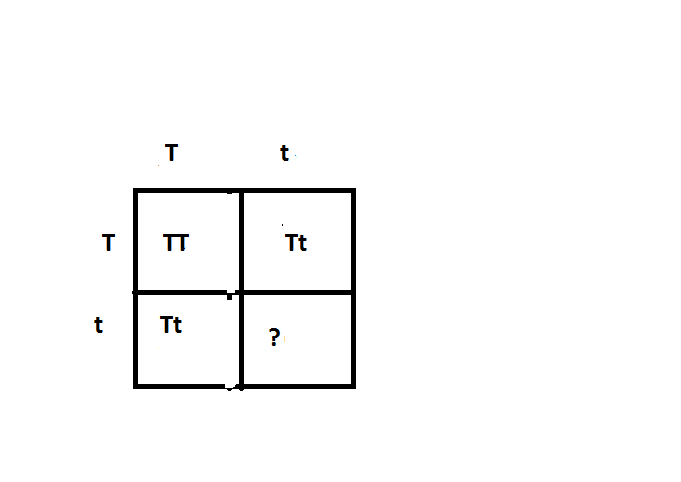
T - tall and t = short

In the punnett square below, what belongs in the missing square

a)

tt

b)

Tt

c)

Bb

d)

TT

96.
Which of the following genotypes is heterozygous?
a)
Bb
b)
BB
c)
bb
d)
B
97.

In a flowering plant species, red flower color (R) is dominant over white flower color (r). What is the genotype of any white-flowering plant resulting from this species?

a)

rr

b)

rR

c)

RR

d)

Rr

98.
In pea plants, the tall allele is dominant to the short allele. What key would demonstrate this?
a)
Tall = T
Short = S
b)
Tall = T
Short = t
c)
Tall = t
Short = T
d)
Tall = TT
Short = tt
99.
Which of the following is NOT a genotype?
a)
heterozygous
b)

black

c)
Bb
d)
homozygous recessive
100.

When one allele is not dominant over another, resulting in a blended phenotype for heterozygous offspring is considered....

a)

Incomplete Dominance

b)

Codominance

101.

When one allele is not dominant over the other, resulting in both traits expressed in a heterozygous individual.....

a)

Incomplete Dominance

b)

Codominance

102.

Some flowers are controlled by codominance. Red flowers (RR), blue flowers (BB) and Speckled flowers (RB).


Cross a red flower with a speckled flower. What is the phenotypic ratio?

a)

2 red, 2 speckled

b)

2 red, 2 blue

c)

2 blue, 2 speckled

103.

Some flowers are controlled by codominance. Red flowers (RR), blue flowers (BB) and Speckled flowers (RB).


Cross two speckled flowers.

a)

1 red, 2 speckled, 1 blue

b)

2 red, 2 blue

c)

2 blue, 2 speckled

d)

1 red, 1 speckled, 2 blue

104.

Some flowers are controlled by codominance. Red flowers (RR), blue flowers (BB) and Speckled flowers (RB).


Cross a red flower with a blue flower.

a)

1 red, 2 speckled, 1 blue

b)

2 red, 2 blue

c)

4 speckled

d)

1 red, 1 speckled, 2 blue

105.

Radish color is completely dominant, red and white are pure breeding colors. While heterozygous are purple.


Cros a red radish with a white.

a)

4 purple

b)

1 red, 2 purple, 1 white

c)

2 red, 2 white

d)

1 red, 1 purple, 2 white

106.

Radish color is completely dominant, red and white are pure breeding colors. While heterozygous are purple.


Cros a red radish with a purple.

a)

4 purple

b)

1 red, 2 purple, 1 white

c)

2 red, 2 purple

d)

1 red, 1 purple, 2 white

107.

Radish color is completely dominant, red and white are pure breeding colors. While heterozygous are purple.


Cros a white radish with a purple.

a)

4 purple

b)

1 red, 2 purple, 1 white

c)

2 purple, 2 white

d)

1 red, 1 purple, 2 white

108.

In mice coat color is incompletely dominant. Black and white are homozygous. Brown mice are heterozygous.


What is the genotype for a brown mouse?

a)

BB

b)

Bb

c)

bb

109.

In cattle red coats are represented as RR, and white coats are represented as WW.


What is the genotype for Roan color?

a)

RR

b)

RW

c)

WW

110.
What type of inheritance do two alleles have if their traits blend together? 
a)
Incomplete Dominance
b)
Co-Dominance
c)
Mendelian Inheritance
d)
Homozygous Inheritance
111.
A calico cat shows both the traits for orange fur and black fur. What kind of allele expression is this?
a)
Incomplete Dominance
b)
Co dominance
c)
Independent assortment
d)
Recessive inheritance
112.
A red flowered plant (RR) breeds with a White flowered plant (WW). The gene for petal color in these plants expresses incomplete dominance.  What percentage of the offspring will have pink (RW) flowers?
a)
0%
b)
25%
c)
50%
d)
100%
113.
An allele whose trait only shows up when no dominant allele is present.
a)
hidden allele
b)
dominant allele
c)
recessive allele
d)
present allele
114.
This type of inheritance pattern is a MIXTURE of both traits.
a)
incomplete dominance
b)
co-dominance
c)
complete dominance
d)
recessive pattern
115.
This type of inheritance pattern shows BOTH traits in possible offspring
a)
complete dominance
b)
incomplete dominance
c)
co-dominance
d)
dominant pattern
116.
Snap dragon color is a incomplete dominant trait.  A red flower (RR) is crossed with white flower (rr)? What color are flowers that are Rr?
a)
Red
b)
Red and White
c)
White
d)
Pink
117.
This is an example of ___________?
a)
Incomplete dominance
b)
Co-Dominance
118.
This is an example of ___________.
a)
 Incomplete Dominance
b)
 Codominance
119.
Which of the following is a hybrid?
a)
BB
b)
bb
c)
Bb
120.

The different forms of a gene are called ---

a)

traits

b)

hybrids

c)

alleles

121.

Codominance occurs in calico cats, which allows for the Black and Tan colors to show. What percentage of the offspring represented in this P square will be calico (black and tan spotted)?

a)

25%

b)

50%

c)

75%

d)

100%

122.

Incomplete dominance occurs in cats, which allows them to be Black, White, or gray as shown on this Punnett square. What percentage of the offspring will be black?

a)

25

b)

50

c)

75

d)

100

123.

Incomplete dominance occurs in cats, which allows them to be Black, White, or gray as shown on this Punnett square. What percentage of the offspring will be white?

a)

25

b)

50

c)

0

d)

100

124.
What percentage of the offspring will have this recessive disease?
a)
0%
b)
25%
c)
50%
d)
75%
125.
What percentage of the female offspring will be a carrier for this recessive disease?
a)
0%
b)
50%
c)
100%
d)
25%
126.
How many PAIRS of chromosomes do humans have?
a)
23
b)
46
c)
1
d)
2
127.
How many PAIRS of sex chromosomes do humans have?
a)
23
b)
46
c)
1
d)
2
128.
I have 2 X chromosomes. What am I?
a)
Male
b)
Female
129.
I have 1 X chromosome and 1 Y chromosome. What am I?
a)
Male
b)
Female
130.
If a gene is found only on the X chromosome and not the Y chromosome, it is said to be what?
a)
sex-linked trait
b)
polygenic trait
c)
codominant trait
d)
incomplete dominance trait
131.
Hemophilia is a recessive x-linked disorder.
Which genotype represents a female who is a carrier for hemophilia?
a)
XHXh
b)
XhXh
c)
XHXH
d)
XhY
132.
Hemophilia is a recessive x-linked disorder.
Which genotype represents a male with hemophilia?
a)
XHXh
b)
XhXh
c)
XHY
d)
XhY
133.

What are the genotypes of these flies:


white eyed, male ?

a)

X R X r

b)

X R X R

c)

Xr X r

d)

X r Y

e)

XR Y

134.

H= normal blood clotting

h=hemophilia


XHXh x XHY


What is the probability that any of their offspring will have hemophilia?

a)

4/4

b)

3/4

c)

2/4

d)

1/4

135.

Look at this cross: XB XB x Xb Y

What proportion/percent of the male children are colorblind?

a)

100%

b)

75%

c)

25%

d)

0%

136.

Look at this cross: XBXb x XBY


What proportion of the male children are colorblind?

a)

100%

b)

75%

c)

50%

d)

25%

137.

A piece of a chromosome is lost

a)

deletion

b)

duplication

c)

inversion

d)

translocation

138.

A piece of a chromosome is copied and remains within the chromosome

a)

deletion

b)

duplication

c)

inversion

d)

translocation

139.

A piece of the chromosome detches, turns 180 degrees, and reattaches

a)

deletion

b)

duplication

c)

inversion

d)

translocation

140.

A piece of one chromosome detaches and reattaches to a different chromosome

a)

deletion

b)

duplication

c)

inversion

d)

translocation

141.

The chromosomal mutation shown in the image is a

a)

deletion

b)

duplication

c)

inversion

d)

translocation

142.

The chromosomal mutation shown in the image is a

a)

deletion

b)

duplication

c)

inversion

d)

translocation

143.

The chromosomal mutation shown in the image is a

a)

deletion

b)

duplication

c)

inversion

d)

translocation

144.

The chromosomal mutation shown in the image is a

a)

deletion

b)

duplication

c)

inversion

d)

translocation

145.
What type of gene mutation has occurred here? 
T-G-A-C-C-A
T-G-A-C-C-A-A
a)
Base Substitution
b)
Base Deletion
c)
Base Insertion
d)
Frameshift 
146.
What type of gene mutation has occurred here? Normal-
AGA-TTC-ATA-GCG
Mutant-
AGA-TTC-AAT-AGC-G
a)
deletion frameshift
b)
insertion frameshift
c)
substitution
d)
nonsense
147.
DNA molecule segment is : TTACGCAAG
The mutated DNA segment is TTACGCAAC. This is an example of ___ mutation.
a)
Base Substitution
b)
Base Insertion
c)
Base Inversion
d)
Translocation
148.
A mutation that does NOT show up through protein function is called
a)
deletion mutation
b)
inversion mutation
c)
silent mutation
d)
transverse mutation
149.
Where do mutations occur?
a)
DNA and RNA
b)
DNA 
c)
RNA
d)
mRNA and tRNA
150.

A nonsense mutation produced _________.

a)

A truncated polypeptide chain

b)

A slightly altered polypeptide chain

c)

A shift in the reading frame

d)

The regulatory sequence being altered.

151.
A base pair substitution can result in all of the following except __________.
a)
Missense mutation
b)
Frameshift Mutation
c)
Silent Mutation
d)
Nonsense mutation
152.
What kind of mutation is the result of an insertion?
a)
Silent Mutation
b)
Missense mutation
c)
Nonsense mutation
d)
Frameshift mutation
153.

Name the mutation that happens when an extra base has been added to the sequence of bases.

a)

Substitution

b)

Deletion

c)

Inversion

d)

Insertion

154.
When one base replaces another, this is a common type of mutation called what?
a)
Insertion
b)
Substitution
c)
Inversion
d)
Deletion
155.

Deletion

a)

A

b)

B

c)

C

156.

Substitution

a)

A

b)

B

c)

C

157.

Insertion

a)

A

b)

B

c)

C

158.

Frameshift mutation

a)

Addition of one or more nucleic acids

b)

Removal of one or more nucleic acids

c)

Replacement of one or more nucleic acids

d)

When codons shift ---nucleic acids are separated from their original triplet

e)

Copying or doubling of a sequence

159.

What type of mutation is this?

a)

Nonsense mutation

b)

Missense mutation

c)

Silent mutation

d)

Frameshift mutation

160.

Occurs when the DNA change does not alter the amino acid sequence of the polypeptide.

a)

Frameshift Mutation

b)

Insertion

c)

Missense mutation

d)

Silent Mutation

161.

Normal RBC

a)

A

b)

B

162.

Sickle-shaped RBC

a)

A

b)

B

163.

In sickle cell anaemia, what happens to the haemoglobin and to the red blood cells?

a)

Stiff, Crescent shaped

b)

Stiff, Round

c)

Flexible, Crescent shaped

d)

Flexible, Round

164.

What type of mutation causing sickle cell anaemia?

a)

Nonsense substitution

b)

Missense substitution

c)

Silent substitution

d)

Deletion

e)

Insertion

165.
In recent years "SuperBugs" (bacteria that aren't effected by antibiotics) are becoming more and more common. How could natural selection explain this?
a)
Superbugs survive antibiotics and reproduce
b)
Antibiotics cause bacteria to become superbugs
c)
We have always had the same amount of superbugs; modern media just discusses them more.
d)
There is no reliable data on the origin of super bugs.
166.
Why do peppered moths tend to be the same color as the trees on which they live?
a)
The coloring goes along with tasting like the tree. 
b)
It keeps the moth the same temperature as the tree. 
c)
It makes the moths faster than the birds
d)
It makes the moths harder to see.
167.
Which of these is an example of natural selection?
a)
The largest animal in a population will have more opportunities for reproduction.
b)
Several species of organisms work together so that they all succeed.
c)
One species takes all the resources in an environment leaving none for others.
d)
Organism that are best suited to an environment tend to survive and reproduce more often.
168.
Humans have been a very successful species on earth.  They have very large, very diverse populations spread all around the world. As a result,
a)
Human have very limited ability to adapt to changes in the environment.
b)
Young humans have lower survival rates as compared to other species.
c)
Humans have a potential to adapt to various environmental changes.
d)
All humans are more disease resistant.
169.
Which of the following explains adaptation.
a)
An individual organism changes to meet its needs in the environment. These changes pass down to their offspring.
b)
The species as a whole changes their characteristics.
c)
Beneficial traits allow organism to survive and pass on those traits
d)
New characteristics arise in a species as needed.  If these traits are helpful, they are passed down.
170.
A large herd of goats lives in a field full of poison ivy.  Some goats are able to eat the poison ivy while others have become sick when they eat it. Over time the herd as a whole will tend to
a)
Become more likely to eat poison ivy.
b)
Become less likely to eat poison ivy.
c)
Not change in the proportion of goats that can and can not eat poison ivy.
d)
Eat all the poison ivy and leave only plants all the goats can eat.
171.
Darwin studied which of these species on Galapagos?
a)
Pigeons and tortoises
b)
Tortoises and finches
c)
Finches and Pigeons
d)
Zebras and Mockingbirds
172.
Which of these was not a form of adaptation mentioned in the reading?
a)
Structural
b)
Behavioral
c)
Survival
d)
Functional
173.
The clear wing moth and the wasp look similar to each other. Why? 
a)
The wasp mimics the moth to attract prey.
b)
The moth and the wasp are closely related
c)
The moth mimics the wasp to repel predators
d)
The moth had one wasp parent
174.
Breed an organism for a desired trait is the definition of
a)
selective breeding
b)
natural selection
c)
natural breeding
d)
biological evolution
175.
Which of these would best form a fossil?
a)
Muscle
b)
Bone
c)
Skin 
d)
Leaves
176.
When an environment changes faster that an species can adapt, the most likely outcome is...
a)
...biological evolution.
b)
...voluntary mutation
c)
...species extinction
d)
...selective breeding
177.
A group of orangutan have become very similar after a series of drastic changes in their environment.  This similarity is likely the result of
a)
selective breeding
b)
random mutaion
c)
inbreeding
d)
natural selection
178.
Some organisms change to resemble their surroundings even when that environment changes.  They most likely do this to
a)
be easier to see
b)
be harder to see
c)
attract a mate
d)
to adapt their diet
179.
Among organism that live in the desert, the most common adaptation is 
a)
water conservation
b)
large ears
c)
broad leaves
d)
deep roots
180.
Evolution works by 
a)
individuals changing to suit their environment
b)
Individuals learned new traits and pass them on
c)
sudden change in the environment cause a species change 
d)
small changes pass down through many generations
181.
What might account for the fact that all of these limbs share similar structures?
a)
They came from the same source
b)
They are all from one animal
c)
They are very similar organisms
d)
Cooincidence
182.
Define homologous structures.
a)
Structures that appear the same, but have different ancestral origins.
b)
Structures that appear the different, but have the same ancestral origins.
c)
Any two body parts from the same organism
d)
Parts that no longer appear to have a function
183.
Define analogous structures.
a)
Structures that appear the same, but have different ancestral origins.
b)
Structures that appear the different, but have the same ancestral origins.
c)
Any two body parts from the same organism
d)
Parts that no longer appear to have a function
184.
Some people use similarities in embryos to support the the theory that 
a)
The organisms have the same ancestors 
b)
The organisms have similar numbers of offspring
c)
Cells naturally develop along similar line 
d)
There are no connections 
185.

1. The process of choosing parent organisms for desired characteristics is called

a)

natural selection

b)

Artificial selection

c)

random selection

d)

genetic manipulation

186.

What is an example of artificial selection?

a)

Letting dogs choose their own mate

b)

Letting plants pollinate on their own

c)

Crossing a labrador and a poodle to create a labradoodle

187.

1. Artificial selection has been a big factor in the evolution of:

a)

Dogs

b)

Panda bears

c)

Snakes

d)

Jellyfish

188.

Which statement is true comparing natural selection and artificial selection?

a)

In natural selection, traits benefit humans and in artificial selection, the traits benefit the species

b)

In natural selection, traits benefit the species and in artificial selection, the traits benefit humans

c)

In natural and artificial selection, the process takes hundreds of years to occur

d)

In natural and artificial selection, nature determines what traits will be passed down to offspring.

189.

The following is a similarity between artificial selection and natural selection

a)

Takes hundreds of years

b)

Humans determine traits

c)

Nature determines traits

d)

Offspring are produced

190.

Artificial selection is also known as

a)

natural selection

b)

selective hearing

c)

genetic manipulation

d)

selective breeding

191.

When nature selects and species with beneficial adaptation survive and produce offspring

a)

natural selection

b)

artificial selection

192.

When humans select desirable traits to be passed down to offspring

a)

natural selection

b)

artificial selection

193.

All artificial selection or "selective breeding" is good

a)

True

b)

False

194.

What is this an example of?

a)

natural selection

b)

artificial selection

195.

What is this an example of?

a)

natural selection

b)

artificial selection

196.

What is this an example of?

a)

natural selection

b)

artificial selection

197.

Artificial Selection is

a)

a new concept

b)

discovered by Darwin and used ever since

c)

used for thousands of years

d)

a 19th century concept

198.

The country that conducted an experiment to show how foxes could be domesticated to dog is

a)

United Kingdom

b)

France

c)

Germany

d)

Russia

199.

Artificial Selection decreases diversity which is bad because

a)

organisms with same traits will refuse to reproduce with each other

b)

organisms with all the same traits are susceptible to extinction.

c)

organisms with the same traits will be very aggressive

d)

organisms with same traits collectively get smarter and will some day rule the world

200.

Transgenic organisms are .......

a)

The ones that acts as vehicles to transport the DNA

b)

The ones that join segments of DNA

c)

The ones that have recieved the new gene

d)

The ones that cut a specific sequence of DNA

201.

Look at the image and choose the correct name...

a)

DNA ligases

b)

Recombinant DNA

c)

Restriction enzymes

d)

Transfer vectors

202.

Complete the sentence: Recombinant DNA consists of____________a __________of an organism and___________it into a different one.

a)

gene, inserting,isolating

b)

gene,isolating,inserting

c)

inserting,isolating,gene

d)

isolating,gene,inserting

203.

Recombinant DNA objective is ......

a)

To give a new characteristic

b)

To eliminate a characteristic

c)

To give a manipuation

d)

To eliminate a protein

204.

Humans with genetic diseases can have a gene inserted into their body using a virus. This is called:

a)

Gene therapy

b)

Cloning

c)

DNA fingerprinting

205.

A circular piece of DNA, found in bacteria, is called:

a)

A plasmid

b)

mRNA

c)

Ribosome

d)

Nucleotide

206.

What is recombinant DNA

a)

DNA from 2 different organisms combined

b)

DNA from 2 different ribosomes

c)

DNA that is separated out from a vector

207.

Which of the following could be used as a vector for a human gene?

a)

Bacterial Plasmid

b)

Bacteria

c)

A mitochondria

d)

mRNA

208.

"transgenic" refers to an animal that:

a)

Has DNA from another organism spliced into its genome

b)

Has undergone DNA modification

c)

Has unique genes for its species

209.

In which ways can genetic engineering can improve crops

a)

Make them pest or drought resistant

b)

Make them more nutritious

c)

Make them larger

d)

All answers are correct

210.

A circular piece of DNA, found in bacteria, is called:

a)

A plasmid

b)

mRNA

c)

Ribosome

d)

Nucleotide

211.

Humans with genetic diseases can have a gene inserted into their body using a virus. This is called:

a)

Gene therapy

b)

Cloning

c)

DNA fingerprinting

212.
Corn and rice are two of these most genetically modified crops in the US.
a)
true
b)
false
213.
When DNA is manipulated and moved from one source to another it is known as
a)
genetic engineering
b)
electrophoresis
c)
gene therapy
d)
GMO
214.
Plasmids, yeast, and viruses are known as ____________.
a)
restriction enzymes
b)
vectors
c)
genetically modified organisms
d)
bacteria
215.
Making changes in the DNA of an organism is
a)
selective breeding
b)
artificial selection
c)
genetic engineering
d)
genetic transformation
216.
Which term refers to a farmer choosing the best corn from this year to plant next year?
a)
natural selection
b)
selective breeding
c)
genetic engineering
d)
genetic transformation
217.
Someone has a wild cat breed with a house cat in order to have a cat that looks wild but is more gentle. This is__.
a)
Genetic Modification
b)
Gene Therapy
c)
Animal Husbandry
d)
Selective breeding
218.
Parkinson's is a disease that could be potentially cured through_____. 
a)
Gene Therapy
b)
Gene Modification
c)
Selective Breeding
d)
Animal Husbandry
219.
Correcting mistakes in DNA is _______
a)
Gene therapy
b)
Gene modification
c)
Selective breeding
d)
animal husbandry
220.
Choosing which organisms can have offspring is_____.
a)
Selective Breeding
b)
Gene Modification
c)
Gene Therapy
d)
Animal Husbandry
221.
Messing with DNA by doing things like putting genes from one organism into another is _____.
a)
Gene modification
b)
gene therapy
c)
Selective breeding
d)
Animal husbandry
222.
If you want to change an organism a lot in a short amount of time which method would be the best?
a)
Selective Breeding
b)
Animal husbandry
c)
Gene Therapy
d)
Gene Modification
223.
Why aren't more scientists using gene modification?
a)
Because they are poor
b)
Because they are lazy
c)
Because of ethics and morality
d)
Because of how long it takes