
 Worksheets
Question Bank for Grade 9 Biology
Total questions: 223
Worksheet time: 3hrs 35mins

In humans, the haploid number of chromosomes is ____.
23
46
69
92
Which of the following is the best definition for MEIOSIS?
the process of two haploid cells uniting
the counting of chromosomes within a diploid cell
a two-step process that reduces the number of chromosomes in half such that there is only one copy of all the chromosomes
the equational division of a cell into two identical copies
True or False? Before cells undergo meiosis they pass through interphase first.
true
false
What is unique to Prophase I- is that the duplicated chromosomes pair up to form _______.
a centrosome
a tetrad
the mitotic spindle
sister chromatids

In which stage of MEIOSIS does crossing over occur? (The exchange of genetic material between chromosomes in a tetrad.)
Anaphase I
Metaphase I
Prophase I
Telophase I
In Metaphase I, tetrads line up along the _______.
mitotic spindle
centrosomes
equatorial plane
contractile ring
In Anaphase I, the _________ are separated by the pulling of the spindle fibers to opposite poles of the cell.
homologous pairs of chromosomes
sister chromatids
centromeres
centrosomes
Check all of the following that DO occur during Telophase I and cytokinesis.
The separated homologous chromosomes are at opposite poles of the cell.
The cell divides in two.
The chromosomes do not uncoil, since they are getting ready for Meiosis II.
Sister chromatids are pulled away from each other.
At the start of Meiosis II, which of the following is NOT true?
There are two cells.
The cells are haploid.
The chromosomes are paired up as homologues.
DNA is present as two sister chromatids joined at the centromere.
In Prophase II, the_________ reforms and the spindle fibers attach to each chromosome.
mitotic spindle
centrosomes
nucleus
cell plate
In Metaphase II, _________ line up on equatorial plane.
homologous pairs of chromosomes
single chromosomes (made up of 2 sister chromatids)
tetrads
centrosomes
In Anaphase II, the _________ separate.
Homologues
Sister Chromatids
Tetrads
Centrioles
How many cells are formed at the end of Meiosis II?
2
3
4
8
True or False. In Meiosis II, there are TWO cells that go through each phase at the same time.
true
false
Which of the following does NOT happen during Telophase II?
the nuclei reform
each cell begins to split evenly in two
the chromosomes duplicate
the nuclei contain a haploid number of chromosomes
Which of the following are CORRECT observations about the differences between MITOSIS and MEIOSIS? (Check all that apply.)
Mitosis produces cells that identical to the parent cell.
Meiosis produces cells that have half the number of chromosomes as the parent cell.
All cells go through INTERPHASE as part of the cell cycle, whether it goes to mitosis or meiosis next.
In both types of cell division, the chromosomes are only duplicated once.
Only in Mitosis, do you see chromosomes pair up to form a tetrad.
Which part of MEIOSIS is identical to MITOSIS?
Meiosis I
Meiosis II
The products of MEIOSIS have _______ number of chromosomes.
haploid
diploid
What do all cells have in common?
plasma membrane
cytoplasm
DNA
cell wall
What do all cells have in common?
ribosomes
nucleus
mitochondria
cytoplasm
What kind of living things have prokaryotic cells?
fungi
plants
protists
bacteria
What kind of living things have eukaryotic cells?
animal
plants
protists
bacteria
What do all eukaryotic cells have in common?
nucleus
nucleoid region
membrane-bound organelles
plasmids
What do prokaryotic cells have in place of a nucleus?
nucleus
nucleoid region
membrane-bound organelles
plasmids
What can cells use to move around?
golgi bodies
cilia
flagella
cell wall
What do all cells have EXCEPT animal cells?
capsule
cell envelope
cell walls
plasma membrane
What do plant cells have that animal cells don't?
centrioles
chloroplasts
endoplasmic reticulum
golgi bodies
What do animal cells have that plants cells don't?
centrioles
chloroplasts
endoplasmic reticulum
golgi bodies
DNA CANNOT be found in which structure?
nucleolus
nucleus
nucleoid region
plasmid

Why are plant cells capable of making their own food but not animals cells? Because of the presence of the
mitochondria
chloroplast
cytoplasm
nucleus

Controls what comes into and out of the cell; found in plant and animal cells
cell membrane
chloroplast
cytoplasm
nucleus

Gel-like fluid where the organells are found
chloroplast
chlorophyll
pigment
cytoplasm

Control center of the cell; contains DNA
mitochondria
cell membrane
nucleus
chromatin

Ridged outer layer of a plant cell
chloroplast
cell membrane
chlorophyll
cell wall

Uses chemicals to break down food and worn out cell parts
lysosomes
ribosomes
ER
Golgi Bodies

Assembles amino acids to create proteins
mitochondria
ER
ribosomes
Golgi bodies

Produces the energy a cell needs to carry out its functions
mitochondria
ER
Golgi bodies
vacuoles

Has passageways that carry proteins and other materials from one part of the cell to another
mitochondria
vacuole
ribosome
ER
Stores food, water, wastes and other materials
mitochondria
chloroplast
vacuole
nucleus

Receives proteins and materials from the ER, packages them and distributes them
Golgi bodies
ribosomes
cell wall
nucleus

How can you tell that this is a prokaryote or eukaryote cell?
It is a prokaryote because it doesn't have a nucleus
It is a eukaryotic cell because it has a cell wall and a nucleus
It is eukaryotic because it does not have a nucleus nor a cell membrane
It is prokaryote because it has a cell wall
What is the difference between mitochondria and chloroplast?
Mitochondria produces energy and chloroplasts breaks down energy
There is no difference. They are the same.
Mitochondria breaks down energy from food and chloroplasts produce energy from sunlight.
Mitochondria contains DNA and chloroplasts are green
What does a plant cell have that an animal cell doesn't have?
Cell Membrane and Cell Wall
Cell Wall and Mitochondria
Cell Wall and Nucleus
Cell Wall and Chloroplast
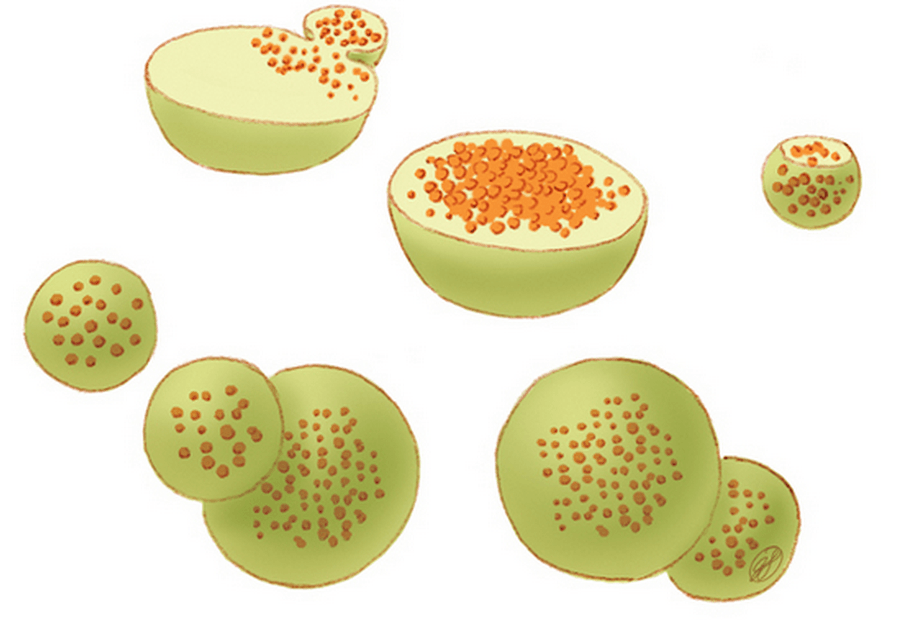
What do you call the tiny cell structures inside a cell that carry out a specific function within the cell?
Biomolecules
Organelles
Cells
Atoms
What do you call the eukaryotic cells that do not have a cell wall and are only surrounded by a cell membrane?
Plant Cells
Animal Cells
Bacteria Cells
Viral Cells
Which type of cells have a membrane bound nucleus and membrane bound organelles?
Eukaryotic Cells
Prokaryotic Cells

Each body cell in a human contains the same DNA, but heart cells and liver cells have different functions. Why is this true?
Heart tissue develops before liver tissue.
Liver tissue develops before heart tissue.
When heart cells divide, mutations typically occur.
Heart cells express different genes than liver cells.
Which explanation describes how cells are differentiated in multicellular organisms?
All genes are always working, but repressor proteins control what tRNA is formed by mRNA
All genes are always working, but chemicals in the cell stop some proteins from forming
All cells have the same genes, but the age of the cell will determine which genes are active
Genes are turned on and off at various times of the cell's life, creating only certain proteins in the cell
Which example best shows how different cells have specialized functions?
In an octopus, cells divide repeatedly to reform a lost tentacle.
In a human, the red blood cells lack nuclei and help to transport oxygen.
In a bacterium, a single cell removes waste products and aids in cell division.
In a plant, xylem cells transport water, and phloem cells transport food.
Which statement best distinguishes stem cells from other body cells?
Stem cells are any body cells, such as mature red blood cells, that lack DNA.
Stem cells are unspecialized cells that are able to differentiate into various cell types.
Stem cells are cells that have temporarily differentiated into specialized cells.
Stem cells are cells in multicellular organisms that are unable to perform cell division.
Which statement is true for specialized cells?
They have the ability to differentiate into new cells.
Bone marrow and adult stem cells are examples.
Stem cells are formed when specialized cells reproduce.
Their function is determined by the gene expressed.
Stem cells have the ability to divide and form one or more different types of cells. What is the name of this process of specialization that forms different types of cells?
cytokinesis
differentiation
reorganization
transformation
The diploid number of chromosomes for human skin cells is 46. If the cells undergo mitosis, what will be the diploid number of chromosomes in the new skin cells?
12
23
46
92
Which statement about mitosis is true?
Each daughter cell has one full set of identical chromosomes.
Each daughter cell has one full set of different chromosomes.
Each daughter cell has one half of a set of identical chromosomes.
Each daughter cell has one half of a set of different chromosomes.

The diagram represents the mitotic division of a cell. Which statement describes the resulting daughter cells?
The daughter cells will be genetically identical to each other, and they will contain exactly half of the genetic information of the original cell.
The daughter cells will be genetically different from each other as well as genetically different from the original cell.
The daughter cells will be genetically identical to each other as well as genetically identical to the original cell.
The daughter cells will contain all the genetic information of the original cell, but the genes will be reordered resulting in genetic differences between the two cells.

What does mitosis produce?
four (4) diploid cells
two (2) haploid cells
four (4) haploid cells
two (2) diploid cells
Division of the cells nucleus
5% of the cells life cycle
Prophase
Interphase
Mitosis
Anaphase

95% of the cells life cycle
Stage where DNA is copied
Interphase
Metaphase
Telophase
Prophase

Nuclear membrane disappears
Chromosomes can now be seen
Centrioles move to opposite sides
Metaphase
Interphase
Telophase
Prophase

Chromosomes line up at the equator of the cell
Spindle fibers extend from the centrioles to the middle of the chromosomes
Prophase
Metaphase
Anaphase
Interphase

Chromatids separate
Anaphase
Metaphase
Prophase
Telophase

Nuclear membrane reforms around the new daughter cells.
Cytoplasm begins to "pinch" in.
Anaphase
Metaphase
Telophase
Interphase

Two replicated cells split from each other and are able to move on their own.
Metaphase
Prophase
Cytokinesis
Telophase
What is the correct hierarchy of cells?
tissues-cells-organ systems-organs-organisms
cell-organisms-tissues-organs-organ systems
cells-tissues-organs-organ systems-organisms
organs-tissues-cells-organ systems-organisms

this organelle makes ATP.
chloroplast
mitochondria
ribosome
nucleolus

Stores food and water like a refrigerator for the cell
Chloroplast
Vacuole
Lysosome
Cytoplasm


What type of biomolecule contains carbon, hydrogen, oxygen, and nitrogen?
carbohydrate
lipid
nucleic acid
protein

The biomolecule that holds an organism's genetic information is called ___________.
carbohydrate
lipid
nucleic acid
protein
Which of the following is the correct pair of biomolecules and their monomers?
Carbohydrate: Fatty Acids
Protein: Amino acid
Lipid: Nucleotide
Nucleic Acid: DNA
Which of the following is a monosaccharide?
Chitin
Sucrose
Starch
Glucose
Cholesterol is a/an...
carbohydrate
lipid
protein
nucleic acid
Enzyme is a/an...
carbohydrate
lipid
protein
nucleic acid
takes over the cell's functions.

Prokaryotes are the _________ of all the cells.
most complext
raddest
prettiest
simplest
Students are observing particles moving against the concentration gradient in a lab investigation. Which type of transport are they observing?
osmosis
active Transport
facilitated diffusion
diffusion
Students are observing particles moving with the concentration gradient in a lab investigation. Which type of transport are they observing?
using pumps to move things quickly
passive transport
osmosis
endocytosis

This picture shows molecules of red dye that have moved. What is this type of movement called?
Osmosis; the water molecules are moving from high concentration to low
Diffusion; the dye molecules are moving from low to high concentration
Diffusion; the dye molecules are moving from high to low concentration.
Facilitated diffusion; because the molecules are moving through a protein channel.
The cell membrane is responsible for allowing molecules to diffuse into or out of the cell. What type of movement is diffusion?
Passive transport
Active transport
The cell membrane needs to use energy to move molecules quickly out of the cell through a pump. What type of transport is this?
Passive transport
Active transport
Passive transport is when molecules move ________ the concentration gradient.
against
up
down
with
Enzymes are an example of
Lipids
Carbohydrate
Protein
Nucleic Acid

Select all parts of the cell theory. (select multiple answers)
cells come from other cells
all life is composed of cells
every cell has a nucleus
cells are the basic unit of organization for living things
all cells have mitochondria
an unidentified cell under a microscope contains a nucleus. you know that this cannot be an example of this type of cell because of this.
prokaryotic cell
eukaryotic cell
plant cell
animal cell
which organisms have the organelle that allows them to go through cellular respiration? (select all that apply)
an animal cell
a plant cell
a bacterial cell
what do plant cells contain that animal cells do not? (select all that apply)
chloroplast
mitochondrion
cell wall
cell membrane
large, central vacuole

what are the yellow circles on the diagram made out of and how do they react to water?
phosphate heads, hydrophilic
phosphate heads, hydrophobic
lipid tails, hydrophobic
lipid tails, hydrophilic

the blue segments of this diagram are used for all of the following (select all that apply)
facilitated diffusion
active transport
simple diffusion
osmosis

this diagram is an example of
simple diffusion
facilitated diffusion
active transport
osmosis
the sodium-potassium pumps in animal cells pump potassium into the cell from an area of low concentration to an area of higher concentration. this is an example of
active transport
facilitated diffusion
simple diffusion
osmosis

equilibrium will be achieved in relation to the small, blue particles by ____________. However, in relation to the large, white particles _____________ will help achieve equilibrium.
osmosis, diffusion
diffusion, diffusion
diffusion, osmosis
osmosis, osmosis
which parts of the cell membrane are hydrophilic?
phosphate heads
lipid tails
both
neither

the environment that the middle cell is in would be classified as
hypertonic
hypotonic
isotonic
all of these
none of these
if a cell with 20% sodium is placed into a solution with 25% sodium. the solution is said to be ____________. (hint: which direction is the water going to move)
hypertonic
hypotonic
isotonic
impossible to tell
the fatty acid tails that make up the interior of the cell membrane are hydrophobic because
the bonds are non-polar so they won't be attracted to the polar water molecules
the bonds are polar so they won't be attracted to the non-polar water molecules

the particles in this diagram are too large to pass through the semipermeable membrane, so water moves across instead to achieve equal concentrations on both sides. this is an example of
simple diffusion
facilitated diffusion
osmosis
active transport
all of these
select all of the following (multiple answers are correct) that would be able to pass through the cell membrane WITHOUT the use of ATP. (think about the cellular energy unit and what needs to get in and out of the cell without energy input)
oxygen
carbon dioxide
water
polar amino acids

some of the red blood cells observed under this microscope have lysed. this is because they were placed in a ___________ solution and had a net _______ of water
hypotonic, gain
hypertonic, gain
hypotonic, loss
hypertonic, loss

a bacteria cell might receive its food through
endocytosis
exocytosis
EVERY cell (prokaryotic and eykaryotic) has (select all that are true)
ribosomes
cypoplasm
cell membrane
cell wall
DNA

this cell must be
a prokaryotic cell
a plant cell
an animal cell
could be either a plant OR an animal cell
ATP is required for which of the following?
Facilitated Diffusion
Exocytosis
Osmosis
Simple Diffusion
Which answer best describes what the cell membrane is made of?
Phospholipids
Proteins
Nitrogen
Glycogen
Osmosis is....
the diffusion of water.
the movement of water from low water concentration to high water concentration.
a process that requires ATP.
a form of active diffusion.
What is the function of the golgi body?
package and modify proteins
synthesize proteins
intracellular digestion
ATP production
Chromatin can be described as....
a threadlike material composed of DNA and proteins.
an extracellular matrix that supports the cell.
the organelle responsible for intracellular transport.
a semipermeable membrane that allows "things" in and out of the cell.

Label B
cell membrane
ribosome
lysosome
mitochondria


Particle of movement from an area of lower concentration to an area of higher concentration.
Active transport
Passive transport

Which type of diffusion is represented?
Facilitated diffusion
Osmosis
Diffusion
Which type of solution has the same solute concentration inside of and outside of the cell?
Hypertonic
Hypotonic
Isotonic

The cell shrunk in size, which means it was placed in a ____ solution.
Isotonic
Hypertonic
Hypotonic

The cell expanded in size to the point of lysing (bursting), which means it was placed in a ____ solution.
Isotonic
Hypertonic
Hypotonic

The cell shows water moving in and out equally, which means it was placed in a ___ solution.
Isotonic
Hypertonic
Hypotonic
takes over the cell's functions.
Prokaryotes are the _________ of all the cells.
most complext
raddest
prettiest
simplest
Which of the following is not under the Cell Theory?
Cells are the basic unit of life
All organisms are made up of cells
Cells came from other cells
A cell is an indestructible particle
PROKARYOTIC cells do NOT have
membrane bound organelles
cell membrane
DNA
ribosomes

This cell is a(n)
prokaryote
eukaryote
Which type of cells have DNA?
Eukaryote
Prokaryote
Both

He stated that new cells came from pre-existing cells.
Robert Hooke
Matthias Schleiden
Rudolf Virchow
Anton Van Leeuwenhoek
Prokaryotes contain ____ in their cell walls.
murein
protein

tures
body structures
insulation
tures
hormones/ transport/ enzymes
sacch
aride rings
sacharid: protein
sacc
harid: poly
sacc
haride

lyceride)
sacch
aride

sacch
aride
sacch
aride

sacch
aride

hydrate
sacc
aride

View Figure 3 (if not visible)


Select all that are raw materials for Photosynthesis.
Water
Carbon Dioxide
Oxygen
Sunlight (Light Energy)
Glucose (Sugar/food)
Select all that are products of Photosynthesis.
Water
Carbon Dioxide
Oxygen
Sunlight (Light Energy)
Glucose (Sugar/food)
Exit: Carbon dioxide
Exit: Glucose
Exit: Oxygen
Exit: Water vapor
What is the pigment in chloroplasts that performs photosynthesis?
Chlorosynthesis
Chlorophyll
Chloroplast
Green
What role does NADPH play in cellular respiration
It is long term energy storage
it is a high-energy hydrogen carrier
it breaks down glucose
it is an enzyme
what are the products of the light reactions
thylakoid
oxygen
ATP
NADPH
what are the inputs of the calvin cycle?
NADPH
ATP
CO2
H2O
chlorophyll
The two components of a virus are nucleic acid and __________.
protein
carbohydrates
lipids
glucose
A virus is
living
non living
dead
What structure determines the shape of the virus?
capsid
nucleic acid
spikes
envelope
True or False: The shape is important because it allows the virus to recognize and attach to the host cell.
True
False
Viruses need a ____________ in order to make copies of themselves.
bacterial cell
host cell
capsid
vaccine
Virus' genetic information contains the code to:
make copies of itself
obtain and use energy
reproduce
grow and develop
Which cycle kills the host cell immediately?
Lytic
Lysogenic
When viral DNA integrates with host cell DNA, this is called a:
capsid
bacteriophage
retrovirus
provirus
During which cycle does a virus's genetic information become a part of the host cell's genetic information?
Lytic
Lysogenic
A virus that goes through the ______ cycle will allow you to feel symptoms immediately due to the cells lysing.
Lytic
Lysogenic
A virus that hides within the host cell for up to years is going through the _______ cycle.
Lytic
Lysogenic
Antibiotics ________ treat viral infections.
can
cannot
One you are infected with a virus, you can only treat the symptoms.
True
False
Vaccines are a preventative measure.
True
False
When given a vaccine, your body recognizes it as an invader and builds _________ against the virus.
lysogens
capsids
antibodies
immunoglobulins



