Wayground logo

Free Printable Worksheets

Font size

S
M
L
XL
Worksheets

Human Population Trends

Total questions: 15

Worksheet time: 31mins

Name
Class
Date
1.

The study of population is

a)

survivorship

b)

demography

c)

age structure

d)

migration

2.

The distribution of ages in a specific population

a)

age structure

b)

infrastructure

c)

life expectancy

d)

demographic transition

3.

Movement of individuals into or out of a population.

a)

demographic transition

b)

infrastructure

c)

urbanization

d)

migration

4.
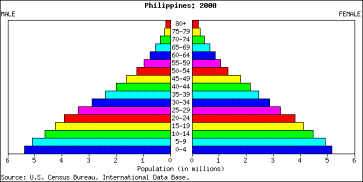
According to the population pyramid of this country, its population is most likely...
a)
growing slowly.
b)
growing rapidly.
c)
decreasing.
d)
not changing.
5.

Name the type of pyramid in the picture.

a)

slow growth

b)

rapid growth

c)

zero growth

d)

negative growth

6.
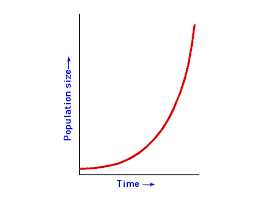
What type of growth is shown in the diagram?
a)
exponential growth
b)
logistic growth 
c)
predator-prey cycle
d)
boom-bust curve
7.
Individuals of a population who move into an area.
a)
Immigration
b)
Emigration
c)
Litigation
d)
Mastication
8.

What does the term carrying capacity describe?

a)

The maximum number of birth rates for a population.

b)

The ability of a population to accept new immigrants.

c)

The ratio of birth rates to death rates in a population.

d)

The population size that the environment can sustain.

9.
What is the carrying capacity of the following graph?
a)
1000
b)
8000
c)
800
d)
600
10.

Which of the following is a density-dependent limiting factor?

a)

human activities

b)

unusual weather

c)

competition

d)

natural disaster

11.
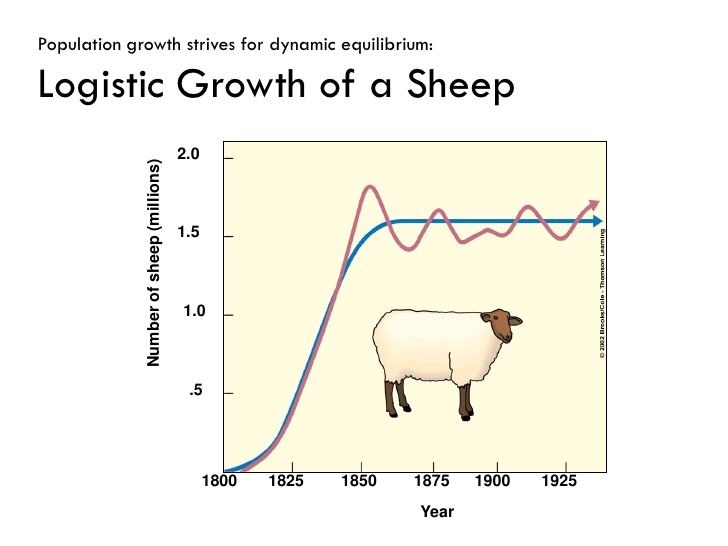
What is the carrying capacity for this sheep population?
a)
1.8 million
b)
1.25 million
c)
1.6 million
d)
1.o million
12.
When a population grows past the ecosystem's carrying capacity, what happens to the population?
a)
Continues to grow
b)
The population starts to die off to return to carrying capcity
c)
The population will go extinct due to lack of resources
d)
The population grows then finds a new carrying capacity
13.

How do you calculate the natural increase of a population?

a)

You divide the death rate by the life expectancy

b)

You multiply the death rate by the life expectancy

c)

You subtract the death rate from the birth rate

d)

You add the death rate to the birth rate

14.

Today the human population of Earth is

a)

more than 10 billion

b)

more than 6.7 billion

c)

less than 7 million

d)

less than 9.9 million

15.
The amount of babies born per 1000 in a population
a)
death rate
b)
birth rate
c)
immigration 
d)
emigration