wayground logo

Free Printable Worksheets

Font size

S
M
L
XL
Worksheets

Honors: Evolution II Test Review

Total questions: 27

Worksheet time: 16mins
Name
Class
Date
1.
In Sickle Cell Anemia, which protein is affected by a mutation?
a)
Insulin
b)
Hemoglobin
c)
Glucagon
d)
Red blood cell
2.
Some organisms that share a common ancestor have features that have different functions, but similar structures.  These are known as
a)
vestigial structures
b)
analogous structures
c)
homologous structures
d)
fossil structures
3.

Evolved from different ancestors, but due to living in similar environments have a similar function.

a)

Homologous structures

b)

Analogous structures

c)

Vestigial structures

d)

All of the above

4.

The following picture denotes

a)

Selective Breeding

b)

Convergent Evolution

c)

Divergent Evolution

d)

Natural Selection

5.

Tall kelp have a distinct advantage over shorter kelp in receiving needed sunlight in their ocean environment

a)

directional selection

b)

disruptive selection

c)

stabilizing selection

d)

sexual selection

e)

artificial selection

6.
What is a mass extinction?
a)
When all the species in a particular area on earth suddenly go extinct
b)
When multiple species from all over the earth suddenly go extinct 
c)
When one species goes extinct due to habitat changes
d)
When all life on earth is wiped out 
7.
Describes a patter of long, stable periods interrupted by brief periods of more rapid change
a)
convergent evolution
b)
coevolution
c)
punctuated equilibrium
d)
adaptive radiation
8.
A single species that has evolved into several different forms that live in different ways has undergone
a)
adaptive radiation.
b)
coevolution.
c)
punctuated equilibrium.
d)
mass extinction.
9.
In convergent evolution, organisms share physical similarities because they 
a)
have a common ancestor
b)
live in similar environments
c)
develop homologous structures
d)
are closely related 
10.

What pattern of evolution occurs when 2 different species evolve together b/c they rely on each other?

a)

divergent evolution

b)

convergent evolution

c)

co-evolution

d)

endosymbiosis

11.
The flowers of pink tulips open in the morning, while the flowers of lavender tulips open in the early afternoon. The bees that pollinate these tulips cannot carry pollen back & forth between the two types of tulips because of their flowers being closed at different times of day. What type of reproductive barrier is this?
a)
behavioral isolation
b)
hybrid sterility 
c)
temporal isolation
d)
mechanical isolation 
12.

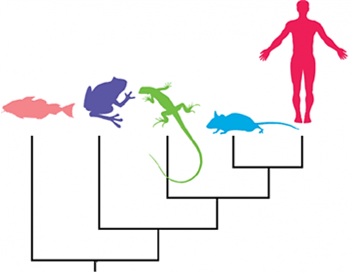
According to this phylogenetic tree, which creature is the least related out of all pictured?

a)

Fish

b)

Frog

c)

Salamander

d)

Human

13.

Which group of animals on this tree are most closely related to birds?

a)

Saurischian dinosaurs

b)

Ornithischian dinosaurs

c)

Crocodiles

d)

None of these are related to birds

14.
Some salmon have adapted to be both male and female at the same time. Why would this provide an evolutionary advantage for the fish?
a)
It reduces the importance of size among salmon, allowing smaller fish to reproduce as often as larger fish.
b)
It reduces the competition between males which eliminates the need for mating rituals.
c)
It allows them to conserve energy for the rigorous swim from the ocean upstream to mate.
d)
It allows them to reproduce with any other salmon which increases the chance of mating.
15.
Which Hardy-Weinberg factor represents the frequency of heterozygous individuals in a population?
a)
p2
b)
2pq
c)
q2
d)
p2 + 2pq
16.
Genetic drift is likely to be seen in a population
a)
That has a low mutation rate
b)
In which natural selection is occurring
c)
That is very small
d)
For which environmental conditions are changing
17.
In the Hardy-Weinberg Equation, q2 is the frequency of what?
a)
The recessive allele 
b)
the dominant allele
c)
the recessive genotype
d)
the dominant genotype
18.

The allele frequency of p=.20 What is q?

a)

.80

b)

.04

c)

.32

d)

.64

19.
A population of 150 individuals has an allele frequency of 0.3 for the dominant allele (B) and a frequency of 0.7 for the recessive allele (b). Use the Hardy-Weinberg equation to determine the frequency of the genotype (bb).
a)
0.09
b)
0.42
c)
0.49
d)
0.21
20.
Determine the expected numbers of organisms with genotype BB if the frequencies are as follows in a population with a total size of 150: f(BB)=0.16, f(Bb)=0.48, and f(bb)=0.36. 
a)
24
b)
72
c)
54
d)
150
21.
What is the best explanation for a population being described as an evolutionary unit?
a)
Population can evolve, not individuals
b)
Natural selection only involves individuals, not populations
c)
Genetic changes only occur in populations
d)
A population's gene pool remains the same throughout time
22.

Can be TREATED with ANTIBIOTICS

a)

Bacteria

b)

Virus

23.
Which of the following correctly describes viruses?
a)
non-living because they grow and develop
b)
living because they can use energy
c)
non-living because they cannot reproduce on their own
d)
living because they can maintain homeostasis
24.

Viruses are surrounded by a protein coat known as a

a)

Capsid

b)

Capsule

c)

Enzyme

d)

Nucleotide

25.

Contain ribosomes

a)

Viruses

b)

Bacteria

c)

Both viruses and bacteria

26.

Which of these statements are true

a)

Viruses can have DNA or RNA

b)

Bacteria has DNA

c)

Viruses have only DNA

d)

Both Viruses and Bacteria can reproduce asexually

e)

Viruses need a host to reproduce

27.

Which of the following is a risk of improperly using antibiotics to treat infections?

a)

Bacteria may become resistant to antibiotics.

b)

Antibiotics increase the rate of infection.

c)

Antibiotics cause other diseases to develop.

d)

Antibiotics only work once.