
 Worksheets
Managerial Economics Revision
Total questions: 55
Worksheet time: 2hrs 1mins
Scarcity is a condition that exists when
there is a fixed supply of resources relative to the demand for the product.
there is a large demand for a product.
resources are not able to meet the entire demand for a product.
All of the above
Select the group that best represents the basic factors of production.
land, labor, capital, technology
land, labor, money, management skills
land, natural resources, labor, capital
land, labor, capital, entrepreneurship
The economic concept of "opportunity cost" is most closely associated with which of the following management considerations?
market structure
product demand
resource scarcity
technology
________ risk involves variation in returns due to the ups and downs of the economy, the industry and the firm.
business
structural
fluctuational
financial
Unlike an accountant, an economist measures costs on a(n) ________ basis.
replacement
explicit
historical
conservative
If OPEC increases its price of oil, and still the demand for oil decreases by a very small amount, we can conclude that the demand for oil is
relatively inelastic.
relatively elastic.
perfectly elastic.
perfectly inelastic.
Suppose the price of beans rises from $1.00 a pound to $2.00 a pound, quantity falls from 10 units to 6 units. In this example, the demand for beans is said to be
relatively elastic.
perfectly elastic.
perfectly inelastic.
relatively inelastic.
If the income elasticity of a particular good is negative 0.2, it would be considered
an inferior good.
a superior good.
a normal good.
an elastic good.
The marginal product of the variable input
is always positive.
typically falls then rises.
is equal to the total product divided by the total amount of the variable input employed.
None of the above
Which of the following markets comes closes to the model of perfect competition?
automobile industry
agriculture
aerospace industry
information technology industry


The law of variable proportions is said to exist when
there are only two variable factors
there is a fixed factor and a variable factor
all factors are variable
The law of variable proportion examines the production function
is a long run production function
with one fixed factor
keeping all factors variable
with one factor variable, while keeping the other factors fixed
When MP is zero
TP is maixmum
TP starts falling
AP becomes negative
TP is zero
Which stage represents the range of rational production decision?
Stage III
Stage I
Stage II
_____________ is a function of inputs.
Raw Materials
Output
Production Function
Labour
________ an addition to the total production by the employment of an extra unit of a factor.
Average Product
Total Product
Marginal Product
Output
When more units of a factor are employed for producing a commodity , the average product first ______ then _______.
falls,rises
rises,falls
the period of time in which plant capacity can be varied is known as:
short run
long run
When MP is negative
TP is maixmum
TP starts falling
AP becomes negative
TP is zero
According to the law of diminishing returns:
the total product of an input will eventually be negative.
the marginal product of an input will eventually be negative.
the marginal product of an input will eventually decline.
the total product of an input will eventually decline.
none of the above
a production function:
Gives the minimum level of output that can be produced from a combination of inputs
Gives the different levels of output that can be produced from a combination of inputs
Gives the maximum level of output that can be produced from a combination of inputs
All of the above
Which of the following is an example of a variable factor?
Permanent labour which remains employed at all levels of output
Land on which the factory is located
Machinery which does not change easily
None of the above
identify the phase in which TP increases at an increasing rate and MP also increases.
increasing returns to a factor.
decreasing returns to a factor
negative returns to a factor.
Tools, machines, etc. are included in-
fixed capital
circulating factor
sunk factor
human capital
A short run production function is one in which-
at least one factor is fixed
at least one factor is variable
all factors are fixed
all factors are variable
Identify the two cost curves which start from the same point on the Y-axis.
TVC and TFC
TFC and TVC
TFC and TC
TFC and AFC
The cost curve, which is inversely S-shaped is:
Average cost curve
Total fixed cost curve
Total variable cost curve
Marginal cost curve
Marginal cost refers to addition to the total cost when one more unit of output is.........
Wasted
Produced
Employed
Sold
MC can be directly derived from:
TFC
TVC
AC
AFC
Average fixed costs:
Remain same at all levels of output
Increase as output increases
Decreases as output increases
Initially increases and then decreases
Cost function is a ________concept:
Economical
Functional
Financial
Technical
Area under MC curve is equal to:
TVC
AFC
AVC
AC
MC curve intersects AC curve at its _____point and AVC curve at its ________point.
Maximum, minimum
Minimum, minimum
Minimum, Maximum
Maximum, maximum
AVC can fall even when MC is rising, provided:
MC<AVC
MC>AVC
MC=AVC
None of these
When the price of good X is $5, the consumer buys 100 units of good X. At what price would he be willing to purchase 140 units of good X? The price elasticity of demand for good X is 2.
The demand for a good at $10 per unit is 40 units. Price falls by $5. If price elasticity of demand is (-) 3, calculate the new quantity demanded.
The quantity demanded of a commodity at a price of $8 per unit is 600 units. Its price falls by 25% and the quantity demanded rises by 120 units. Calculate the price elasticity of demand. Is its demand elastic? Give reason for your answer.
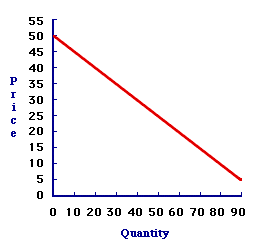
In case of downward sloping straight line curve, the coefficient of elasticity at the intercept of the demand curve on the X-axis is equal to:
Zero
More than one
One
Infinity
If there is no change in demand for commodity 'X', even after rise in its price, then its demand is:
Perfectly elastic
Perfectly inelastic
Less elastic
Highly elastic
Sam spent $5,000 on a commodity and bought 25 units of it. When its price changed, he spent $6,000 and bought 20 units. The elasticity of demand by total expenditure method will be:
Ed<1
Ed=1
Ed>1
Ed=0
A 5% fall in the price of X leads to a 10% rise in its demand. In case of Good Y, a 2% rice in price leads to a 6% fall in its demand. In the given case,_____is more elastic.
X
Y
Both X and Y are equally elastic.
Both X and Y are inelastic.

