wayground logo

Free Printable Worksheets

Font size

S
M
L
XL
Worksheets

Revision

Total questions: 144

Worksheet time: 11hrs 30mins
Name
Class
Date
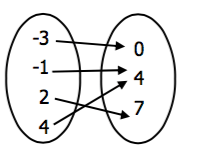
1.
Is this mapping a function or not a function? 
a)
Function
b)
Not a Function 
2.
Is this table a function or not a function? 
a)
Function
b)
Not a Function
3.
Is this graph a function or not a function? 
a)
Function
b)
Not a Function
4.
Which set of values is a function?
a)
(9,5) (10,5) (9,-5) (10,-5)
b)
(3,4) (4,-3) (7,4) (3, 8)
c)
(6,-5) (7, -3) (8, -1) (9, 1)
d)
(2, -2) (5, 9) (5, -7) (1, 4)
5.
Find the value of y when x = 2.
a)
2
b)
6
c)
7
d)
8
6.
Find the value of y when x = 2.
a)
2
b)
6
c)
7
d)
8
7.

What does "m" represent in y=mx+b?

a)

y-intercept

b)

slope

c)

x-intercept

d)

standard form

8.
1.)  Simplify
 (2a2b4z)(6a3b2z5)
a)
8a5b6z6
b)
12a6b8z5
c)
12a5b6z6
d)
8a6b8z5
9.
(2ab)3
a)
23a3b3
b)
2ab3
c)
6a3b3
d)
6ab
10.
(53x2y4)0
a)
5xy
b)
1
c)
0
d)
5
11.
Write the product using exponents.
a)
7m3
b)
(7m)3
c)
49m3
d)
72m3
12.

(-2u2)(6u6)

a)

-12u8

b)

-12u12

c)

4u8

d)

4u12

13.
a)

x11

b)

x18

c)

x-7

d)

x7

14.
According to exponent rules, when we raise an exponential expression to a power we _______ the exponents.
a)
add
b)
subtract
c)
multiply
d)
divide
15.
According to exponent rules, when we multiply exponential expressions we _______ the exponents.
a)
add
b)
subtract
c)
multiply
d)
divide
16.
According to exponent rules, when we divide the expressions we _______ the exponents.
a)
add
b)
subtract
c)
multiply
d)
divide
17.

Simplify the radical:
169\sqrt{169}  

a)

2132\sqrt{13}  

b)

13213\sqrt{2}  

c)

131313\sqrt{13}  

d)

1313  

18.

Explain why the radical expression is or is NOT in simplified form?

a)

The expression is simplified because the radicand contains no fractions

b)

The expression is simplified because the radicand has no​ perfect-square factors other than 1.

c)

The expression is not in simplified form because a radical appears in the denominator of a fraction.

d)

The expression is not simplified because it contains a fraction.

19.
The square roots of all perfect squares are___________?
a)
integers or whole numbers
b)
irrational
c)
fractions
d)
divisible by 2
20.
Find the sum.
(2x2 + 5x - 7) + ( 3 - 4x2 + 6x)
a)
2x+ 3x +1
b)
-2x- 11x -4
c)
2x2 + 5x -7
d)
-2x2 + 11x -4
21.
(4x3-5x2+3x)+(-2x3-x2+6x)
a)
2x3-6x2-9x
b)
2x3+6x2+9x
c)
-2x3-6x2+9x
d)
2x3-6x2+9x
22.
(5x- 4x- 2x2 + x - 19) - (x+ 5x3 + 8x2 + x + 5)
a)
4x- 9x- 10x- 24
b)
4x- 9x3 - 10x- 2x - 24
c)
4x4 - 9x3 - 10x2 + 2x - 24
d)
-4x4 - 9x3 - 10x2 - 24
23.
Is b + 8 a monomial?
a)
yes
b)
no
24.

What is the degree of the polynomial? 5x5 - 6x6 + 2

a)

1

b)

5

c)

6

d)

11

25.

Which of the following are examples of like terms?

a)

2 and 2x

b)

y3 and x3

c)

y and x

d)

-3x and 3x

26.
Add the polynomials.
(2x + 5y) + (3x - 2y)
a)
3x + 5y
b)
5x + 3y
c)
5x + 7y
d)
7xy + 1xy
27.
Add the polynomials.
(3x3 + 3x2 – 4x + 5) + (x3 – 2x2 + x – 4)
a)
4x3 + 1x2 – 3x + 1
b)
2x3 + 1x2 - 5x + 9
c)
6x3 + 1x - 1x2 - 3
d)
3x5 +1x - 1x5 - 3x
28.
What is the correct name of the following:
3x + 5y2 - 3
a)
monomial
b)
binomial
c)
trinomial
d)
polynomial
29.

What is the standard form of the polynomial,

9x2 + 5x + 27 + 2x3

a)

27 + 5x + 9x2 + 2x3

b)

9x2 + 5x + 2x3 + 27

c)

9x2 + 5x + 27 + 2x3

d)

2x3 + 9x2 + 5x + 27

30.

What is the standard form of the polynomial,

7x - 125 - 6x4 + 14x2

a)

125 + 7x - 14x2 +6x4

b)

6x4 -14x2 - 7x +125

c)

125 + 14x2 + 7x - 6x4

d)

-6x4+ 14x2 + 7x - 125

31.
Find the difference. 
(3- 2x + 2x2) - (4x -5 +3x2)
a)
x2 + 6x + 8
b)
2x+ 5x - 7
c)
-x2 -6x + 8
d)
-2x2 + 11x - 4
32.
Simplify each expression.
(6b3 + 6 - b4) - (8b3 - 6b4 + 2)
a)
4b4 - 2b3 + 7
b)
5b4 - 2b3 + 4
c)
b4 - 2b3 + 7
d)
5b4 - 2b3 + 7
33.
(3x + 4y - 3z) - (2x - 6y + 7z)
a)
x + 10y - 10z
b)
-x +10y - 10z
c)
x -10y - 10z
d)
-x -10y - 10z
34.
Which of the following are examples of like terms?
a)
2 and 2x
b)
yand x3
c)
y and x
d)
-3x and 3x
35.
Add the polynomials.
(2x + 5y) + (3x - 2y)
a)
3x + 5y
b)
5x + 3y
c)
5x + 7y
d)
7xy + 1xy
36.
What is the standard form of the polynomial,
 9x2 + 5x + 27 + 2x3
a)
27 + 5x + 9x2 + 2x3
b)
9x2 + 5x + 2x3 + 27
c)
9x2 + 5x + 27 + 2x3
d)
2x3 + 9x2 + 5x + 27
37.
Find the sum.
(3x3 + 3x2 – 4x + 5) + (x3 – 2x2 + x – 4)
a)
4x3 + 1x2 – 3x + 1
b)
2x3 + 1x2 - 5x + 9
c)
6x3 + 1x - 1x2 - 3
d)
3x5 +1x - 1x5 - 3x
38.

Combine like terms:

8x3y + 3x2y + 4xy + 5x2y + 2xy + 7x2y

a)

8x3y + 8x2y + 2xy

b)

11x3y + 15x2y + 8xy

c)

8x3y + 15x2y + 6xy

d)

23x2y + 6xy

39.
(3x + 4y - 3z) - (2x - 6y + 7z)
a)
x + 10y - 10z
b)
-x +10y - 10z
c)
x -10y - 10z
d)
-x -10y - 10z
40.
Which of the following are examples of like terms?
a)
2 and 2x
b)
yand x3
c)
y and x
d)
-3x and 3x
41.
Add the polynomials.
(2x + 5y) + (3x - 2y)
a)
3x + 5y
b)
5x + 3y
c)
5x + 7y
d)
7xy + 1xy
42.
What is the standard form of the polynomial,
 9x2 + 5x + 27 + 2x3
a)
27 + 5x + 9x2 + 2x3
b)
9x2 + 5x + 2x3 + 27
c)
9x2 + 5x + 27 + 2x3
d)
2x3 + 9x2 + 5x + 27
43.
Subtract: (2a2 + 5a + 3) -(a2 - 3a - 4)
a)
3a2 + 2a - 1
b)
a+ 8a + 7
c)
3a+ 8a + 7
d)
a2 + 2a - 1
44.

Combine like terms:

8x3y + 3x2y + 4xy + 5x2y + 2xy + 7x2y

a)

8x3y + 8x2y + 2xy

b)

11x3y + 15x2y + 8xy

c)

8x3y + 15x2y + 6xy

d)

23x2y + 6xy

45.
Which of the following are examples of like terms?
a)
2 and 2x
b)
yand x3
c)
y and x
d)
-3x and 3x
46.
Add or Subtract to Simplify:
(4n4 - 8n + 4) - (8n2 + 4n4 + 1)
a)
-8n2 - 8n + 3 
b)
-7n2 - 8n + 3 
c)
-6n2 - 8n + 3
d)
-7n2 - 4n + 3
47.
Simplify each expression.
(4n4 - 8n + 4) - (8n2 + 4n4 + 1)
a)
-8n2 - 8n + 3 
b)
-7n2 - 8n + 3 
c)
-6n2 - 8n + 3
d)
-7n2 - 4n + 3
48.
What is the type of polynomial 3x4 + 2x2 + 5x ?
a)
monomial
b)
binomial
c)
trinomial
d)
polynomial
49.
Combine like terms to simplify:
 (5x + 2) + (4x + 5)
a)
9x -7
b)
-9x-11
c)
9x+7
d)
x+7
50.
3a(5a2 + 8a + 2)
a)
15a3 + 24a2 + 6a
b)
10a3 + 24a + 6
51.
5x(4x3 + 8)
a)
9x4 + 40x
b)
20x4 + 40x
52.
3x(2x2 + 9x + 6)
a)
6x3 + 27x2 + 18x
b)
6x3 + 18x2 + 9
53.
7y(5y2 + 2y + 3)
a)
35y3 + 14y2 + 21y
b)
12y3 + 14y2 + 21y
54.
4m(3m7 + 2m5)
a)
7m7 + 6m6
b)
12m8 + 8m6
55.
-2x(5x2 + 8)
a)
-10x3 -16x
b)
-10x2 - 16
56.
-6y(y5 + 8y)
a)
-6y6 - 48y2
b)
-6y6 - 48
57.

10(x+y+z)

a)

10x+y+z

b)

10x+10y+z

c)

10x+10y+10z

d)

10xyz

58.
-2x(5x2 + 8)
a)
-10x3 -16x
b)
-10x2 - 16
59.

2x2(x+5)

a)

2x2+5

b)

2x2+10x2

c)

2x3+5

d)

2x3+10x2

60.

10(x+y+z)

a)

10x+y+z

b)

10x+10y+z

c)

10x+10y+10z

d)

10xyz

61.
A transformation in which a graph or geometric figure is picked up and moved to another  location without any change in size or direction.
a)
Translation
b)
Rotation
c)
Reflection
d)
Dilation
62.
Determine how to translate triangle ABC to triangle A'B'C'.
a)
left 2, up 9
b)
right 2, down 9
c)
left 2, down 9
d)
left 2, up 5
63.
What transformation is happening?
(x, y) ----> (x + 2, y - 3) 
a)
slide up 2, left 3
b)
slide right 2, up 3
c)
slide right 2, down 3
d)
slide left 3, right 2
64.
When Translating an image, if you move a figure to the right , you will have _____ a number.
a)
x +
b)
x -
c)
y +
d)
y -
65.
A slide is also called a _________.
a)
Translation
b)
Reflection
c)
Rotation
d)
Transformation
66.
A turn is also called a ___________.
a)
Translation
b)
Reflection
c)
Rotation
d)
Transformation
67.
Translations, reflections and rotations are all known as ________________________.
a)
Geometry
b)
Transformations
c)
Congruent
68.
What does a translation do to an image?
a)
Turns it 90* clockwise
b)
Mirrors it
c)
Shrinks it
d)
Slides it
69.
How do you represent a translation Algebraically? 
a)
(-y, -x)
b)
(x + a, y + b)
c)
(-x , -y)
d)
(ax, by)
70.

This point is translated 3 right and 2 down. Which diagram shows the new position of the point?

a)
b)
c)
d)
71.
a)

3 up, 7 right

b)

3 left, 7 down

c)

3 right, 7 up

d)

3 down, 7 right

72.
a)

8 left and none up or down

b)

8 right and none up or down

c)

8 up and non left or right

d)

8 down and none left or right

73.
a)

2 right, 6 down

b)

2 left, 6 down

c)

2 left, 6 up

d)

2 right, 6 up

74.

How would you describe the translation of the green shape to the red shape?

a)

6 up

b)

3 right, 1 up

c)

3 up

d)

3 right, 4 up

75.
Find K' if the figure is reflected across the x-axis
a)
(4, 1))
b)
(-1, -4)
c)
(1, -4)
d)
(1, 4)
76.
Reflect the point (2, -4) over the y-axis.
a)
(-4, 2)
b)
(-2, 4)
c)
(-2, -4)
d)
(2, 4)
77.
Reflect (6, -3) over the line x-axis.
a)
(6, 3)
b)
(-6, -3)
c)
(-3, 6)
d)
(3, -6)
78.
Which answer shows a reflection across the x-axis?
a)
d
b)
c
c)
b
d)
a
79.
∆QRS contains the points: Q(4, 2) R(5, 1) S(3,7). If the triangle is reflected across the y-axis, what will S' be?
a)
S'(3, 7)
b)
S'(-3, 7)
c)
S'(-3, -7)
d)
S'(3, 7)
80.
Another name for Reflection is...
a)
flip
b)
turn
c)
slide
d)
dilation
81.
∆BCD contains the points: B(2,3) C(2,1) D(5,1). If the triangle is reflected across the x-axis, what will B' be?
a)
B'(2, -3)
b)
B'(-2, 3)
c)
B'(-2, -3)
d)
B'(2, 3)
82.
Reflect Point C over the y-axis:
a)
(-3, 2)
b)
(3,2)
c)
(-2,3)
d)
(3,0)
83.
Flipping a figures is a ...
a)
Rotation
b)
Reflection
c)
Dilation
d)
Translation
84.
Identify the transformation from ABC to A'B'C'.
a)
90o clockwise rotation
b)
90o counter clockwise rotation
c)
Reflection across the y-axis
d)
Reflection across the x-axis
85.
If you were to rotate ABCD 180°  about the origin, what would the coordinate of A' be?
a)
(-5, 5)
b)
(-3, -5)
c)
(-5, 3)
d)
(-3, 3)
86.
If you were to rotate ABCD 180° about the origin, what would the coordinates of B' be?
a)
(0, 0)
b)
(-6, -5)
c)
(-1, 3)
d)
(-6, 2)
87.
Rotate the point (-3,-4) around the origin 180 degrees. State the image of the point.
a)
(-4,-3)
b)
(-4,3)
c)
(4,-3)
d)
(3,4)
88.
What is this picture an example of? 
a)
An angle
b)
A cat vertex 
c)
Rotation 
d)
Dilation
89.
The image A'B'C' is a rotation of ABC.
a)
True
b)
False
90.
What type of rotation does this represent (from red to blue)?
a)
270⁰ clockwise
b)
360⁰
c)
90⁰ counterclockwise
d)
180⁰
91.
Triangle A is rotated 90° clockwise with the origin as the center of rotation to create a new figure. Which rule describes rotating 90° clockwise?
a)
(x,y)→(y, -x) 
b)
(x,y)→(-x,-y)
c)
(x,y)→(-y,x)
d)
(x,y)→(x,y)
92.
Triangle A is rotated 270° counterclockwise with the origin as the center of rotation to create a new figure. Which rule describes rotating 270° counterclockwise?
a)
(x,y)→(y, -x) 
b)
(x,y)→(x,y)
c)
(x,y)→(-y,x)
d)
(x,y)→(-x,-y)
93.
Triangle C is rotated 180° clockwise with the origin as the center of rotation to create a new figure. Which rule describes rotating 180° clockwise?
a)
(x,y)→(y, -x) 
b)
(x,y)→(-x,-y)
c)
(x,y)→(x,y)
d)
(x,y)→(-y,x)
94.
In a triangle, how many total degrees are there?
a)
100%
b)
180 degrees
c)
it varies
d)
360 degrees
95.
Find the measure of the indicated angle. 
a)
95
b)
85
c)
35
d)
45
96.
Find the measure of angle D.
a)
140 degrees
b)
16 degrees
c)
40 degrees
d)
90 degrees
97.
Find the missing angle.
a)
29° 
b)
39° 
c)
49° 
d)
59° 
98.
If two of the angles of a triangle are 30 and 70 degrees, the third angle measures...
a)
80
b)
100
c)
60
d)
90
99.
Find the measure of the indicated angle. 
a)
145
b)
113
c)
102
d)
78
100.
Find the measure of the indicated angle. 
a)
89
b)
211
c)
119
d)
81
101.
Solve for the missing angle with the question mark. 
a)
A
b)
B
c)
C
d)
D
102.

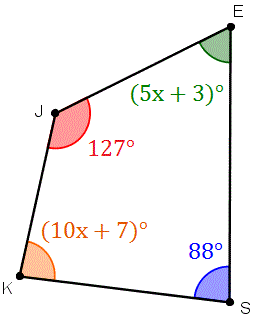
Find the value of x.

a)

A

b)

B

c)

C

d)

D

103.
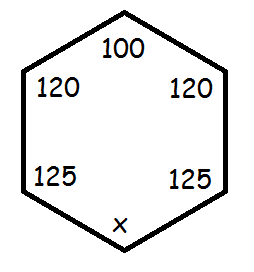
Find the value of X.
a)
100
b)
120
c)
125
d)
130
104.

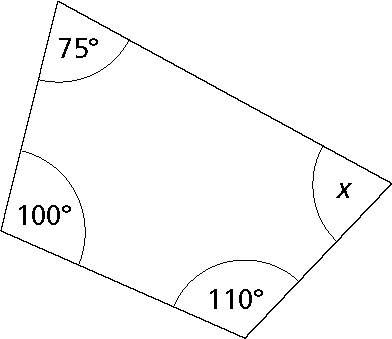
Find the missing angle.

a)

75

b)

105

c)

100

d)

70

105.

What is the measure of ONE interior angle in a regular hexagon?

a)

60°

b)

80°

c)

108°

d)

120°

106.
What is the sum of exterior angles of a pentagon?
a)
180
b)
360
c)
540
d)
760
107.
What is the measure of each interior angle of a regular octagon?
a)
135
b)
180
c)
145
d)
190
108.
The sum of the interior angles of a polygon is 1620°.  How many sides does the polygon have?
a)
8
b)
11
c)
3
d)
16
109.
The sum of the interior angles of a polygon is 3960°. How many sides does the polygon have?
a)
12
b)
24
c)
25
d)
13
110.
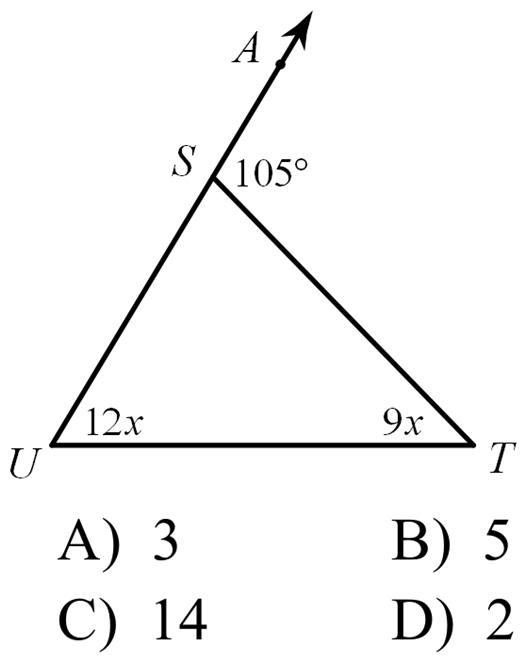
Solve for x
a)
45
b)
12
c)
90
d)
2
111.

Find the measure of the indicated angle.

a)

35

b)

17

c)

78

d)

67

112.

Find the measure of angle E.

a)

9

b)

97

c)

48

d)

79

113.

Find the measure of angle K.

a)

9

b)

97

c)

48

d)

79

114.

The measure of an interior angle of a regular polygon is 120. How many sides does the polygon have?

a)

3

b)

4

c)

6

d)

8

115.
A dilation is which of the following: 
a)
only an enlargement
b)
only a reduction
c)
Either an enlargement or a reduction
d)
Neither an enlargement or a reduction
116.

A dilation produces a congruent figure

a)

True

b)

False

117.
When a dilation has a scale factor greater than one, the dilation is an enlargement.
a)
True
b)
False
118.
When the scale factor of a dilation is less than one, the dilation is a reduction.
a)
True
b)
False
119.
Similar figures have the same ______ but different ______. 
a)
measure; shapes
b)
sizes; shapes
c)
value; measures
d)
shape; sizes
120.

State the coordinate of the image of the given point B (4,9) under a dilation with center at the origin with the given scale factor of 2.

a)

B' (2 , 4.5)

b)

B' (-8 ,-18)

c)

B' (8 ,18)

d)

B' (9 ,4)

121.
A dilation always produces a congruent figure.
a)
True
b)
False
122.
In a dilation what mathematical operation is used with the scale factor?
a)
addition 
b)
subtraction 
c)
multiplication 
d)
division 
123.
State the coordinate of the image of the given point B (-10,-6) under a dilation with center at the origin with the given scale factor k = 1/2.
a)
(5,3)
b)
(20,12)
c)
(-20,-12)
d)
(-5,-3)
124.
A dilation is which of the following: 
a)
only an enlargement
b)
only a reduction
c)
Either an enlargement or a reduction
d)
Neither an enlargement or a reduction
125.

When A(3, 6) is under a dilation of 2 what are the coordinates of A'?

a)

(3, 6)

b)

(1.5, 3)

c)

(6, 12)

d)

(12, 6)

126.

Are the triangles similar using AA Similarity? If so, which similarity statement is correct?

a)

No

b)

Yes, ΔABCΔFED\Delta ABC\sim\Delta FED

c)

Yes, ΔACBΔDFE\Delta ACB\sim\Delta DFE

d)

Yes, ΔBACΔDEF\Delta BAC\sim\Delta DEF

127.

Are the triangles similar using AA Similarity? If so, which similarity statement is correct?

a)

No

b)

Yes, ΔPQRΔZYX\Delta PQR\sim\Delta ZYX

c)

Yes, ΔPRQΔXYZ\Delta PRQ\sim\Delta XYZ

d)

Yes, ΔRPQΔZXY\Delta RPQ\sim\Delta ZXY

128.

If two figures are similar,

then the angles are _________________.

a)

proportional

b)

congruent

c)

complementary

d)

supplementary

129.

If two figures are similar,

then the sides are _________________.

a)

proportional

b)

congruent

c)

none of these

d)

equal

130.

Are the triangles similar? If so, why?

a)

No

b)

Yes, they look like it.

c)

Yes, Mrs. Wingard said so.

d)

Yes, AA Similarity

131.

Which triangle(s) are similar to Triangle A?

a)

B

b)

C

c)

Both

d)

Neither

132.
Find the value of x.
a)
7
b)
8
c)
9
d)
10
133.
Find the value of x.
a)
36
b)
12
c)
16
d)
25
134.
Find the value of x.
a)
√33
b)
√29
c)
√35
d)
√41
135.
Find the missing side
a)
48
b)
108
c)
83.6
d)
72
136.
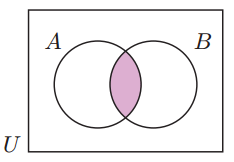
What statement does the shaded region represent
a)
A or B
b)
Not A
c)
A and B
d)
Not B
137.
A = {1, 3, 5, 7, 9}
B = {2, 3, 5, 7}
What is A ∩ B ?
a)
{3, 5, 7}
b)
{2, 3, 5, 7}
c)
{2, 3, 5, 7, 9}
d)
{1, 2, 3, 5, 7, 9}
138.
What is the P(B)?
a)
56/135
b)
52/135
c)
64/135
d)
63/135
139.
Find the probability of rolling greater than a 1 on a single die.
a)
6/6
b)
5/6
c)
4/6
d)
1/6
140.

What type of set is denoted as either { } or ∅?

a)

Superset

b)

Disjointed Set

c)

Empty (or Null) Set

d)

Subset

141.

The image represents which of the following?

a)

intersection, "and"

b)

intersection, "or"

c)

union, "and"

d)

union, "or"

142.

If A = {1, 3, 5, 7, 9} and B = {2, 3, 5, 7}, what is A ∪ B?

a)

{3, 5, 7}

b)

{2, 3, 5, 7}

c)

{2, 3, 5, 7, 9}

d)

{1, 2, 3, 5, 7, 9}

143.

If A = {1, 3, 5, 7, 9} and B = {2, 3, 5, 7}, what is A ∩ B?

a)

{3, 5, 7}

b)

{2, 3, 5, 7}

c)

{2, 3, 5, 7, 9}

d)

{1, 2, 3, 5, 7, 9}

144.
The image represents which of the following?
a)
intersection, "and"
b)
union, "or"
c)
intersection, "or"
d)
union, "and"