wayground logo

Free Printable Worksheets

Font size

S
M
L
XL
Worksheets

Final Exam Review

Total questions: 123

Worksheet time: 4hrs 30mins

Name
Class
Date
1.

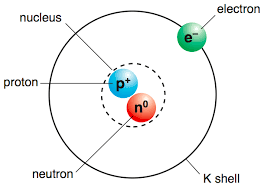
What is the middle or centre part of an atom called?

a)

Proton

b)

Neutron

c)

Electron

d)

Nucleus

2.

These particles have a positive (+) charge.

a)

Proton

b)

Neutron

c)

Electron

d)

Nucleus

3.

These particles have a negative (-) charge.

a)

Proton

b)

Neutron

c)

Electron

d)

Nucleus

4.

These particles have a neutral or no (0) charge.

a)

Proton

b)

Neutron

c)

Electron

d)

Nucleus

5.

An atom of Aluminum has 13 Protons, 14 Neutrons and 13 Electrons. How many positive (+) charges does it have?

a)

13

b)

14

c)

27

d)

0

6.
The atomic number always tells you
a)
the number of protons
b)
the number of electrons
c)
the number of neutrons
d)
the mass of an atom
7.
Atomic Mass is composed of
a)
protons and neutrons
b)
protons and electrons
c)
neutrons and electrons
8.
The two particles that affect the charge of an atom are:
a)
protons and neutrons
b)
protons and electrons
c)
neutrons and electrons
9.
The periodic table is arranged by
a)
atomic number
b)
atomic mass
c)
alphabetically
10.
If the number of electrons is changed, the atom is called
a)
an ion
b)
an isotope
c)
the name is the same
d)
you cannot change the number of electrons
11.
If the number of protons is changed, the atom is called
a)
an ion
b)
an isotope
c)
the name is the same
d)
you cannot change the number of protons
12.
If the number of neutrons is changed, the atom is called
a)
an ion
b)
an isotope
c)
the name is the same
d)
you cannot change the number of neutrons
13.
A cation is an atom that has
a)
gained protons
b)
gained electrons
c)
lost electrons
d)
lost neutrons
14.
An anion is an atom that has
a)
lost protons
b)
gained electrons
c)
lost electrons
d)
gained neutrons
15.
What atom has an atomic number of 4?
a)
Helium
b)
Lithium
c)
Potassium
d)
Beryllium
16.
What element has more protons than Neon?
a)
Helium
b)
Argon
c)
fluorine
d)
nitrogen
17.
What subatomic particles would you find in the nucleus of an atom?
a)
Protons only
b)
Protons and Neutrons
c)
Neutrons and Electrons
d)
Protons and Electrons 
18.
Which subatomic particles contribute the most to the mass of an atom?
a)
Protons, Neutrons, Electrons
b)
Protons only
c)
Protons and Electrons
d)
Protons and Neutrons
19.
The first energy level can hold up to how many electrons?
a)
8
b)
4
c)
2
d)
5
20.
As you move down the first group, reactivity _________.
a)
Increases
b)
Decreases
c)
Stays the same
d)
They are all inert
21.
Which two groups on the Periodic Table are the MOST reactive?
a)
Group 1 and Group 17
b)
Group 2 and Group 16
c)
Group 13 and Group 15
d)
Group 17 and Group 18
22.
Which group on the Periodic Table is inert?
a)
Group 1
b)
Group 2
c)
Group 17
d)
Group 18
23.
How many valence electrons are elements trying to reach in their outer shells?
a)
1
b)
2
c)
5
d)
8
24.
What determines the reactivity of an element?
a)
Size of its nucleus
b)
Number of total electrons
c)
Number of valence electrons
d)
Number of shells
25.
How do you determine the number of valence electrons an element has?
a)
Look at its period
b)
Look at its group
c)
Look at its atomic number
d)
Look at its atomic mass
26.
Atoms on which side of the Periodic Table will tend to LOSE electrons?
a)
Right
b)
Left
c)
Middle
d)
No atoms lose electrons
27.
How do bonds tend to form between metals and nonmetals?
a)
Atoms gain or lose electrons
b)
Atoms share electrons
c)
Atoms gain or lose neutrons
d)
None of the above
28.
How do bonds tend to form between nonmetals?
a)
Atoms gain or lose electrons
b)
Atoms share electrons
c)
Atoms gain or lose neutrons
d)
None of the above
29.

Where do metals come from?

a)

From rocks called ores

b)

From fibers woven together

c)

From trees

30.

Which spoon is safer to stir very hot soup with?

a)

A metal spoon

b)

A wooden spoon

c)

A paper spoon

31.
Which of these is a property of metals?
a)
It's malleable
b)
It can't conduct electricity
c)
They are used in food
d)
It's very brittle
32.
Which of these grouping of elements could have the characteristic of brittle?
a)
Metal
b)
Nonmetal
33.
Which of the following is a good conductor of heat?
a)
Metal
b)
Nonmetal
c)
Metalloid
34.
Some characteristics of a metal are that it is malleable and ductile.
a)
TRUE
b)
FALSE
35.
Iron is a good conductor, malleable and magnetic. What type of element is Iron? 
a)
Metal
b)
Nonmetal
c)
Metalloid
d)
Pretty
36.
Which elements are found on the left to middle of The Periodic Table? 
a)
Metals
b)
Nonmetals
c)
Metalloids
d)
Candles
37.
Silicon is a semiconductor and has properties of both metals and nonmetals. What type of element is Silicon? 
a)
Metal
b)
Nonmetal
c)
Metalloid
d)
Pretty
38.
Which elements are found on the right side of The Periodic Table?
a)
Metals
b)
Nonmetals
c)
Metalloids
d)
Water
39.
Which element is a metalloid?
a)
Titanium
b)
Selenium
c)
Potassium
d)
Polonium
40.
Anytime you see the word SEMICONDUCTOR - what substance do you have?
a)
Metal
b)
Nonmetal
c)
Metalloid
41.

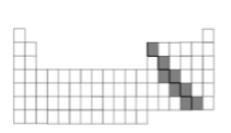
Elements in the shaded area can best be described as -

a)

Malleable

b)

Brittle

c)

Dull

d)

Insulators

42.

Elements in the shaded area can best be described as -

a)

Shiny and brittle

b)

Insulators

c)

Good conductors

43.
What type of reaction occurs between an element and a compound?
Zn + 2HCl --> ZnCl2 + H2
a)
Synthesis
b)
Decomposition
c)
Single Replacement
d)
Double Replacement
44.
What kind of reaction is this:
2H2 + O2 --> 2H2O
a)
Synthesis
b)
Decomposition
c)
Single Replacement
d)
Double Replacement
45.
What kind of reaction is this:
2H2O2 →2 H2+ O2
a)
Synthesis
b)
Decomposition
c)
Single Replacement 
d)
Combustion
46.
What kind of reaction is this:
2C3H7OH +9O2 -> 6CO2 + 8H2O
a)
Double Replacement
b)
Combustion
c)
Single Replacement
d)
Decomposition
47.
The reaction below is an example of?
AgNO3 + NaCl 
→ AgCl + NaNO3
a)
Single Replacement
b)
Double Replacement
c)
Decomposition
d)
Combustion
48.
Predict the products for the following reactants.
C6H12 + O2 --> 
a)
CO + H2
b)
CO2 + O2
c)
C3H6O
d)
CO2 + H2O
49.
Predict the products for the following reactants.
Mg + I2 --> 
a)
MgI
b)
MgI2
c)
Mg + I2
d)
Mg2I
50.
Predict the products for the following reactants.
Na + MgCl2 -->
a)
NaCl + Mg
b)
NaCl2 + Mg
c)
No Reaction
d)
NaMgCl2
51.
Predict the products for the following reactants.
Al + O2 --> 
a)
AlO
b)
AlO2
c)
Al2O3
d)
Al2O
52.
Predict the products for the following reactants.
AgNO3 + Na2CO3 -->
a)
Ag2CO3 + NaNO3
b)
No Reaction
c)
AgCO3 + NO3Na
d)
AgCO3 + NaNO3
53.
Predict the products for the following reactants.

Ag­2O -->
a)
Ag + O
b)
Ag + O2
c)
AgO
d)
Ag2 + O
54.
Write a complete balanced reaction for the following.
Calcium metal reacts with oxygen gas to form a solid
a)
2 Ca (s) + O2 (g) --> 2 CaO (s)
b)
2 Ca (s) + 2 O (g) --> 2 CaO (s)
c)
Ca (s) + O2 (g) --> 2 CaO (s)
d)
Ca (s) + O2 (g) -->  CaO2 (s)
55.
Write a complete balanced reaction for the following.
Liquid butane, C4H8, is burned in the presence of gaseous oxygen.
a)
C4H8 (l) + 6 O2 (g) --> 4 CO2 (g) + 4 H2O (g)
b)
C4H8 (l) + 12 O (g) --> 4 CO2 (g) + 4 H2O (g)
c)
C4H8 (l) + 12 O2 (g) --> 4 CO2 (g) + 4 H2O (g)
d)
C4H8 (l) + 5 O2 (g) --> 4 CO2 (g) +  O2 (g) + 4 H2 (g)
56.
Number of C's in 2Na₂CO₃
a)
1
b)
2
c)
3
d)
5
57.
The number of Na's in Na₂CO₃
a)
1
b)
2
c)
3
d)
6
58.
How many total atoms are in the compound C2H8O ?
a)
11
b)
2
c)
8
d)
1
59.
Balance this equation:
 2Li + Cl2 -> LiCl
a)
2Li + Cl2 -> 4LiCl2
b)
2Li + Cl2 -> LiCl2
c)
2Li + Cl2 -> 2LiCl
60.
The substances listed on the left side of a chemical equation are the
a)
Products
b)
Coefficients
c)
Precipitates
d)
Reactants
61.
Name the part in red:

H2 + O2 -> H2O
a)
Coefficient
b)
Product
c)
Yield
d)
Subscript
62.
Name the part in red:

H+ O2 -> H2O
a)
Coefficient
b)
Product
c)
Reactant
d)
Subscript
63.
Name the part in red:

H+ O-> H2O
a)
Coefficient
b)
Product
c)
Reactant
d)
Subscript
64.
Which number should go in the blank?
_ H2 + O2 -> 2 H2O
a)
1
b)
2
c)
3
d)
0
65.
What are the coefficient used to balance the equation below?
__Ag2O →__ Ag +___O2
a)
2,4,1
b)
1,1,1
c)
2,1,2
d)
2,2,2
66.

A group of compounds that are able to trap heat in the atmosphere, keeping the Earth's surface warmer than it would be if they were not present.

a)

CO2 emissions

b)

greenhouse gases

c)

climate change

67.

Global warming is the term used to describe the RISING of the average temperature on Earth.

a)

True

b)

False

68.

Global warming has negative effects on plants, animals and human beings.

a)

True

b)

False

69.

The Greenhouse Effect happens when the HEAT cannot escape the Earth.

a)

True

b)

False

70.
Which layer of the atmosphere generates the aurora borealis (aka "Northern Lights")?
a)
Troposphere
b)
Stratosphere
c)
Thermosphere
d)
Ionosphere
71.
What is the greenhouse effect?
a)
warming of the earth due to gases in our atmosphere.
b)
cooling of the earth due to gases in our atmosphere
72.
Which 2 greenhouse gases contribute the MOST to global warming of Earth?
a)
N2O and H2O
b)
O3 and H2O
c)
CO2 and CH4
73.
In the movie Wall-E, the robot named "Eve" stood for "Extraterrestrial Vegetation Evaluator."
a)
True
b)
False
74.
Why is the increase of Greenhouse gasses a big issue?
a)
It causes climate change and increase in the global temerature 
b)
It can lead to a major increase in Greenhouses 
c)
It leads to more factories
d)
It causes a major decrease in people
75.
Global warming and the greenhouse effect are exactly the same.
a)
True
b)
False
76.

How is the greenhouse effect produced?

a)

When solar energy trespasses the atmosphere.

b)

When some energy is reflected back to earth.

c)

When the green house is burned.

d)

When the sun doesn't emit radiation.

77.

Green House gases

a)

absorb the sun's radiation and trap heat

b)

are good for our health

c)

absorb gravity and keep us attached to Earth

d)

expulse radiation to the sun and prevent us from getting to warm

78.

The sugar cubes are called the

a)

solute

b)

solvent

79.

The water is called the

a)

solvent

b)

solute

80.
Anna filled a ​cup with hot tea. Then she added a sugar cube. ​Which of these will help to make the sugar cube dissolve more quickly? 
a)
stirring the hot tea
b)
adding more sugar cubes
c)
adding ice to the tea
d)
pouring more tea into the cup
81.
Ernesto and Amanda fill two cups with water. They use hot water in one cup and cold water in the other cup. Next, they will stir a spoon of salt into each cup.     

In which cup will the salt dissolve more slowly?
 
a)
The salt will not dissolve in either cup
b)
The salt dissolves more slowly in the hot water
c)
The salt dissolves more slowly in the cold water
d)
The salt dissolves at the same speed in both cups
82.

when a solvent can no longer hold any more solute

a)

saturation

b)

dilute

c)

dissolve

83.
When a solution is saturated:
a)
No additional material will dissolve in it
b)
You need to stir it more 
c)
Two materials have combined to create a clear liquid
d)
Crystals form 
84.

Polar solvents will dissolve...

a)

polar solutes

b)

non-polar solutes

c)

all solutes

85.

Soap is...

a)

Polar

b)

Non-Polar

c)

Both

86.
What is a limiting reactant?
a)
the reactant that determines how much product can be made
b)
the reactant that is in excess
c)
the product that you can make the most of
d)
the amount of reactants that react with each other
87.
Fe + S --> FeS
If 7.62g Fe react with 8.67g S, what is the limiting reactant?
a)
Fe
b)
S
c)
FeS
d)
none 
88.
When does a chemical reaction stop?
a)
When the lab is finished
b)
When the excess reactant is used up
c)
When the limiting reactant is used up
d)
Chemical reactions never stop
89.

Which of the following is an example of synthesis? Select all that apply.

a)

Na + Br2 → NaBr

b)

KClO3 → KCl + O2

c)

HgO + Cl2 HgCl + O2

d)

Cl2 + NaBr → NaCl + Br2

e)

Ca + I2 → CaI2

90.

Predict the product:

K + O2 → ?

a)

K3O2

b)

KO

c)

K2O

d)

K2O3

e)

K2O2

91.

copper(II)carbonate → ___________ + carbon dioxide

a)

copper

b)

copper(II) oxide

c)

copper (I) oxide

d)

copper (II) hydroxide

92.

Predict the products and determine the balanced equation for hydrogen + oxygen -->

a)

H + O --> OH

b)

2H + O --> H2O

c)

H2 + O --> H2O

d)

2H2 + O2 --> 2H20

e)

2H2 + O2 --> 2H2O2

93.
How do the following two elements bond together?
Cr3+  O2-         
a)
CrO
b)
Cr3O2
c)
Cr2O3
d)
CrO3
94.
What is the formula for magnesium chloride?
a)
MgCl
b)
Mg2Cl
c)
MgCl2
d)
Mg(ClO3)2
95.

What gas is known for increasing the amount of "trapped" heat in the atmosphere?

a)

Oxygen

b)

Nitrogen

c)

Methane

d)

Carbon Dioxide

96.
Which of the following is evidence of the Big Bang Theory?
a)
Cavemen heard a loud bang at the beginning of time.
b)
The universe isn't moving
c)
The universe is expanding
d)
The universe is getting smaller
97.

Light emitted from a star or galaxy can be separated into a band of colors, called a ________.

a)

Red Shift

b)

Wave Length

c)

Spectrum

d)

Microwave

98.
How old do scientists think the Universe is?
a)
13.8 billion years old
b)
4.5 billion years old
c)
24,000 years old
d)
5 years old
99.

As galaxies move away from our galaxy

a shift on the electromagnetic spectrum

(EMS) is noticed. This phenomena is

called _____________.

a)

redshift

b)

blueshift

c)

unshift

d)

blackshift

100.
The only elements in the universe were hydrogen and helium until:
a)
the big bang.
b)
humans came along.
c)
stars began doing fusion.
d)
the redshift was discovered.
101.
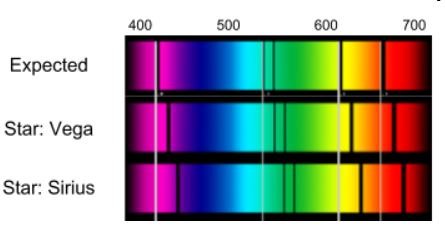
What is true about these stars?
a)
Both of these stars are moving away from us.
b)
Both of these stars are moving towards us.
c)
Both of these stars are blueshifted.
d)
The star Sirius is closer to us.
102.

What is the Doppler Effect?

a)

A change in frequency due to the relative motion of a wave source and an observer

b)

When a wave overlaps with another wave

c)

When a wave bounces off of another object

d)

When a wave bends due to traveling through a different medium

103.

What is the Lithosphere?

a)

The molten outer part of the earth, consisting of the crust and the upper mantle

b)

The rigid outer part of the earth, consisting of the crust and the upper mantle

c)

The rigid center of the earth's core, consisting of the crust and the upper mantle

d)

The lowest level of the atmosphere.

104.

Which explains CORRECTLY how old the Earth is estimated to be and the chemicals that make up our planet?

a)

The Earth is 1 billion years old. Except for hydrogen and some helium created in the Big Bang. This occurred through sustained fusion or in supernova explosions.

b)

The Earth is 8 billion years old. Except for hydrogen and some helium created in the Big Bang. This occurred through sustained fusion or in supernova explosions.

c)

The Earth is 4.54 billion years old. Except for hydrogen and some helium created in the Big Bang. This occurred through sustained fission or in supernova explosions.

d)

The Earth is 4.54 billion years old. Except for hydrogen and some helium created in the Big Bang, all of the stuff we and the Earth around us are made of was generated in stars. This occurred through sustained fusion or in supernova explosions.

105.

Where did the Earth's moon come from?

a)

It came from a fiery crash. The most popular scientific theory for the origin of the moon is that two large planetesimals, Thea and Earth, collided in the solar nebula.

b)

It came from a fiery crash. The most popular scientific theory for the origin of the moon is that two large planetesimals, Mars and Earth, collided in the solar nebula.

c)

It came from a fiery crash. The most popular scientific theory for the origin of the moon is that two large planetesimals, Venus and Mercury, collided in the solar nebula.

d)

The origin of the moon is that two large planetesimals collided in the solar nebula thereby cutting Tony Stark off from Earth and leaving the formation process in the capable hands of Thanos who held the Infinity stones.

106.

What is the process of differentiation?

a)

Materials do not separate according to their properties and are found in nature based on this simple principle.

b)

Materials separate according to their properties and are found in nature based on this simple principle.

c)

Materials demagnetize according to their properties and are found in nature based on this simple principle.

d)

Materials resist each other according to their properties and are found in nature based on this simple principle.
107.
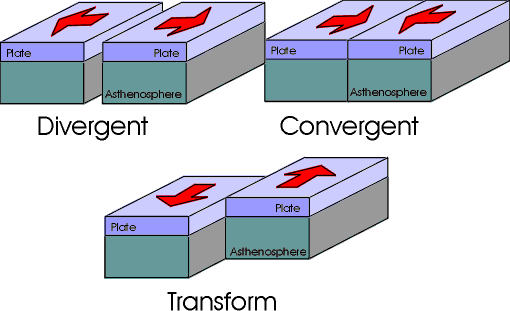
The San Andrea's Fault in California is which type of boundary?
a)
Convergent
b)
Divergent
c)
Subductive Zone
d)
Transform
108.
At which type of plate boundary does seafloor spreading occur?
a)
Tranform
b)
Convergent
c)
Divergent
d)
Subductive Zone
109.
What type of boundary is formed when plates collide?
a)
convergent
b)
horizontal
c)
divergent
d)
transform
110.
According to the continental drift theory, a single, huge continent once existed called
a)
Pangaea.
b)
Wegener.
c)
Panthalassa.
d)
Euraisa.
111.
The process that takes place at mid-ocean ridges is called
a)
sea-floor spreading.
b)
uplift. 
c)
continental drift.
d)
subduction.
112.
What are the two types of crust
a)
continental and oceanic
b)
ocean and upper
c)
lower and upper
d)
pizza and subway
113.
What is the name of the area where one crust slides underneath another
a)
no flex zone
b)
subduction zone
c)
transverse zone
d)
school zone
114.
Who is the person credited with developing the theory of continental drift?
a)
Harry Hess
b)
Galileo
c)
Alfred Wegener
d)
Newton
115.
How many electrons can the first energy level hold?
a)
1
b)
2
c)
8
d)
0
116.
The electron configuration of an atom is 1s22s22p6.  The number of electrons in the atom is 
a)
3
b)
6
c)
8
d)
10
117.
Which electron configuration belongs to Chlorine (Cl)?
a)
1s2s2p3s3p5
b)
1s2s2p3s3p6
c)
1s2s2p3s3p7
118.
What atom matches this electron configuration?
1s22s22p63s23p64s23d10
a)
Zinc
b)
Copper
c)
Nickel
d)
Germanium
119.
This is the correct dot diagram for sodium (Na)
a)
true
b)
false
120.
This is a correct dot diagram for oxygen (O)
a)
true
b)
false
121.

What is the octet rule?

a)

Elements can only have 8 electrons in its outermost shell

b)

The elements must form an octopus like structure

122.

Electron dot notation is . . . .

a)

A representation of an element in which only valence electrons of an atom are shown

b)

A representation of how compounds are formed.

123.
How many electrons should Helium have around its Lewis dot model?
a)
1
b)
2
c)
7
d)
8