
 Worksheets
A year in Review
Total questions: 203
Worksheet time: 3hrs 0mins
In which part of the Scientific Process do you design a test.
Analysis
Experiment
Conclusion
Research
A student wants to test the effects of type of exercise on heart rate. What is the dependent variable?
heart rate
type of exercise
amount of exercise
time of day exercise occurs
Students are investigating how the height of a ramp impacts the speed of a toy car. They will make a ramp 30 cm high, 60 cm high, and 90 cm high. They will measure the speed of the car. What is the independent variable?
speed of the toy car
height of the ramp
how hard the car is pushed
which car is used
Students are investigating how the height of a ramp impacts the speed of a toy car. They will make a ramp 30 cm high, 60 cm high, and 90 cm high. They will measure the speed of the car. What is the dependent variable?
speed of the toy car
height of the ramp
how hard the car is pushed
which car is used

Gianna wants to test which brand of popcorn pops the most kernels. She picked a store brand, Orville Redenbacher, and PopSecret. All three bags started with the same number of kernels. She popped each for 3 minutes in the same microwave, and then counted the number of kernels left over. What is her independent variable?
Number of kernels left over
Brand of popcorn
Number of kernels before popping
Length of time cooking
Is this a qualitative or a quantitative observation?
Ms. Higgins' dog Penny is blonde and fluffy
Quantitative
Qualitative
Neither
Is this observation qualitative or quantitative?
Adult humans have 206 bones.
Qualitative
Quantitative
Neither
I give students different snacks, pretzels and M&Ms, and measure their energy levels by measuring their heart rate. What is the dependent variable?
Brain activity
Heart rate
Snack type
Just M&Ms
Carbon
Cb
C
Ca
Cn
Calcium
Cl
Ca
C
Cm
Copper
C
Co
Cu
Cr
Hydrogen
Hy
H
Hr
Hn
N
Sodium
Nickel
Neon
Nitrogen
Pb
Gold
Lead
Peanut butter
Platinum
Potassium
P
K
Pt
Po
quark
quark
subscript
molecule
compound
When the number of water molecules outside of the cell is greater than inside the cell, which will most likely occur?
Molecules of water will not move either way.
Molecules of water will move out of the cell.
Molecules of water will move into the cell.
Molecules cannot move across a permeable membrane.
In our egg lab, why were water molecules able to enter the egg but not the glucose molecules?
Glucose molecules cannot move through a permeable membrane.
The glucose molecules were too large.
Both the glucose and water molecules moved.
Glucose is a smaller molecule than water.
when molecules move from a high concentration to a low concentration
when molecules need energy to move
a type of active transport
all molecules
large particles
If there is 5 percent water inside a cell and 5 percent water outside a cell
More water will move inside the cell from high to low
More water will move outside the cell from high to low
There will be no movement of water cells since it is at equilibrium
When both inside and outside of a cell have the same amount of water it is said that the cell has reached a state of
osmosis
diffusion
equilibrium
active transport
Permeable means
all particles an pass through
no particles can pass through
some particles can pass through
particles are unable to move

In which direction will water move?
There is 99% water inside the cell and 96% water outside the cell.
Into the cell
Out of the cell
Equally in & out
There is no movement
A student noticed that placing wilted lettuce in a bowl of cool water caused the lettuce to become more crisp and firm. What is the best explanation for this observation?
Salt moved out of the lettuce cells by diffusion.
Water moved into the lettuce cells by osmosis.
Salt moved into the lettuce cells by diffusion.
Water moved out of the lettuce cells by osmosis.
What happens during osmosis?
water molecules moves from a high to a low concentration
water molecules moves from a high to a low concentration with the use of energy
water molecules moves across an impermeable membrane
water molecules use energy to move across membranes
Something is ___________ ____________
when some molecules can cross the membrane while others cannot.
selectively (or semi) permeable
permeable
non-permeable
impermeable
Which part of the cell controls the movement of substances in or out of the cell?
cytoplasm
cell membrane
nuclear membrane
nucleus

Examine the image. Which statement is true?
The red blood cell that is shriveled up is in a beaker of salt water.
The red blood cell that swelled and burst is in a beaker of salt water.
The red blood cell that is normal and has not changed shape is in a beaker of salt water.
Which of the following types of transport requires an input of energy?
passive transport
osmosis
diffusion
active transport
Movement of molecules from LOW to HIGH concentration
Passive Transport
Active Transport
diffusion
osmosis
A _______________ membrane allows all molecules to pass through.
permeable
semi-permeable
selectively permeable
impermeable
non permeable
Someone sprays air freshener and the scent fills the room. This is an example of
endocytosis
diffusion
exocytosis
osmosis

How many molecules need to move in order to reach equilibrium?
6 left
3 right
6 right
9 right
Photosynthesis uses sunlight to convert water and carbon dioxide into
oxygen
high-energy sugars
ATP and oxygen
Oxygen and glucose
What are the reactants required for the process of cellular respiration?
Oxygen and lactic acid
Carbon dioxide and water
Glucose and oxygen
Water and glucose
A structure made up of different types of tissue and performs a specific job.
cells
tissue
organ
organ system
A group of similar cells that perform the same function.
tissue
organelle
organism
system
A group of organs that work together to perform a major function is an organ
organ system
cell
tissue
organism
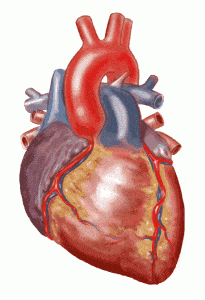
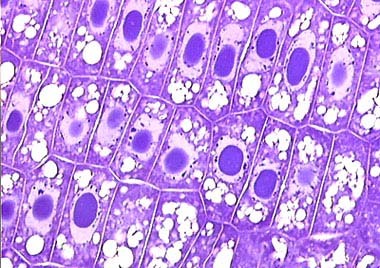

Brain, spinal cord, and nerves are included in this system.
digestive system
circulatory system
nervous system
respiratory system

Heart, arteries, veins, and capillaries are included in this system.
nervous
respiratory
digestive
circulatory

Lungs, trachea, and bronchi are included in this system.
respiratory
endocrine
reproductive
circulatory

In the levels of organization, leaves of a plant are considered
tissue.
organs
cells.
organ
system.

What is oxygen needed for?
energy releasing chemical reactions
to make glucose
to take in sunlight
none of the above
The "windpipe" is known as the
alveoli
esophagus
trachea
bronchi
A small flap of tissue that covers the trachea is called the
bronchi
larynx
pharynx
epiglottis


NUMBER 3:
Pharynx
Trachea
Bronchi
Alveoli
They are....
What is a compound?
Two different elements bonded together.
Two of the same elements bonded together.
A mixture of different substances.
Two substances stuck together with glue.
Which example is a compound?
N2
O2
Cu
H2O2

What is the mass on this triple beam balance?
25.7 g
252.0 g
250 g + a little extra
251.9 g

Use the water displacement method to find the volume of the button.
4 mL
12 g
2 mL
19 mL
Mass is...
the amount of space an object occupies
the amount of matter in an object
the amount of gravitational pull on an object
the distance an object travels
the phase of mitosis in which the chromatids separate (pull apart) from each other
prophase
metaphase
anaphase
telophase


1 new cell

The structures labeled B are
chromosome
sister chromatids
centromeres
centrioles
A male shark has 40 chromosomes in each of its body cells. How many would be present in the new daughter cells?
20
40
80
160
During which stage of cell division do the chromosomes shorten, condense, and become visible with a light microscope?
How many chromosomes are in every human body cell?
92
46
23
1
Cells go through cell division
so an organism can grow
so parts of an organism can heal after injury
so an organism can replace deasd cells
all of these

How many chromosomes? How many chromatids?
8, 4
4, 8
4, 4
2,4
The purpose of meiosis is to form ________ cells.
gametes


What is the job of the cell membrane?
protects the cell and what controls comes in and out of the cell
to make glucose from the sun's energy
to control the cell and hold it's genetic material (DNA)
the cell structure that makes proteins
What is the jelly-like fluid of the cell that holds the organelles?
nucleus
chloroplast
cytoplast
cytoplasm
This is found in plant cells but not in animal cells. It provides protection and support to the cell.
cell membrane
nucleus
chloroplast
cell wall
This structure supplies energy to the cell
chloroplast
mitochondria
nucleus
cell membrane
This contains chlorophyll to trap energy from the Sun to use in photosynthesis. It is only found in plant cells.
cell wall
vacuole
mitochondrion
chloroplast
The basic unit of all living things is called a(n)
nucleus
organelle
atom
cell
The "brain" of the cell is
the mitochondria
the endoplasmic reticulum
the organelles
the nucleus

What type of cell is this?
plant cell
animal cell
bacteria cell
prokaryote
In what organelle does the process of photosynthesis take place?
chlorophyll
mitochondria
chloroplasts
vacuoles

Balloon-shaped organelle used for storage
nucleus
vacuole
ribosome
mitochondrion
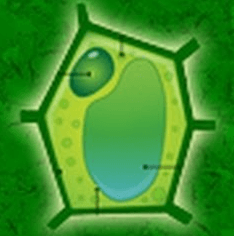
The outermost rigid layer of a plant cell is the
cytoplasm
nuclear membrane
cell wall
cell membrane
This structure transports materials around the cell
vacuole
endoplasmic reticulum
nucleus
mitochondrion
According to cell theory
all living things contain 2 or more cells
all living things have a nucleus
all living things are multicellular
all living things are made up of 1 or more cells
According to the cell theory
all living things come from non living matter.
all cells come from other cells.
all living things come from dead or decaying matter.
all living things contain at least 2 cells.
Prokaryotic cells
contain a nucleus
do not contain a nucleus
This controls what goes in and out of the nucleus
nuclear membrane
nucleus
ribosomes
endoplasmic reticulum
This part of the microscope is where the specimen is placed.
platform
specimen location
stage
specimen spot
Magnifies the image 10x. It is also what you look through.
medium power objective
low power objective
ocular lens
high power objective
Turns the objectives so that the scientist can view specimen at different powers.
ocular revolving piece
eyepiece revolver
objective revolver
revolving nosepiece
These are used to keep the specimen slide in place.
stage prongs
stage pins
stage tacks
stage clips
If the field of view is too dark to see the specimen clearly, you can adjust the amount of light using the __________.
light source
light controller
revolving nosepiece
diaphragm
Use this to bring the image into focus on low and medium power.
adjuster
coarse adjustment knob
fine adjustment knob
coarse tuning knob
Brings the image into a sharp, clear focus and is used to focus on high power.
fine adjustment knob
coarse adjustment knob
fine tuning knob
adjustment tuner
The ___________ maintains the correct distance between the ocular lens and the objectives.
arm
body tube
revolving nose
coarse adjustment knob
The microscope used in class is called a ___________.
electron microscope
compound light microscope
scanning electron microscope
electron transmitting microsocpe
The area you see when you look through the eyepiece is known as the _________________.
area of view
viewing circle
field of view
specimen view
When viewing a specimen with the 4x objective, the total magnification would be _____________.
4x
10
14x
40x
What is an organism that consists of more than one cell?
unicellular
multicellular
nucleus
organelle
What organism reproduces using budding?
hydra
paramecium
bacteria
sea star
Which of the following is NOT a unicellular organism?
bacteria
paramecium
yeast
hydra
What is an disadvantage of asexual reproduction?
An organism can reproduce without a mate
Some organisms can quickly produce a large number of offspring
There is little genetic variation within a population

When a single-celled organism splits into 2 new organisms it is called _________________.
regeneration
binary fission
budding
sporulation
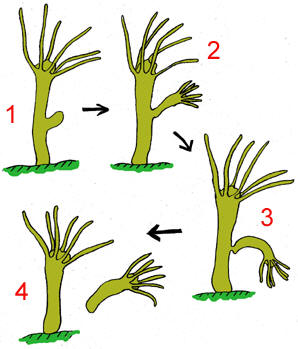
When an offspring grows off from the body of a parent organism it is called __________________.
budding
binary fission
regeneration
sporulation
Occurs when an offspring grows from a piece of its parents:
binary fission
budding
sexual reproduction
regeneration
What are the products of photosynthesis?
carbon dioxide and water
carbon dioxide and oxygen
glucose and oxygen
glucose and water

What is the source of energy for photosynthesis?
chemical
light
thermal
electrical
Why does bread rise when baked?
The waste gas of fermentation, CO2, makes bread rise
The alcohol produced makes bread dangerous
Ingredients in the dough consumes O2, causing bread to rise
Glucose is created by fermentation causing the rise
What cells in the body may undergo lactic acid fermentation during strenuous exercise?
muscle cells
liver cells
alveoli
skin cells
Although both are energy releasing, cellular respiration is different from fermentation because it requires
exercise.
light.
glucose.
oxygen.
Organisms with no nucleus are
unicelular.
multicellular.
eukaryotic.
prokaryotic.
Levels of cellular organization from simple to complex:
cell, organ, tissue, system
tissue, cell, system, organ
cell, tissue, organ, system
system, organ, tissue, cell
Multicellular organisms are
only plants and animals.
all living things.
able to do more work with less energy.
only bacteria.
A cactus a thick, waxy leaves that help hold in water. This is an example of _____________________________ adaptation.
behavioral
structural
physiological

Why are advantageous traits more likely to be passed onto offspring?
Because they are more likely to survive and reproduce.
Because they come from dominant alleles.
Because they come from recessive alleles.
Because the organism knew it needed that trait, survives, and passes it on.
Mutations are a change in what?
DNA
genotype
protein
phenotype

On the Galapagos Islands, different finches evolved on different islands to fit their environment. When a species develops unique traits because it is trapped in one area this is called:
Geographic isolation
Geologic separation
General relocation
Genetic differentiation
Linnaeus created a system for classifying organisms based on
structural adaptations, behavioral adaptations, food needs, and chemical makeup
how they move
where they were found
how they move and chemical makeup


Based on the karyotype, what is the sex of this person?
Male
Female
What is the phenotype of the flower whose genotype is Pp
What is the term used for a segment of DNA that codes for a specific trait and is passed from parent to offspring?
allele
gene
chromosome
nucleus
Different forms of genes are called ____.
The physical appearance of an organism's traits is referred to as ____.
genotype
gene
phenotype
allele
____ is the genetic makeup of an organism, or their combination of genes.
Allele
Gene
Genotype
Phenotype
What is the phenotype for Tt?
Name the proteins on the surface of red blood cells.
Antibodies
Antigens
Plasma
Collagen
What type of antigens can be found on the surface of RBC's when someone has blood type O?
A
B
AB
none
What antibodies can be found when someone has blood type A?
none
A
B
A and B
Select all that type B can receive from
A
B
AB
O

What kingdom?- eukaryotic, multi-celled-photosynthetic.
animal
plant
protist
fungi
What kingdom? prokaryotic; lives in harsh environments
plants
animals
archaebacteria
eubacteria
How many kingdoms are there?
4
5
6
7

Mushrooms belong to what kingdom?
PLANT
ANIMAL
FUNGI
PROTIST

AMOEBA-PARAMECIUM-EUGLENA-DINOFLAGELLATES BELONG TO WHAT KINGDOM?
PLANT
PROTIST
FUNGI
ANIMAL
EUBACTERIA

Which of the following is not a characteristic of arthropods?
exoskeleton
jointed appendages
segmented body
warm blooded
The process of shedding an exoskeleton is called ____.
mutating
molting
morphing
excreting
Why do arthropods molt?
To attract a mate
To lay an egg
To grow
To hibernate
Arthropod means
cold-blooded
soft shelled
jointed foot
limbed being
These structures are used for sensing touch, taste, and smell. Many arthropods have them.
antenna
spiracles
tympanum
wings
This term means cold-blooded.
endothermic
ectothermic
poda
arthro
What is the hard, outer covering called that covers, supports, and protects the internal body?
endoskeleton
molt
exoskeleton
appendage
A disadvantage of an arthropod's exoskeleton is
it allows the organism to stay protected
it allows the organism to move
it does not grow with the organism
it makes it more appealing to mates
What are the stages of incomplete metamorphosis?
egg, larva, adult
egg, nymph, adult
egg, pupa, adult
egg, larva, pupa, adult
What are the stages of complete metamorphosis?
egg, larva, pupa, nymph, adult
egg, nymph, larva, adult
egg, pupa, nymph, adult
egg, larva, pupa, adult
Spiders, ticks, scorpions all belong to which class?
crustaceans
arachnids
insects
centipedes
Which class of arthropods has one pair of legs per segment?
centipedes
millipedes
crustaceans
arachnids
Beetles, ants, and bees all belong to which class?
crustaceans
arachnids
insects
centipedes
Barnacles, shrimp, and lobsters all belong to which class?
crustaceans
arachnids
insects
centipedes
Which of the following is true of millipedes?
they are carnivores
they are omnivores
they are herbivores
they are autotrophs
What is the purpose of the tympanum?
detect sound
jumping away from predators
detect light
detect motion
How did you determine if the grasshopper is male or female?
Females have an ovipositor
Males have an ovipositor
Males have a forked abdomen
Females have a rounded abdomen
Grasshopper's respiratory system exchanges oxygen and carbon dioxide. Where does this begin?
tympanum
simple eyes
mouth
spiracles

This grasshopper is a
male
female

Which class of mollusks does this organism belong to?
Gastropods
Cephalopods
Bivalves
Snail

Which class of mollusks does this octopus belong to?
Cephalopods
Gastropods
Bivalves
Univalve
This phylum is made of segmented worms
Annelida
Mollusca
Arthopoda

