wayground logo

Free Printable Worksheets

Font size

S
M
L
XL
Worksheets

Gr 5 Science rev

Total questions: 70

Worksheet time: 37mins

Name
Class
Date
1.

Find the mean of this data:

5, 4, 7, 2, 11, 1

a)

4.21

b)

4

c)

5.68

d)

5

2.

Vascular tissue that transports water and minerals UPWARDS from a plant's roots is know as ______.

a)

Chlorophyll

b)

Phloem

c)

Stomata

d)

Xylem

3.

Where is xylem vessels found in plants

a)

roots and stems only

b)

leaves and root only

c)

roots, stems and leaves

d)

root hair cells and veins

4.

What does the phloem transport

a)

water

b)

sugar

c)

minerals

d)

air

5.

Water and minerals move in which direction within the plant

a)

Upward

b)

Down

6.
Water travels through
a)
phloem
b)
xylem
c)
veins
d)
tubes
7.

What gas do plants need to make their own food through photosynthesis?

a)

oxygen

b)

carbon dioxide

c)

helium

d)

neon

8.
In what part of a plant does the process of photosynthesis occur?
a)
flower
b)
xylem
c)
leaves
d)
roots
9.

This is what an organism that cam make its own food is called.

a)

Producers

b)

Consumers

10.

This is what animals are because they get energy by eating plants or other animals that ate plants.

a)

Producers

b)

Consumers

11.

What is the source of energy for producers?

a)

Earth

b)

Sun

c)

Wind

d)

Water

12.

What kind of organisms come last in the food chain?

a)

Omnivores

b)

Producers

c)

Decomposer

d)

Consumers

13.
Which is an example of a decomposer?
a)
a hawk
b)
a mouse
c)
a flower
d)
a mushroom
14.
Which describes a decomposer?
a)
an organism that eats only plants
b)
an organism that makes its own food
c)
an organism that breaks down dead matter
d)
an organism that receives energy from the sun
15.
A living organism that puts materials from dead  plants and animals back to the soil is called a ____________?
a)
carnivore
b)
decomposer
c)
herbivore
d)
omnivore
16.
Bamboo is a 
a)
producer
b)
consumer 
c)
decompser
17.

Which part of the plant is responsible for taking in water and minerals from the soil?

a)

roots

b)

stem

c)

leaves

d)

flower

18.

Which part of the plant helps the water and nutrients move from the roots to the leaves?

a)

stomata

b)

stem

c)

flower

d)

pollen

19.

Look at the picture. The predator is ____________ and the prey is _____________.

a)

snake, eagle

b)

eagle, snake

20.

In this diagram, the eagle is

a)

the top predator.

b)

the prey.

c)

the both predator and prey.

d)

the predator.

21.
How do consumers get their energy? 
a)
laying in the sun
b)
eating other organisms 
c)
providing food for other organisms
d)
surviving in an ecosystem 
22.
Which of the following is a herbivore?
a)
cricket
b)
frog
c)
hawk
d)
shrew
23.
A food web can be broken down into several seperate
a)
food chains
b)
food pyramids
c)
producers
d)
consumers
24.
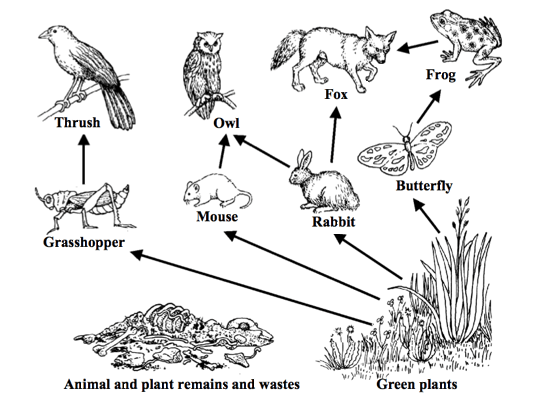
The owl receives energy from which organisms?
a)
grasshopper and mouse
b)
mouse and rabbit
c)
rabbit and butterfly
d)
butterfly and frog
25.
An organism that is killed and eaten by another organism
a)
Predator
b)
Prey
c)
Competition
d)
Adaptation
26.
A consumer that hunts is called:
a)
a producer.
b)
an omnivore.
c)
a predator.
d)
a herbivore.
27.
How do consumers get their energy? 
a)
laying in the sun
b)
eating other organisms 
c)
providing food for other organisms
d)
surviving in an ecosystem 
28.
If a hawk eats a snake, the snake is the...
a)
Predator
b)
Alpha
c)
Prey
d)
Mutualistic partner
29.
What role does the mouse play?
a)
Predator
b)
Prey
30.
Which of the following is a herbivore?
a)
cricket
b)
frog
c)
hawk
d)
shrew
31.
How many carnivores are shown in this food web?
a)
6
b)
4
c)
5
d)
3
32.
A frog eats a fly. The frog and fly are demonstrating ________.
a)
mutualism
b)
competition
c)
predator/prey
d)
parasitism
33.
A food web can be broken down into several seperate
a)
food chains
b)
food pyramids
c)
producers
d)
consumers
34.
The owl receives energy from which organisms?
a)
grasshopper and mouse
b)
mouse and rabbit
c)
rabbit and butterfly
d)
butterfly and frog
35.
An animal that is hunted and eaten for food is a __________.
a)
predator
b)
prey
c)
population
36.
Where does the energy start in this food chain?
a)
Plant
b)
Sun
c)
Deer
d)
Wolf
37.

A system of many food chains that interact with each other:

a)

predator

b)

consumer

c)

food web

38.
An animal that eats only plants is an...
a)
carnivore
b)
omnivore
c)
herbivore
d)
decomposer
39.

Which of the following is a producer?

a)
b)
c)
d)
40.

A system of many food chains that interact with each other:

a)

predator

b)

consumer

c)

food web

41.
An organism that lives by breaking apart dead organic matter into simpler parts is...
a)
scavenger
b)
consumer
c)
decomposer
d)
carnivore
42.

Flies, worms and ants ead dead plants and animals. They are called:

a)

producers.

b)

consumers.

c)

decomposers.

d)

carnivores.

43.

Herbivores are animals that

a)

only eat plants.

b)

eat plants and animals.

c)

eat only animals.

44.

Carnivores are animals that

a)

only eat plants

b)

eat plants and animals.

c)

only eat animals.

45.

All food chains start with

a)

a producer.

b)

a consumer.

c)

a decomposer.

d)

an omnivore,

46.

Worm is

a)

a herbivore.

b)

a carnivore.

c)

an omnivore.

d)

a decomposer.

47.

What is a food chain?

a)

The flow of energy from one thing to another

b)

The way animals eat each other

c)

The way the sun makes everything

d)

How the plants grow

48.

These are the abiotic factors in ecosystem, except

a)

Light

b)

Air

c)

Water

d)

Fungi

49.

What are biotic factors in an ecosystem?

a)

Dead things

b)

Weather

c)

Animals

d)

Soil

50.

Is soil a biotic or abiotic factor?

a)

biotic

b)

abiotic

51.

Are rocks biotic or abiotic factors?

a)

biotic

b)

abiotic

52.

Abiotic factors are ___________.

a)

non-living parts of an ecosystem

b)

living parts of an ecosystem

c)

things that once were alive, but now are dead

d)

not important parts of ecosystems.

53.

Biotic factors are ___________.

a)

non-living parts of an ecosystem

b)

living parts of an ecosystem

c)

things that once were alive, but now are dead

d)

not important parts of ecosystems.

54.

An ecosystem is made up of __________.

a)

living things only

b)

non-living things only

c)

both living and non-living things

55.
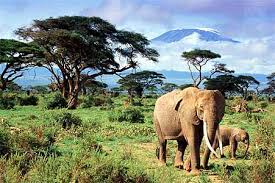
What are the biotic factors in this image?
a)
sunlight, elephants, and grasses
b)
sunlight, water,  and air
c)
elephants, plants, trees 
56.
A place where plants and animals live and grow is called a ____________. It provides, food, water, shelter, and air.
a)
shelter
b)
tree
c)
habitat
d)
organism
57.

What is the niche of the plants in their ecosystem ?

a)

decomposers

b)

consumers

c)

scavengers

d)

producers

58.
What are plants called in a food chain?
a)
Producers
b)
Consumers
c)
Decomposers
59.
What is this called?
a)
Food Web
b)
Food Chain
c)
Abiotic Factors
60.

Bacteria, fungi, and earthworms are examples of:

a)

scavengers

b)

predators

c)

prey

d)

decomposers

61.
What is a niche?
a)
the place where a species lives
b)
what a species eats
c)
the role of a species
d)
how a species uses resources
62.
A food chain is a diagram of how 
a)
communities are connected
b)
energy and nutrients pass among organisms in an ecosystem
c)
producers make food
d)
an ecosystem develops and changes
63.

Air is mainly composed of which two gases?

a)

Carbon Dioxide

b)

Oxygen

c)

Nitrogen

d)

Helium

64.

The water that makes up Earth. It includes bodies of water and the water in the atmosphere (water vapor and different forms of precipitation). It includes water in all three states: solid, liquid, and gas.

a)

Atmosphere

b)

Hydrosphere

c)

Geosphere

d)

Biosphere

65.

All living things, plants and animals,

including humans, on Earth.

a)

Atmosphere

b)

Hydrosphere

c)

Geosphere

d)

Biosphere

66.

The land that makes up Earth. It includes the soil and rocks that make up Earth’s landforms as well as the molten rock beneath Earth’s surface.

a)

Atmosphere

b)

Hydrosphere

c)

Geosphere

d)

Biosphere

67.

The air that surrounds Earth.

a)

Atmosphere

b)

Hydrosphere

c)

Geosphere

d)

Biosphere

68.

________________ is when water vapor is releases from the leaves of plants.

a)

transpiration

b)

precipitation

69.

What is it called when plants give off water vapor as a waste product?

a)

condensation

b)

evaporation

c)

runoff

d)

transpiration

70.
Why is the CO2 and O2 cycle considered to be a cycle?
a)
there is a exchange of gases
b)
the trees use it and trees are apart of all cycles
c)
there is a continuous exchange of gases