wayground logo

Free Printable Worksheets

Font size

S
M
L
XL
Worksheets

Science Check-In 1 Review

Total questions: 67

Worksheet time: 1hrs 14mins

Name
Class
Date
1.
What is it called when plants give off water vapor as a waste product?
a)
condensation
b)
evaporation
c)
sublimation
d)
transpiration
2.
During which stage do clouds form?
a)
condensation
b)
evaporation
c)
precipitation
3.
Which stages does liquid water from the ocean turn into water vapor?
a)
condesantion
b)
evaporation
c)
precipitation
d)
run off
4.
Which stage does ground water try to return to the ocean or soak into the ground?
a)
condensation
b)
evaporation
c)
precipitation
d)
run off
5.
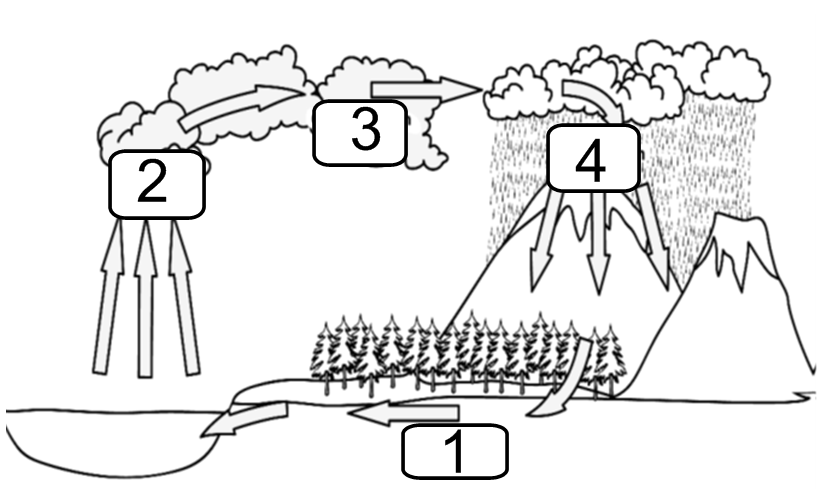
Which stage does the #2 show in the diagram?
a)
condensation
b)
evaporation
c)
precipitation
d)
run off
6.
Which stage does the #3 show in the diagram?
a)
condensation
b)
evaporation
c)
precipitation
d)
run off
7.
what does the #4 show in the diagram?
a)
condensation
b)
evaporation
c)
precipitation
d)
run off
8.
does warm water evaporate quicker than cold water
a)
true 
b)
false
9.
What is the water cycle?
a)
the 3 forms of water
b)
the movement of water on, above, or below the surface of the Earth
c)
when water melts
d)
when clouds form
10.
Which is the opposite of condensation?
a)
runoff
b)
evaporation
c)
precipitation
d)
transpiration
11.
Which best explains why runoff is important?
a)
It returns water to other locations on Earth
b)
It increases the chance of flooding
c)
It makes evaporation occur faster
d)
It increases condensation
12.
What follows evaporation during the water cycle? How does this occur?
a)
Water evaporates into water vapor
b)
Water vapor condenses and forms a  cloud
c)
Water precipitates to the ground
d)
Water runs down into the hydrosphere
13.
The sun will cause water in the puddle to change from
a)
a gas to a liquid
b)
a liquid to a gas
c)
solid to a liquid
d)
a liquid to a solid
14.
A cup of ice sits in the sun.  The ice melts. What change of state will occur NEXT?
a)
from solid to solid
b)
from liquid to solid
c)
from liquid to gas
d)
from gas to liquid
15.
The ______________is the beginning source of energy for the water cycle.
a)
sun
b)
wind
c)
geothermal
d)
volcano
16.
Water begins to evaporate when you add _______ to it.
a)
cold
b)
ice
c)
water cycle
d)
heat
17.
Which of these is an example of precipitation?
a)
snow
b)
air
c)
clouds
d)
vapor
18.
When water _________, dew forms.
a)
Melts
b)
Evaporates
c)
Condenses
d)
Precipitates
19.
What is the water cycle?
a)
the 3 forms of water
b)
the movement of water on, above, or below the surface of the Earth
c)
when water melts
d)
when clouds form
20.
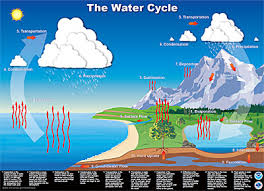
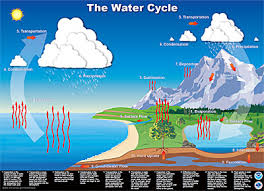
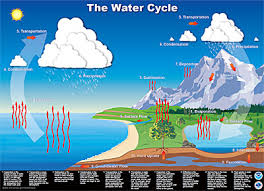
What does this illustration show?
a)
Sunrise
b)
The Water Cycle
c)
Sunset
d)
the recycling of snow
21.
What is water doing when it is changed to water vapor?
a)
evaporating
b)
condensing
c)
transpiring
d)
freezing
22.
On which kind of day would you expect the most evaporation from the surface of a  pond?
a)
sunny and hot
b)
sunny and cold
c)
rainy and hot
d)
rainy and cold
23.

Which is not one of the main factors that determine the state of matter?

a)

particle size

b)

particle forces

c)

particle motion

24.

In which state of matter do particles vibrate in place?

a)

gas

b)

solid

c)

liquid

25.

In which state of matter are the particles furthest apart?

a)

gas

b)

solid

c)

liquid

26.

A (a)   is matter that has a definite shape and a definite volume.

27.

Matter with a definite volume but no definite shape is a (a)   .

28.

A (a)   is matter with no definite shape and no definite volume.

29.

Measure of the average kinetic energy of the particles in an object.

a)

thermal energy

b)

temperature

c)

kinetic energy

30.

Change from a liquid to a gas.

a)

condensation

b)

vaporization

c)

sublimation

31.

Change from a gas to a liquid.

a)

condensation

b)

vaporization

c)

sublimation

32.

Change directly from a solid to a gas.

a)

condensation

b)

vaporization

c)

sublimation

33.
What are the states of matter?
a)
solid, liquid, and juice
b)
solid and liquid
c)
solid and gas
d)
solid, liquid, and gas
34.
Matter that has its own shape and takes up space.
a)
solid
b)
liquid
c)
gas
35.
Matter that always fills the shape in a container, such as air.
a)
solid
b)
liquid
c)
gas
36.
Milk takes the shape of its container because it is a:
a)
solid
b)
liquid
c)
gas
37.
How is a gas defined?
a)
no shape, no volume
b)
Definite shape, definite volume
c)
Found in stars
d)
Definite volume, no shape
38.
What happens when my glass of water is sitting in the sun and disappears into a gas?
a)
evaporation
b)
burning
c)
melting
d)
freezing
39.
Molecules are closest together in a 
a)
Solid
b)
Liquid
c)
Gas
d)
plasma
40.
Define a liquid
a)
no shape, no volume
b)
Definite shape, definite volume
c)
Found in stars
d)
Definite volume, no shape
41.
On a hot summer day chocolate candy can melt in your pocket.  How can you get the chocolate to return to a solid?
a)
add heat
b)
leave it in your pocket
c)
cool it in the refrigerator
d)
leave it outside
42.
Which state of matter does ice start as (before you cool it)?
a)
liquid
b)
solid
c)
gas
43.
Which item is more dense than water (sinks)?
a)
Styrofoam Cup
b)
Wooden Block
c)
Silverware
d)
Beach Ball
44.
Choose the item that is less dense than water (floats).
a)
Beach Ball
b)
Brick
c)
Magnet
d)
Metal Key
45.
Which of these examples are a solid?
a)
water
b)
oxygen
c)
orange juice
d)
rock
46.
Steel and silver are examples of matter that_______?
a)
can float
b)
are edible
c)
have magnetic properties
d)
have no gravity
47.
The amount of matter in an object is the definition of which term?
a)
volume
b)
weight
c)
temperature
d)
mass
48.
What is the volume of the rock? The water level is displaced from 20 mL to 23 mL with the rock.
a)
3 mL
b)
23 mL
c)
20 mL
d)
43 mL
49.
Which physical property is the amount of space something takes up and can be measured with a graduated cylinder?
a)
conductivity
b)
relative density
c)
thermal energy
d)
volume
50.
What is weight?
a)
the amount of matter in an object
b)
the distance between one point to another
c)
how fast something travels
d)
the amount of gravity pulling on the mass of an object
51.
Which tool helps us to measure mass?
a)
scale
b)
triple beam
c)
ruler
d)
magnifying glass
52.
A change in which the form or shape of a substance changes but the chemical makeup of the substance remains the same.
a)
chemical change
b)
reaction
c)
physical change
d)
solution
53.
A change in one or more substances, caused by a reaction, that forms new and different substances.
a)
mixture
b)
physical change
c)
element
d)
chemical change
54.
A combination of two or more different substances in which the substances keep their identities. 
a)
reaction
b)
mixture
c)
solution
d)
atom
55.
The process in which new substances are formed during  a chemical change.
a)
reaction
b)
solution
c)
matter
d)
volume
56.
The smallest unit into which an element can be divided and still retain all the properties of that element.
a)
atomic theory
b)
compound
c)
element
d)
atom
57.
sodium and potassium react violently with water
a)
physical change
b)
chemical change
58.
pancakes cook on a griddle
a)
physical change
b)
chemical change
59.
food digested in the stomach
a)
physical change
b)
chemical change
60.
grass grows on a lawn
a)
physical change
b)
chemical change
61.
tire inflated with air
a)
physical change
b)
chemical change
62.
water absorbed by a paper towel
a)
physical change
b)
chemical change
63.
water freezes at 0⁰C
a)
physical change
b)
chemical change
64.
fireworks explode
a)
physical change
b)
chemical change
65.
Alka-Seltzer gives off carbon dioxide when added to water
a)
physical change
b)
chemical change
66.
clouds form in the sky
a)
physical change
b)
chemical change
67.
Salt dissolves in water
a)
physical Change
b)
chemical change