wayground logo

Free Printable Worksheets

Font size

S
M
L
XL
Worksheets

3rd Year Revision Quiz

Total questions: 54

Worksheet time: 48mins

Name
Class
Date
1.
Mg2+ and Cl- create...
a)
Mg2Cl
b)
MgCl2
c)
Mg2Cl2
d)
MgCl
2.

Na+ and Cl- create...

a)

Na2Cl

b)

NaCl2

c)

Na2Cl2

d)

NaCl

3.

Be careful with this question..... SO2-  and  Al 3+

a)

(SO4)3Al2

b)

(SO4)2Al3

c)

Al3SO4

d)

Al2(SO4)3

4.

Beryllium will _______ outer electrons when forming an ionic bond.

a)

lose 4

b)

gain 4

c)

lose 2

d)

gain 2

5.

Which of the following is true for ionic bonding & ionic compounds?

a)

They must be made of ions with like charges.

b)

The negative ion must be written first.

c)

Compounds must have an overall charge of zero.

d)

They are made of metals and nonmetals.

e)

The positive ion must be written first.

6.

What is the charge of ion "X" in the formula XF3?

a)

+3

b)

-3

c)

+1

d)

-1

7.

Which of the following pairs of elements will NOT form an ionic compound?

a)

sodium and fluorine

b)

phosphorous and aluminum

c)

potassium and magnesium

d)

strontium and oxygen

8.
What region of the periodic table contains atoms that form covalent bonds?
a)
the left side
b)
the middle
c)
the right side
d)
top left
9.
What is a diatomic element?
a)
a metal bonded with a nonmetal
b)
2 or more nonmetals bonded together
c)
2 or more metals bonded together
d)
2 atoms of the same element bonded together
10.

How many electrons are shared in a double covalent bond?

a)

2

b)

4

c)

6

d)

8

11.
Electrons have a charge of:
a)
-1
b)
-2
c)
+1
d)
+2
12.

The chemical bond between a non-metal and another non-metal will be a ________ bond.

a)

metal

b)

ionic

c)

covalent

d)

polar

13.

Identify the following compound as ionic or covalent: CF4

a)

ionic

b)

covalent

14.

Which is the correct structure for NH3?

Pictures correspond with a-d.

a)

Option A.

b)

Option B.

c)

Option C.

d)

Option D.

15.

The type of separation that would be appropriate if you needed to separate solid particles from a liquid is....

a)

Distillation

b)

Filtration

c)

Separation funnel

d)

Crystallization

16.

What separation method is used to separate substances by their boiling point?

a)

Filtration

b)

Evaporation

c)

Crystallization

d)

Distillation

17.
Grinding a seltzer tablet into powder increases the rate of reaction due to increased
a)
concentration
b)
surface area
c)
temperature
d)
reactants
18.
What is gold?
a)

element

b)

compound

c)

mixture

d)

metal

e)

non-metal

19.

The steam coming off the pot of boiling water is an example of....

a)

Evaporation

b)

Sublimation

c)

Melting

d)

Freezing

20.
What is the charge on a chloride ion?
a)
-1
b)
1
c)
+2
d)
+1
21.
Ionic bonds form between metals and ____.
a)
metalloids
b)
metals
c)
nonmetals
22.
What type of elements will form an ionic bond?
a)
Metals + Metals
b)
Nonmetals + Nonmetals
c)
Metals + Nonmetals
d)
None of the above
23.
The force of attraction that holds together positive and negative ions is a(an):
a)
ionic compound
b)
ionic bond
c)
electrolyte
d)
crystal
24.
1.22 Why are ions charged particles?
a)
The number of electrons does not equal the number of protons.
b)
The number of protons does not equal the number of neutrons.
c)
The number of neutrons does not equal the number of electrons.
d)
The electric charges of the electrons and protons cancel each other out.
25.
1.21 These usually lose electrons and form positive ions.
a)
halogens
b)
metalloids
c)
metals
d)
nonmetals
26.
Which of the following is the correct Lewis dot structure for the molecule fluorine (F2)?
a)
A
b)
B
c)
C
d)
D
27.

What is the formula for the ammonia molecule shown below?

a)

NH

b)

NH3

c)

N3H3

d)

N3H

28.
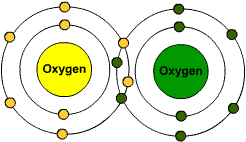
Is this image an example of covalent bonding?
a)
Yes
b)
No
29.

Pure substances contain: 

a)

Only one type of substance

b)

Substances that cannot be chemically separated

c)

A solvent and a solute

d)

All of the above

30.

A suspension contains:

a)

A bridge hanging over a valley

b)

A solvent and a solute

c)

A solvent and suspended particles

d)

A solution and a solvent

31.

In chemistry, a solution contains

a)

An answer to a problem

b)

A solvent and a solute

c)

A solvent and suspended particles.

d)

A solution and a solvent

32.

A soluble substance will

a)

Form small particles to form a clear suspension

b)

Dissolve to form a cloudy solution

c)

Dissolve to form a clear solution

d)

Form small particles to form a cloudy suspension

33.

What is the correct order for obtaining salt from a mixture of sand and salt?

a)

Dissolving in water - filtration - evaporation

b)

Evaporation - filtration - dissolving in water

c)

Filtration - dissolving in water - evaporation

d)

Dissolving in water-sieving- decanting

34.

Which states of matter are freely moving?

a)

Gases

b)

Liquids

c)

Solids

35.
As particles are exposed to warmer temperatures they __________
a)
speed up
b)
slow down
c)
stay the same
d)
vibrate
36.

What is the term given to the temperature at which a solid turns into a liquid?

a)

Boiling point

b)

Melting point

c)

Freezing point

d)

Heating point

37.

What is the chemical formula for phosphorus trichloride?

a)

KCl3

b)

PCl3

c)

K3Cl

d)

P3Cl

38.
The correct chemical formula for magnesium phosphide is
a)
MgP
b)
Mg₂P₃
c)
Mg₃P₂
d)
Mg₃(PO₄)₂
39.
The correct name of Mg₃N₂ is
a)
manganese nitride
b)
magnesium nitride
c)
magnesium (III) nitride
d)
trimagnesium dinitride
40.
Ionic Formula - 
strontium iodide
a)
SrI
b)
SrI2
c)
Sr2I
d)
StI2
41.
Which side of a chemical equation is the reactant side?
a)
Left (before the arrow)
b)
Right (after the arrow)
42.
Which problem is balanced?
a)
PbO2 + 2H2
b)
SO2 + H20 --> H2SO4
c)
2Na + 2H2O --> 2NaOH + H2
43.
Is the equation balanced?: 2H2O + O2 --> 4MgO + 3Fe
a)
Yes
b)
No
44.
What is the little number after an element in a chemical equation called.
Example: H2
a)
Coefficient 
b)
Subscript
c)
Atom
d)
Equation
45.
Balance this equation
_Zn+_HCl-->_ZnCl+_H2
a)
1,1,2,1
b)
1,1,1,2
c)
1,2,1,1
d)
2,1,1,1
46.
KNO3 --> KNO2 + O2
What coefficients are needed to balance the reaction?
a)
2, 2, 1
b)
2, 3, 2
c)
1, 2, 2
d)
1, 3, 1
47.
Balance this equation
_Zn+_HCl-->_ZnCl+_H2
a)
1,1,2,1
b)
1,1,1,2
c)
1,2,1,1
d)
2,1,1,1
48.

Which equation is balanced?

a)

PbO2 + 2H2--> H2SO4

b)

SO2 + H20 --> H2SO4

c)

2Na + 2H2O --> 2NaOH + H2

d)

2Na + 2H2O --> 2NaOH + H

49.
Balance this equation:
P4+O2  -->  P2O3
a)
3 P4+ O--> 2 P2O3
b)
 P4+ O--> 2 P2O3
c)
 P4+ 3 O2 --> 2 P2O3
d)
 P4+ 2 O--> 3 P2O3
50.
Balance this reaction: ____ RbNO3 + ____ BeF2 ----> ____ Be(NO3)2 + ____ RbF
a)
1,1,1,1
b)
1,2,1,1
c)
2,1,1,2
d)
2,1,2,1
51.
The diagram shows the apparatus for separating soil and water. What are the labelled parts?
a)
A = distillate, B = filtrate
b)
A = filtrate, B = residue
c)
A = residue, B = filtrate
d)
A = residue, B = distillate
52.

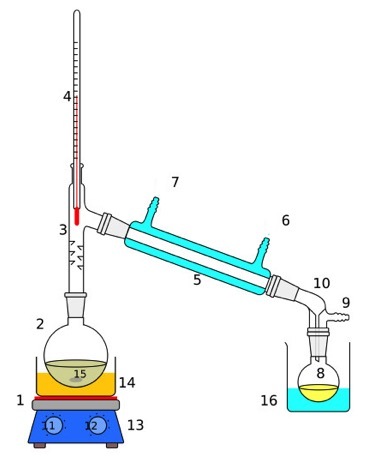
What is the flow of water in 6 and 7?

a)

6: water in; 7: water out

b)

6: water out; 7: water in

53.

Put the two processes used in fractional distillation in the correct order.

a)

Evaporating and then melting

b)

Evaporating and then condensing

c)

Condensing and then evaporating

d)

Melting and then condensing

54.

What physical property is used to separate substances in distillation process?

a)

difference between the evaporation points of the mixed substances

b)

difference between the boiling points of the mixed substances

c)

difference between the freezing points of the mixed substances