wayground logo

Free Printable Worksheets

NEW

Font size

S
M
L
XL
Worksheets

Unit 1 Matter Knowles (19-20)

Total questions: 51

Worksheet time: 33mins

Name
Class
Date
1.

Subatomic particles with a negative charge

a)

Electrons

b)

Neutrons

c)

Protons

d)

Quarks

2.
Subatomic particles with a positive charge
a)
neutrons
b)
atomic mass
c)
protons
d)
isotopes
3.
Value representing the number of protons in an element
a)
Atomic Mass
b)
Mass Number
c)
Valence Electrons
d)
Atomic Number
4.
Subatomic particles that are neutral in charge
a)
Neutrons
b)
Protons
c)
Nucleus 
d)
Electrons
5.
Atoms of the same element with a different number of neutrons
a)
Ion
b)
Gluons
c)
Isotope
d)
Quarks
6.
A charged atom
a)
Ion
b)
Isotope
c)
Electron Cloud
d)
Quark
7.
Where electrons are likely to be found as they travel around the nucleus
a)
Nucleus
b)
Electron Cloud
c)
Within a Proton
d)
Within a Neutron
8.
A tiny but very dense, positively charged portion of the atom that holds most of the atomic mass
a)
Electron Shells
b)
Orbitals
c)
Electron Cloud
d)
Nucleus
9.
Arrangement of elements organized by atomic number
a)
Electron Cloud 
b)
Periodic Table 
c)
Electron Configuration
d)
None of these
10.
Calculation used to find the number of neutrons in an atom
a)
Atomic Mass - Atomic Number
b)
Atomic Number - Atomic Mass
c)
Atomic Mass - Electrons
d)
none of these
11.
These are found in the nucleus and have a positive charge. 
a)
proton 
b)
electron 
c)
neutron 
d)
moron 
12.
These are found in the nucleus and have a neutral charge. 
a)
proton 
b)
electron 
c)
neutron 
d)
moron 
13.
These are found outside the nucleus and have a negative charge. 
a)
proton 
b)
electron 
c)
neutron 
d)
moron 
14.
These will determine what element an atom is. 
a)
number of neutrons
b)
number of electrons
c)
number of atoms 
d)
number of protons 
15.
The atomic mass is the number of _______ plus ________. 
a)
protons, electrons 
b)
protons, neutrons 
c)
electrons, neutrons 
d)
quarks, neutrons 
16.
You see an model of an atom with 5 protons and 4 electrons. What kind of atom is this? 
a)
positive ion 
b)
negative ion 
c)
neutral ion 
d)
strange ion
17.
These subatomic particles are taken or removed to form ions. 
a)
neutrons 
b)
protons 
c)
electrons 
d)
nimrons 
18.
How many protons does an Oatom have?
a)
8
b)
24
c)
16
d)
When is lunch? 
19.
An atom is said to be neutral if it has the same # of electrons and ________. 
a)
thing-ons 
b)
electrons 
c)
neutrons 
d)
protons 
20.

The vertical (up and down) columns in the Periodic Table are called

a)

groups

b)

towers

c)

periods

d)

atomic numbers

21.
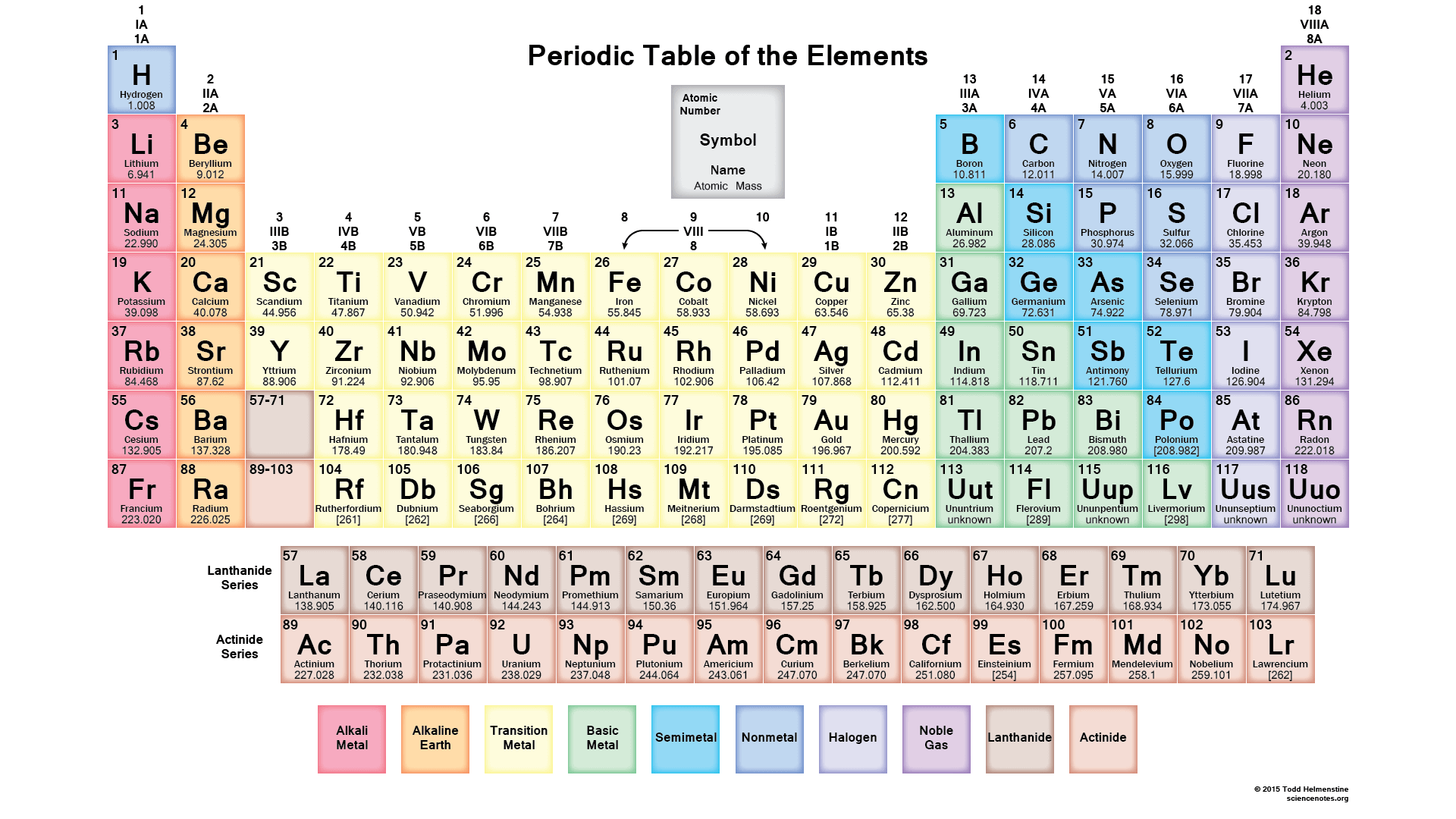
Sodium (Na) is found in group 
a)
1
b)
2
c)
3
d)
4
22.

The atomic number tells you what? READ THE ANSWERS CAREFULLY

a)

only the number of electrons

b)

only the number of protons

c)

only the number of neutrons

d)

the number of both electrons and protons in an atom.

23.

What are valence electrons?

a)

Any of an atom's electrons

b)

Electrons located on the first energy level

c)

Electrons not attached to any atom

d)

electrons located on the outer energy level

24.

What category is silicon (Si) a part of?

a)

Metal

b)

Nonmetal

c)

Metalloid

d)

Halogens

25.

What Element is in period 4, group 5A?

a)

Antimony

b)

Arsenic

c)

Tin

d)

Germanium

26.

What is the ionic charge of Phosphorus (P)?

a)

+5

b)

-3

c)

+3

d)

-5

27.

How many electrons does a Strontium (Sr) ION have?

a)

38

b)

10

c)

8

d)

36

28.

What is group name of the most reactive metals?

a)

Noble gases

b)

Halogens

c)

Alkali metals

d)

Alkaline earth metals

29.

Why are halogens so reactive?

a)

They want to get rid of their only valance electron

b)

They only need one more electron

c)

They are non reactive, they have a full shell

30.

Which element conducts electricity the best?

a)

Silicon

b)

Fluorine

c)

silver

d)

Arsenic

31.
All elements found on the left side of the Periodic Table of the Elements have what properties in common?
a)
They conduct heat and electricity 
b)
They are all gases 
c)
They are brittle and dull
d)
They are radioactive
32.
Based on their locations in the periodic table, which element has chemical properties most similar to those of calcium, Ca?
a)
beryllium, Be
b)
potassium, K
c)
titanium, Ti
d)
yttrium, Y
33.
The number of valence electrons in an element affects the reactivity of that element. Which element listed has the fewest valence electrons?
a)
beryllium (Be)
b)
sodium (Na) 
c)
oxygen (O) 
d)
neon (Ne)
34.
What is the family name of this group of elements? 
a)
Alkali metals 
b)
Halogens 
c)
Noble Gases 
d)
Alkali Earth Metals 
35.
Covalent bonds are between...
a)
Metal and Non-metal
b)
Non-metal and Non-metal
c)
Metal and Metal
36.
Ionic bonds are between...
a)
Metal and Non-metal
b)
Non-metal and Non-metal
c)
Metal and Metal
37.
Atoms are most stable when their outer shell is complete.
a)
true
b)
false
38.

Covalent bonds actually "share" electrons?

a)

true

b)

false

39.
How are ionic bonds formed?
a)
Transfer of electrons
b)
Sharing of electrons
40.
Is hydrogen considered a metal or a non-metal?
a)
A metal
b)
Nonmetal
c)
Metalloid
41.
Why do elements bond?
a)
To be friends
b)
To create a new element
c)
To become stable
42.
What is a valence electron?
a)
The sum of neutrons and protons.
b)
The # of electrons in the last shell.
c)
A type of bond.
d)
A popular compound.
43.
Group numbers on the periodic table help us determine 
a)
The number of valence electrons
b)
Color of the elements
44.

An atom with 3 valence electrons "wants" a full shell, so it can either gain 5 or lose 3. Which is more likely to occur?

a)

Gain 5

b)

Lose 3

c)

Nothing

45.

How many Aluminum atoms are in Al2O3?

a)

3

b)

5

c)

2

d)

1

46.

When naming ionic compounds, the metal is always named first and the nonmetal is always named second.

a)

True

b)

False

47.

Mg3N2

a)

Magnesium nitride

b)

Magnesium (II) nitride

c)

Trimagnesium dinitrogen

48.

What two types of atoms make a covalent bond?

a)

2 Nonmetals

b)

1 Metal and 1 Nonmetal

c)

2 Metals

d)

2 Noble Gases

49.

When an atom loses an electron, it becomes a

a)

positive ion

b)

negative ion

c)

neutral ion

d)

neutral atom

50.

What is the proper name for CH4?

a)

Monocarbon hydride

b)

Carbon tetrahydride

c)

Monocarbon tetrahydride

51.

What is the proper name for S2O2?

a)

Sulfur oxide

b)

Sulfur dioxide

c)

Sulfur (II) oxide

d)

Disulfur dioxide