
 Worksheets
Chem Unit 9 Review
Total questions: 50
Worksheet time: 2hrs 49mins
Synthesis
Decomposition
Single Replacement
Combustion
Synthesis
Decomposition
Single Replacement
Combustion
Synthesis
Decomposition
Single Replacement
Combustion
N2+O2--> _NO
__Li + __Cl2 -> __LiCl
H2O + CO2 → HCO + HO
Predict the products, before balancing.
Co2(SO4)3 + NaOH -->
CoOH + NaSO4
CoNa + OH(SO4)3
Co2OH + Na(SO4)3
Co(OH)3 + Na2SO4
no reaction
What are the products for this combustion reaction:
C2H4 + 2 O2 -->
C2O2 + H4
CO2 + HOH
CO + H
CO2 + H2O
Predict the products for the this Double Replacement reaction:
AgNO3 + KCl →
AgCl + KNO3
AgK + ClNO3
KAg + NO3Cl
AgCl + 3 KNO
Predict the type of the following reaction.
3KOH + H3PO4 -->
Synthesis
Decomposition
Single Replacement
Double Replacement
Predict the products of the following reaction. No need to balance.
F2 + KBr →
FBr + K
KF + Br
KF2 + Br2
KF + Br2
If an element is diatomic it should have a subscript of___
1, always
2, only when it is an element
it shouldn't have a subscript, it should have a coefficent
2, when bonded in a compound
What is the charge of Iron in this compound. (Hint: think swap drop method):
Fe3(PO4)2
3+
2+
1+
6+
The symbol for a substance dissolved in solution is ______
(s)
(l)
(aq)
(g)
Fill in the blank. (Copper has a charge of 2+)
Cu+ AgNO3 → Ag + _____
Cu(NO3)2
CuNO3
CuAg
Cu
Predict the products for the this Single Replacement reaction:
K + HCl →
KCl + H2
KHCl
KH + Cl2
HCl + K2
Complete the balanced equation for this Double Replacement reaction.
3 NaOH + Fe(NO3)3 →
NaFe + OH(NO3)3
NaNO3 + Fe(OH)3
3 NaNO3 + Fe(OH)3
3 NaFe + 3 (OH)NO3
Predict the products for the this Single Replacement reaction: (Copper has a charge of 1+)
Mg + CuCl →
MgCl2 + Cu
Mg + Cu
MgCu + Cl2
MgCl + Cu2
The two sides of a chemical equation are called?
Reactants (left) and Products (right)
Ingredients (left) and Product (right)
Cations and Anions
Products (left) and Reactants (right)
Mass cannot be gained or lost in a chemical reaction.
Mass can only be lost in a chemical reaction.
Mass can only be gained in a chemical reaction.
Mass can be gained and lost in a chemical reaction.
Br2 (l) + KI (aq) →
Au (s) + HCl (l) →
Oxidation is the _________ of electrons.
loss
gain
sharing
transfer
Reduction is the ___________ of electrons.
loss
gain
sharing
transfer
In the reaction Zn + 2HCl --> ZnCl2 + H2
which element, if any, is oxidized?
Zinc
Hydrogen
Chlorine
None
In the neutralization reaction:
HCl + NaOH → NaCl + H2O
the NaOH is an example of a/an
Oxidation
Acid
Reduction
Base
In the neutralization reaction:
HCl + NaOH → NaCl + H2O
the HCl is an example of a/an
Oxidation
Acid
Reduction
Base
Use the solubility chart to determine if this is a chemical reaction and if so, what formed a precipitate?
Li2S + 2AgNO3 → 2LiNO3 + Ag2S
Yes, and LiNO3 formed a precipitate.
Yes, and Ag2S formed a precipitate.
No, it is not a chemical reaction because no precipitate formed.
Which of the following is a balanced equation for representing the decomposition of Aluminum Oxide?
2 Al2O3 → 3 O2 + 4Al
Al2O3 → O2 + 2Al
Al2O3 → 3 O+ 2Al
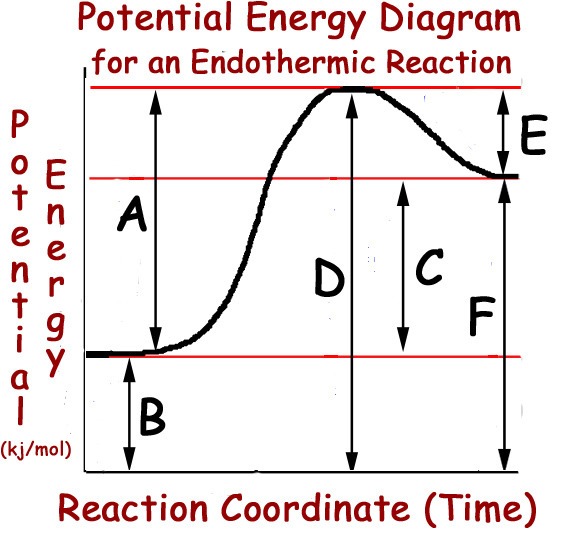
What letter represents the energy of the reactants?
A
B
C
F
What letter represents the energy of the products?
B
C
E
F
A pot of 2400.g of water at a temperature of 25.00˚C is heated on a stove until the water boils (100.0˚C). The specific heat of water is 4.184 J/(g˚C).
Determine the heat energy needed to heat the water in the pot to boiling.
Name this acid with the formula HF
hydrofluoric acid
hypofluoric acid
hydrogen fluorine acid
fluoric acid
Name this acid: HNO2
hydronitrous acid
hydrogen nitrogen oxygen
nitrous acid
hyponitrous acid
I have a balloon that can hold 100. liters of air. If I blow up this balloon with 3.00 moles of oxygen gas at a pressure of 1.00 atmosphere, what is the temperature of the balloon?
Remember: PV=nRT R = 0.0821 (L atm)/ (mol K)
400 K
2.74 K
406 K
3 K

