
 Worksheets
1970s-1980s
Total questions: 25
Worksheet time: 1hrs 15mins

What was one of President Nixon's goals for the meeting shown in this photograph?
To negotiate the withdrawal of U.S. and Chinese soldiers from Korea
To normalize relations between the United States and China
To create an agreement limiting Chinese and Soviet development of nuclear weapons
To create a military alliance with China against the Soviet Union

What was the primary goal of discussions between these two leaders?
To develop a global environmental-protection policy
To negotiate the reunification of Germany
To real a formal agreement on weapons control
To recognize the independence of former satellite states
One action that influenced the U.S.-Soviet signing of the SALT I treaty in 1972 was President Richard Nixon's -
opening of diplomatic relations with China
involvement in the Watergate scandal
support of Israel during the Yom Kippur War
withdrawal of military forces from Vietnam

Which speaker would most likely agree with President Ronald Reagan's national security policies?
Speaker 1
Speaker 2
Speaker 3
Speaker 4
The policy objectives of Reaganomics were based on the theory that -
borrowing from foreign countries would help cover the costs of domestic programs
reducing trade barriers would result in a budget surplus
broad tax cuts and financial deregulation would promote economic expansion
significant increases from foreign countries would help cover the costs of domestic programs
Why was President Ronald Reagan criticized for the Iran-Contra Affair?
His administration supported a revolution against an elected leader in Iran
His policies involved the sharing of nuclear technology with Iran
His policies threatened petroleum trade agreements with Iran
His administration violated an embargo by selling weapons to Iran

The name of which Middle Eastern country correctly completes the excerpt?
Egypt
Israel
Kuwait
Saudi Arabia

These demonstrations led to -
a global energy crisis borught on by an OPEC embargo
the bombing of a Marine barracks, followed by retaliatory U.S. air strikes
a U.S. boycott of the Olympics in protest of events in Central Asia
a hostage crisis that severely damaged confidence in the Carter administration

How did President Jimmy Carter attempt to end hostilities between the groups that fought these wars?
He helped negotiate a peace treaty known as the Camp David Accords.
He deployed U.S. troops to defeat the Palestine Liberation Organization.
He ordered the boycott of the Olympic Games in Moscow.
He treatened to sever diplomatic ties with Syria.

The author of this letter was -
a leader of the Civil Rights movement
the cofounder of the National Organization for Women
a leader of a conservative interest group
the cofounder of Ms. Magazine

Earth Day was created for the purpose of -
celebrating the diversity of mankind
honoring the world's agricultural workers
raising awareness of environmental issues
promoting peace throughout the world

How did this treaty contribute to the end of the Cold War?
By reducing tensions associated with the threat of nuclear war
By providing an exchange of weapons for war hostages
By allowing secret weapons technologies to be shared
By establishing an official cease-fire
Which action did Congress take to protect native plants and animals from extinction?
Passed the Endangered Species Act
Contructed the Hoover Dam
Passed the Community Reinvestment Act
Established the Department of Energy

Which statement correctly completes this timeline?
The Centers for Disease Control petitioned Congress to eliminate waste treatment plants.
The federal government created the Environmental Protection Agency to oversee environmental issues.
The automobile industry began researching alternative energy sources.
The president ordered the Public Health Service to deal with environmental pollution.
Which action is prohibited under the provisions of Title IX of the Education Amendments of 1972?
A principal refuses to organize athletic events and programs for female sports teams.
The funding for a music program is cut because of declining tax revenues.
A teacher attempts to organize a charity basketball game for faculty and friends.
The staffing for a foreign language class is reduced due to lack of interest.

How did the U.S. government work to change this situation?
By encouraging the development of alternative forms of fuel
By increasing the speed limit of interstate highways
By decreasing funding for electrical power stations
By discouraging exploration for fossil fuels

Which option completes this diagram?
President Richard Nixon's involvement in Watergate?
The proposed ratification of the Equal Rights Amendment
President Jimmy Carter's negotiation of the Camp David Accords
The introduction of the Marshall Plan as official foreign policy

The incident illustrated by this cartoon increased cynicism toward the U.S. government because -
the press secretary failed to keep the public infomred of national policy changes
the president direct a conspiracy to mislead the nation
the Supreme Court overruled federal statutes that defined confidentiality
Congress failed to pass legislation enforcing protection of privacy rights
Which diagram is about Sandra Day O'Connor?


How do Germany, Korea, and Vietnam have in common?
They were divided into communist and non-communist sides during the Cold War.
They were all enemies of the United States
They were all defeated after World War II
They were Soviet puppet states
The United States' policy in Vietnam seeking to contain communism in Southeast Asia was known as...
Truman Doctrine
Detente
Domino Theory
Reunification
The Gulf of Tonkin Resolution (1964) defined America's involvement in Vietnam by...
increasing executive power to deploy troops and weapons to Vietnam
increasing legislative power to deploy troops to Vietnam
recognizing North Vietnam's communist regime
withdrawing from South Vietnam
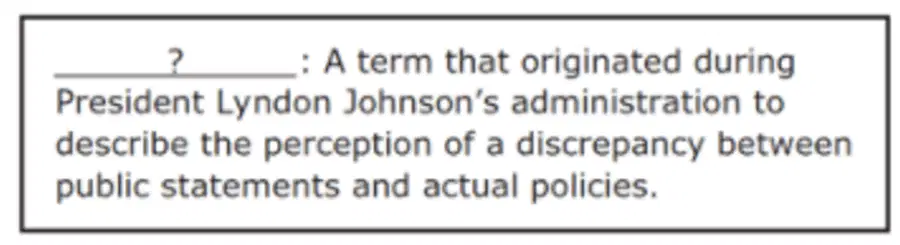
Which term completes this text box?
Hawk mentality
Living-Room War
Credibility gap
Flexible response
Which of these best explains why worldwide reactions to U.S. involvement in Vietnam grew increasingly hostile during the late 1960s and early 1970s?
The United States was viewed as appeasing a brutal dictator
The United States was viewed as an aggressor invading an underdeveloped nation
The United States demanded the unconditional surrender of Ho Chi Minh
The United States ignored a United Nations Security Council resolution to cease hostilities
Why did the United States fight in the Persian Gulf War?
Iraq needed help resisting a communist revolution
Iraq supplied weapons to al-Qaeda terrorists
Iraq invaded and occupied Kuwait
Iraq financed the Soviet invasion of Afghanistan

