
 Worksheets
YEAR 10 QUIZ FIRST ROUND
Total questions: 117
Worksheet time: 2hrs 43mins
Expand and simplify the following quadratic expression...
(x + 3)(x + 2)
x2 + 5x + 6
x2 + 5x + 5
x2 + 6x + 6
x2 + 6x + 5


What is the size of the relex angle COA?
62o
128o
232o
290o

RHS
Solve x2−9x+20=0
-2 or 10
-5 or -4
4 or 5
-4 or 5

The diagram shows the sports played by 80 students.
How many students play two sports only?
36
17
14
12
f-1(x) = −4x−3
f-1(x) = 3x+4

In the diagram, TP and TQ are tangents to a circle with centre O. Find each value of x
5x
90
15
180
Differentiate y= 5x-4
-5x-5
-20x-4
-25x-5
-20x-5
f(x) = 3x + 10 g(x) = x - 2 Find fg(0)
-16
Solve for x: log4 X= 3
12
64
81
100
A computer game was sold for $42 at a profit of 20%. How much was the original price of the game?
$60
$49
$42
$35

What are the roots of the quadratic equation shown in the graph?
-2 and 2
x= -2 and 6
A curve is given by y=3x2+6x+5 . Find the coordinates of the turning point.
(-1, 2)
(-1, -4)
(-1, 14)
(-1, 8)

DAE is a tangent to a circle.
Write down the size of angle ACB. Giv
61o
29o
63o
27o

The diagram shows a tangent to a circle with centre O. Find x and y
x = 80°
y = 40°
x = 100°
y = 50°
x = 80°
y = 50o
x = 100°
y = 40°
y is directly proportional to x y=54 when x=36 If:
y=kx Find k
6
9
10
324


Find the value of b.
90o
29o
61o
39o

Which material heats up quickest?
Aluminium
Concrete
Diamond
Glass
Water
Which material heats up quickest?
Aluminium
Concrete
Diamond
Glass
Water

10 kg of aluminium is heated from 120C to 220C. How much energy is needed?
8 970 000 J
897 J
8970 J
89 700 J
897 000J
What is the equation for specific heat capacity?
Q=mcΔT
Q=ΔTmc
Q=mcΔT
Q=mcΔT
Q=mΔcT
What are the units for specific heat capacity?
J kg / °C
J / kg / °C
J / °C
J / kg
kg °C / J

What is happening between D and E?
Melting
Boiling
Condensing
Freezing
Sublimation

2 kg of glass is given 84 000 J. What is the change in temperature?
+50°C
-50°C
0°C
+100°C
-100°C
When an electric heater is supplied with an electric power of 2.0 kW to heat 4.0 kg of water for 1 minute, calculate the increase in temperature of the water. Assume that the specific heat capacity of water is 4200 J kg-1 0C-1 and there is no heat loss to the surroundings.
3.050C
7.10C
140C
300C
Given that the specific latent heat of fusion of a sample is 550 kJ kg-1. Which of the following is correct?
The mass of this sample is 1 kg.
The energy needed to increase the temperature of 1 kg of this sample in solid state through 1oC is 550 kJ.
The energy needed to increase the temperature of 1 kg of this sample in liquid state through 1oC is 550 kJ.
The energy needed to change 1 kg of the material from solid state to liquid state is 550 kJ.
Regarding to the fixed points in Celsius scale, which of the following is correct?
The upper fixed point is the freezing point of water and the lower fixed point is the boiling point of water.
The upper fixed point is the boiling point of methane and the lower fixed point is the freezing point of methane.
The upper fixed point is the boiling point of water and the lower fixed point is the freezing point of ice.
The upper fixed point is the melting point of ice and the lower fixed point is the freezing point of ice.
How much energy is required to change 5 kg of ice at 0 ° C into water at the same temperature? (latent heat of fusion is 3.36 X 10⁶ J/kg )
16.1 XundefinedJ
16.8 XundefinedJ
15.1 Xundefinedcal
16.8 Xundefinedcal
Because of surface tension, you can put things into a full glass of water and...
the water will immediately spill.
the water won't spill for quite a while.
the water will never spill.
when the water spills, whatever you put in will also spill.

When calculating molar mass for an element, which number do you need to look at on the periodic table?
Atomic number
Atomic Mass
Atomic particles
Avogardo's Number
Because of surface tension, you can put things into a full glass of water and...
the water will immediately spill.
the water won't spill for quite a while.
the water will never spill.
when the water spills, whatever you put in will also spill.
Surface tension is the property of water in which...
water molecules at the surface tend to stick together.
water spills easily.
water tends to be see-through.
Describe COHESION.
Water molecules attracted to other substances.
Water molecules climbing upwards against the force of gravity.
Water molecules dissolving many substances because of its polarity.
Water molecules attracted to other water molecules.
surface tension of water can be reduced by
heating
Adding soap solution
cooling
adding salt


Centre of gravity the point in an object where its weight is balanced
True
False
none
Which one describe the point through which the whole weight of the body acts?
Inertial Point
Center of gravity
Centriod
Central point
The point through which the whole weight of the body acts is called
Inertial Point
Center of gravity
Centriod
Central point
Center of gravity of an object depends on it's
weight
mass
density
shape
What is the centre of gravity
The centre of the earth
An imaginary point at which weight is concentrated
Gravity
How objects fall to the ground.
Do all objects have a centre of gravity?
No objects have a centre of gravity
Only some objects have a centre of gravity
Only very heavy objects have a centre of gravity
Yes all objects have a centre of gravity
Where will be the centre of mass of a uniform rod lies ?
At its end
At its middle point
At its centre of its cross sectional area
Depends upon its material

The diagrams show four solid cones. The centre of mass of each cone is marked by a point labelled M.
Which cone is the most stable
A
B
C
D


When calculating molar mass for an element, which number do you need to look at on the periodic table?
Atomic number
Atomic Mass
Atomic particles
Avogardo's Number

A mole of any substance is how many particles?
6.02 x 10²³
6.02 x 10⁻²³
602 million
602

The calculation of the relationships between different molecules in a reaction is the definition of __________________.
physics
algebra
stoichiometry
language arts

Before you begin any stoichiometry problem, you must always start with this.
A periodic table.
A calculator.
A balanced chemical equation.
All of the above are helpful.

If I have 6.02 x 10²³ particles of O2, how many moles do I have?
1
6.02 x 10²³
None
16

In the reaction: P4 + 6Cl2 ---> 4PCl3, how many atoms of Chlorine are in the reactant?
1
2
6
12

In the reaction: P4 + 6Cl2 ---> 4PCl3, how many molecules of Phosphorous Chloride are there in the product?
1
2
4
12

If I were to put 6.02 x 10²³ particles of H2O on a balance, what would the reading be?
2 g
4 g
18 g
6.02 g

The process of comparing units is called ____________________.
stoichiometry
dimensional analysis
algebra
social studies

The hardest part of chemistry this year was:
States of matter
Labs
Balancing equations
Atomic Theory
Stoichiometry
Adding a catalyst ___________ the activation energy.
Raises
Lowers
Doesn't affect
Inreases
The minimum amount of energy needed for colliding particles to react is called
Chemical Energy
Kinetic Energy
Activation Energy
Potential Energy
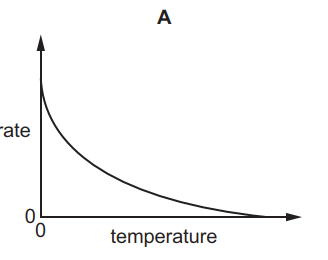
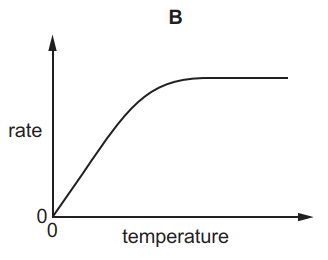
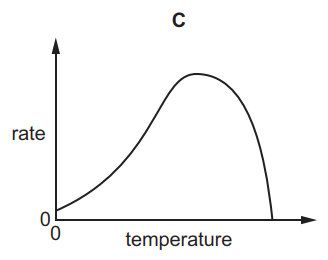
Which graph shows the effect of increasing temperature on the rate of reaction of calcium carbonate with dilute hydrochloric acid?
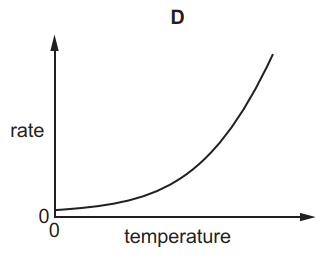
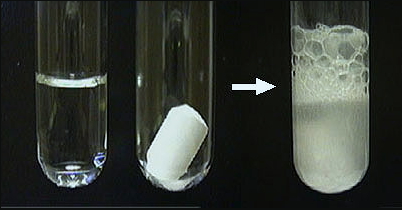
How could we make this reaction happen more quickly?
Decrease the concentration of the acid
crush the chalk to increase the surface area
Put the test tube in an ice bath
The major theory of reaction rate is called
Collision theory
Crash theory
Newton's laws
Thermodynamics
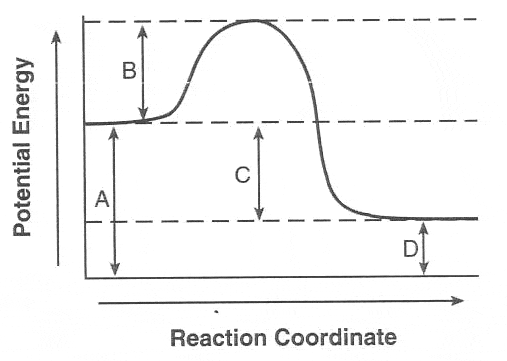
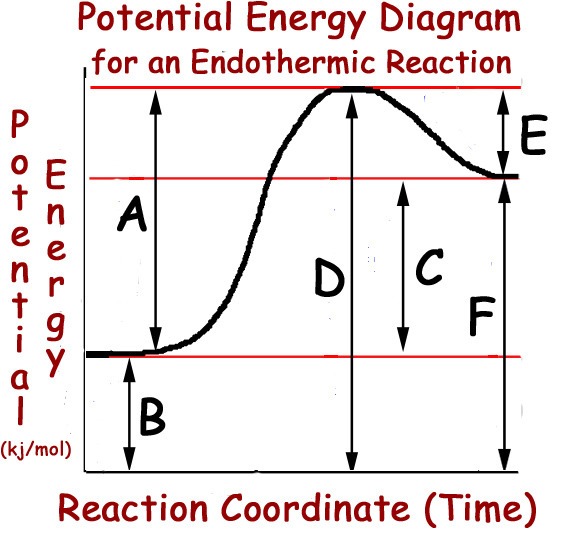
What type of reaction is this?
Endothermic
Exothermic
A chemical reaction in which energy is absorbed is ______________.
an endothermic reaction
an exothermic reaction
a single replacement reaction
a double replacement reaction
The following equation shows the reaction between calcium carbonate, CaCO3 and hydrochloric acid, HCl:
CaCO3(aq) + 2HCl(aq) → CaCl2(aq) + CO2 (g) + H2O(l)
Which of the following is the suitable method to determine the rate of reaction?
Change in the temperature of the solution with time
Change in the volume of carbon dioxide gas with time
Change in the mass of water with time
Change in the concentration of hydrochloric acid with time
Which of the following explains the meaning of effective collision?
The collision where its energy is less than the activation energy
The collision that has a low energy
The collision which takes place before a reaction
The collision that causes a reaction
Which of the following is the meaning of activation energy?
The maximum energy that the particles need to produce effective collision
The amount of energy used by the particles during a collision
The minimum amount of energy that particles must have in order to react
The amount of kinetic energy of molecules during a collision
Smaller particle size allows for a _________ surface area to be exposed for the reaction.
larger
smaller
rectangular
spherical
Which unit is correct for the rate of reaction?
g mol-1
g min-1
mol dm-3
kJ mol-1
Which of the following would react fastest in sweet tea?
a sugar cube
a sugar cube cut in half
a sugar cube cut in fourths
a sugar cube crushed into powder
Enzymes in your body act as catalysts. Thus, the role of enzymes is to___________.
inhibit chemical reactions.
increase the rate of chemical reactions.
decrease the rate of chemical reactions.
Which of the following has the lowest rate of reaction?
Combustion of ethanol
Oxidation of magnesium
Fermentation of glucose
Precipitation of silver chloride

Table 4 shows the total volume of gas evolved at different intervals for the dissociation of hydrogen peroxide.
What is the average rate of reaction in the second minute?
14.0 cm3 min-1
18.0 cm3 min-1
16.0 cm3 min-1
28.0 cm3 min-1
Typically, atoms are more stable when they are
bonded together
apart from each other

