
 Worksheets
PHS Geometry Mid Year Review
Total questions: 120
Worksheet time: 2hrs 49mins
What is the difference between a LINE SEGMENT and a LINE?
Line Segments are two-dimensional, Lines are one-dimensional
Lines can be represented on single planes; Line Segments can only be represented on multiple planes.
Line Segments have finite lengths; Lines go on forever.
Line segments are geometric figures; Lines are not.
Which terms are considered undefined terms in Euclidean geometry?
Point, plane, line segment
Point, line, plane
Line, plane, angle
Point, line, ray
In a geometric system, which would best describe how postulates differ from theorems?
Postulates do not require a proof and are presumed true, while theorems are statements requiring proof.
Postulates are statements that require proof, while theorems cannot be proven.
Both postulates and theorems do not require proof and are assumed to be true.
There is no difference between postulates and theorems.


F
G
H
J

23 degrees
66 degrees
89 degrees
91 degrees

A
B
C
D

x = 12
x = 24
x = 36
x = 46

A
B
C
D

3
4
5
6

4
12
51
180

A
B
C
D

A
B
C
D

The perimeter of triangle ABC is about 15
The length of the longest side of the triangle is about 5.83 units
The area of the triangle is 9 square units
The length of the shortest side of the triangle is about 3.16 units
What is the slope of line KH if H(-4, 2) and K(2, -2)? Remember to reduce!
-3/2
-2/3
2/3
3/2
What is the slope of line CD if C(2, 5) and D(6, 5)? Remember to reduce!
5/2
2/5
0
undefined
Are Line PQ and line JK parallel, perpendicular, or neither if:
slope of PQ = 5
slope of JK = -1/5
parallel
perpendicular
neither
Are Line EF and line CD parallel, perpendicular, or neither if:
slope of EF = -3/4
slope of CD = -3/4
parallel
perpendicular
neither
Are Line BC and line ST parallel, perpendicular, or neither if:
slope of BC = -5/3
slope of ST = 3/5
parallel
perpendicular
neither
Are Line FG and line KJ parallel, perpendicular, or neither if:
F(–1, 2), G(3, –4), K(–2, –3), and J(4, 1)?
parallel
perpendicular
neither

What is the slope of the graphed line?
(a)
Are line RS and line TU parallel, perpendicular, or neither if:
R(–2, 3), S(3, 3), T(–3, 1), and U(3, –1)?
parallel
perpendicular
neither
Are line A and line B parallel, perpendicular, or neither if:
line a goes through (-1,2) and (3, -6) and
line B has an equation of 3y = -6x + 9?
parallel
perpendicular
neither
Write the equation of a line in slope intercept form that is perpendicular to
y = (2/3)x - 4 and passes through (-6, 1).
y = (2/3)x + 5
y = (2/3)x - 8
y = (-3/2)x + 5
y = (-3/2)x - 8
y= 2x - 7
If a line has a slope of 2/3 a line that is perpendicular has a slope of what?
-3/2
3/2
2/3
-2/3


If the lines are parallel to each other and the slope of the blue line is 1/4, what is the slope of the purple line?
4
-4
−41
41

Name a pair of alternate interior angles.
∠1 and ∠4
∠2 and ∠4
∠3 and ∠4
∠4 and ∠5

Name a pair of alternate exterior angles.
∠1 and ∠3
∠1 and ∠4
∠1 and ∠6
∠1 and ∠7

Name a pair of consecutive interior angles.
∠1 and ∠2
∠3 and ∠7
∠4 and ∠5
∠6 and ∠7

What is the m∠1?
78°
87°
93°
102°

Name a pair of corresponding angles.
∠1 and ∠2
∠1 and ∠4
∠1 and ∠5
∠1 and ∠6

Triangle DEF is reflected over the line x=−2 . What are the coordinates of D'?
(a)

Triangle ABC is rotated 90° counterclockwise around the origin. What are the coordinates of B'?
(a)
If point H(−6,2) is translated 4 units up and 3 units right, what are the coordinates of the translated image?
(3,4)
(−2,5)
(−3,6)
(10,5)

Determine the rule on how to translate triangle ABC to its image A'B'C'.
(x+5, y-3)
(x+3, y-5)
(x-3, y+5)
(x-5, y+3)

Triangle ABC is reflected across the line y=0. Where is A'?
(a)

Which option does NOT accurately describe the transformation from triangle ABC to A'B'C'.
270° counterclockwise rotation around the origin
90° clockwise rotation around the origin
90° rightward rotation around the origin
90° counterclockwise rotation around the origin

Which vector represents the translation from triangle ABC to A'B'C'?
<4, 2>
<-5, 3>
<5, -3>
<-3, 5>
How can you tell if an object has been reflected over the x axis? Select all that apply.
The new object mirrors the original object.
The object slid over the x axis.
The object was flipped over the x axis.
The new object is the same distance away from the x axis as the original object.

What transformation has occurred?
Translation
Reflection
Rotation
Dilation
(x, y) ----> (x + 2, y - 3)


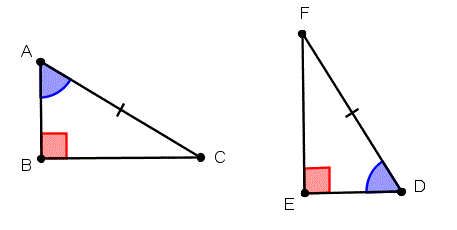


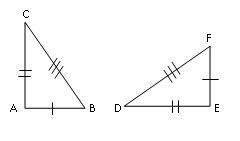
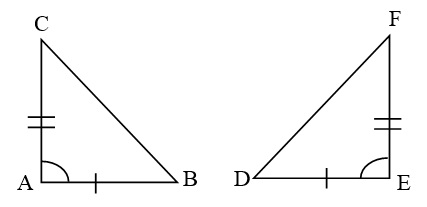
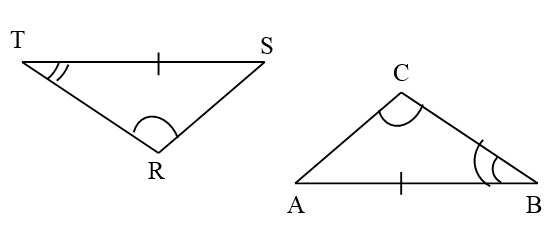

Are the triangles congruent?
Yes, by AAS≅
Yes, by AA≅
Yes, by ASA≅
Yes, by SAS≅
Not enough information

Which pieces of information could you use to prove the triangles congruent? (Select multiple.)
m∠LKN = m∠MNK
m∠NLK = m∠KMN
m∠LNK = m∠MKN
KN = KN
LN = MK

Which pieces of information could you use to prove the triangles congruent? (Select multiple.)
m∠Q = m∠S
m∠P = m∠R
m∠POQ = m∠ROS
SO = QO
RO = PO

Which pieces of information could you use to prove the triangles congruent? (Select multiple.)
m∠T = m∠V
m∠U = m∠W
m∠TXU = m∠VXW
TX = VX
TU = VW

Are the triangles congruent?
Yes, by AA≅
Yes, by AAS≅
Yes, by ASA≅
Yes, by AAA≅
Not enough information

Are the triangles congruent?
Yes, by AA≅
Yes, by AAS≅
Yes, by ASA≅
Yes, by SAS≅
Not enough information

Are the triangles congruent?
Yes, by SSA≅
Yes, by AAS≅
Yes, by ASA≅
Yes, by SAS≅
Not enough information

Using the Triangle Inequality Theorem, find the inequality that represents the possible side lengths of the given triangle.
(Note: The triangle is not necessarily drawn to scale)
4<x<22
x<17
17<x<24
2<x<5

The given figure is a parallelogram. Solve for x.
x=7
x=311
x=113
x=71

Find the measure of the angle indicated by x in the parallelogram.
(a)

Find m∠C in the given figure.
m∠C=40∘
m∠C=25∘
m∠C=80∘
m∠C=50∘

Using the given figure, which congruence statement is correct?
ΔABC≅ΔBDA
ΔADE≅ΔBCE
ΔAED≅ΔAEB
ΔAEB≅ΔDEC

Determine if the given triangles can be proven congruent. If they can, state the name of the postulate or theorem that can be used to prove them congruent.
No, there is not enough information to prove the triangles are congruent.
Yes, SAS congruence postulate
Yes, ASA congruence postulate
Yes, HL congruence theorem
Using the Triangle Inequality Theorem, which set of side lengths below could not be used to make a triangle?
{1.5 m, 2 m, 3 m}
{20, 60, 70}
{200 ft, 150 ft, 51 ft}
{120 cm, 60 cm, 50 cm}

x = 8
x = 16
x = 32
x = 4

m∠KLJ=15°
m∠KLJ=73°
m∠KLJ=48°
m∠KLJ=24°

m∠YQR=21°
m∠YQR=3°
m∠YQR=46°
m∠YQR=33°
The altitudes of a triangle intersect at the ____________________.
Circumcenter
Incenter
Centroid
Orthocenter
The angle bisectors of a triangle intersect at the ________________________.
Circumenter
Incenter
Centroid
Orthocenter

Circumcenter
Incenter
Centroid
Orthocenter

Circumcenter
Incenter
Centroid
Orthocenter

If H is the circumcenter of the triangle, find BE.
BE = 9
BE = 14
BE = 18
BE = 12
If H is the circumcenter of the triangle, find EH.
EH = 10.7
EH = 9
EH = 14
EH = 5.8

m∠ZTV=43°
m∠ZTV=86°
m∠ZTV=5°
m∠ZTV=51°

If G is the centroid of the triangle, find AC.
70
35
42
28
Which of the following could represent side lengths of a triangle? Check ALL that apply.
19, 11, 17
23, 28, 52
34, 9 , 25
13, 22, 14

21
26
9
15

Which of the following list the sides of ΔDEF from least to greatest?
DE, EF, DF
EF, DF, DE
EF, DE, DF
DF, DE, EF
angles
What quadrilaterals has 2 pairs of parallel lines; 4 sides have equal length; 4 right angles?
rectangle
rhombus
square
I don't know

What is the name of this shape?
Rectangle
Square
Rhombus
Kite

Which quadrilateral has perpendicular diagonals?
rectangle
rhombus
parallelogram
trapezoid
Which quadrilateral has equal diagonals?
rectangle
rhombus
kite
parallelogram
A parallelogram is ____________ a rectangle.
Always
Sometimes
Never
A rhombus is ___________ a parallelogram.
always
sometimes
never
A quadrilateral is _____________ a triangle.
Always
Sometimes
Never
What is the perimeter of a rhombus that has a side length of 7 ft?
7 ft
14 ft
28 ft
49 ft
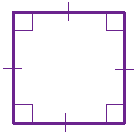
Consecutive angles in a parallelogram are always....
Complementary
Supplementary
Congruent
Unrelated
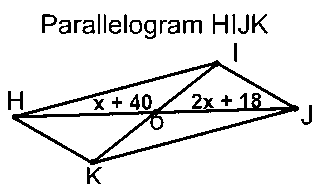
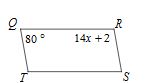
Solve for x.

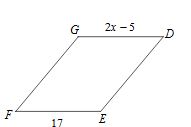
Solve for x.


Find x:
120°
60°
135°
144°

