wayground logo

Free Printable Worksheets

Font size

S
M
L
XL
Worksheets

Relations and Functions Test

Total questions: 125

Worksheet time: 6hrs 41mins

Name
Class
Date
1.

Does the table show y as a function of x?

a)

Yes, it is a function.

b)

No, it is not a function

2.

Does the table show y as a function of x?

a)

Yes, it is a function.

b)

No, it is not a function

3.

Match the relations with their domain and range.

a)
1.

D: {-4, 3, 5, 7}

R: {4, 14, 32}

b)
2.

D: {-7, -2, 0, 5}

R: {-9, -4, -1}

c)
3.

D: {-2, -1, 0, 1, 2}

R: {-2, -1, 0, 1, 2}

d)
4.

D: {-1, 0, 2, 7}

R: {-2, 1, 4, 7}

e)
5.

D: {-5, -3, 3}

R: {-5, -2, 5}

4.

Which tables show y as a function of x?

a)
b)
c)
d)
5.

Which set of ordered pairs represents y as a function of x?

a)

{(−9, 2), (0, 6), (1, −2), (−3, 6)}

b)

{(−1, 0), (4, 3), (−7, −3), (−1, −8)}

c)

{(3, 2), (−4, −2), (3, 1), (−4, 1)}

d)

{(5, 4), (2, 3), (1, 1), (2, 4)}

6.

The mapping below represents y as a quadratic function of x.

Which representation shows the same relationship between x and y?

a)
b)
c)
d)
7.

Which representation does not show y as a function of x?

a)
b)
c)
d)
8.

Which tables do not represent y as a function of x?

a)
b)
c)
d)
9.

Which graph does not represent y as a function of x?

a)
b)
c)
d)
10.

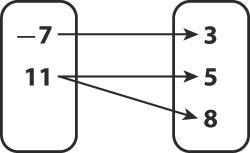
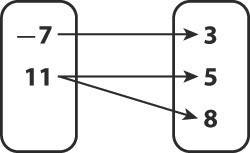
Is the relation a function? Why?

a)

Yes, because the x-value 11 has two y-values paired with it.

b)

Yes, because each x-value has only one y-value paired with it.
c)

No, because the x-value 11 has two y-values paired with it.

d)

No, because each x-value has only one y-value paired with it.

11.

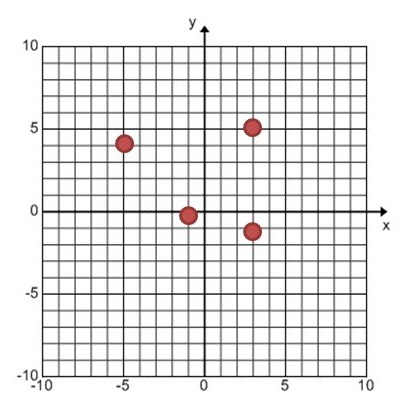
Does the graph represent a function?

a)

Yes

b)

No

12.

Which table represents the same relation as the graph?

a)
b)
c)
d)
13.

Why is the relation below not a function?

14.

Which table shows y as a function of x?

a)
b)
c)
d)
15.
Is this graph a function or not a function? 
a)
Function
b)
Not a Function
16.

ANY set of ordered pairs is called what?

a)

Coordinates

b)

Relation

c)

Function

d)

Vertical Line Test

17.
Which relation is NOT a function?
a)

{(1,-5), (3,1), (-5,4), (4,-2)}

b)

{(2,7), (3,7), (4,7), (5,8)}

c)

{(1,-5), (-1,6), (1,5), (6,-3)}

d)

{(3,-2), (5,-6), (7,7), (8,8)}

18.
Is the relation a function?
a)

YES

b)

NO

19.
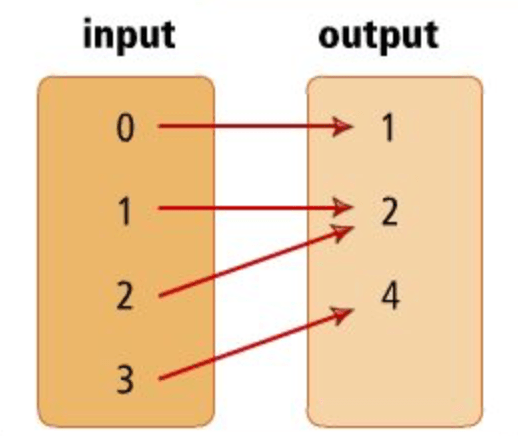
Is this mapping a function or not a function? 
a)

Function

b)

Not a Function

20.

If g(x) = 2x + 5, what is the value of g(4)?

a)

13

b)

29

c)

22

d)

9

21.

What is the domain?

a)

the set of all x-values

b)

the set of all y-values

22.

What is the range?

a)

the set of all x-values

b)

the set of all y-values

23.
For the function {(0,1), (1,-3), (2,-4), (-4,1)}, write the domain and range.
a)
D: {1, -3, -4,}
R: {0, 1, 2, -4}
b)
D:{0, 1, 2, -4}
R:{1, -3, -4}
c)
D:{0, 1, 2, 3, 4}
R:{1, -3, -4}
d)
D:{0, 1, 2, 3}
R:{0, 1, 2, 3, 4}
24.
Does the graph represent a function?
a)
Yes, because the vertical line test shows there are no repeating input values
b)
No, because the vertical line test shows there are repeating input values
25.
Does this mapping diagram represent a function?
a)
No, because there are repeating input values
b)
Yes, because there are no repeating input values
26.
Is the relation a function? 
{(-6, -1), (5,-1), (0, -1), (-2, -1), (3, -1)}
a)
Yes
b)
No
27.
Is the relation a function? 
{(4,5), (4,-7), (4,2), (4,0), (4,9)}
a)
Yes
b)
No
28.
A set of ordered pairs is called what?
a)
Coordinates
b)
Relation
c)
Function
d)
Vertical Line Test
29.
Which type of relation is shown?
a)
Mapping
b)
Graph
c)
Table
d)
Set of ordered pairs
30.

A relation where every input in matches with exactly one output is called what?

a)

Relation

b)

Linear

c)

Exponential

d)

Function

31.
a)
Function
b)
Not a Function
32.
a)
Function
b)
Not a Function
33.
a)
Function
b)
Not a Function
34.
a)
Function
b)
Not a Function
35.
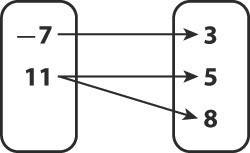
Is the relation a function? Why.
a)
Yes, because the x-value 11 has two y-values pair with it.
b)
Yes, because each x-value has only one y-value paired with it.
c)
No, because the x-value 11 has two y-values pair with it.
d)
No, because each x-value has only one y-value paired with it.
36.
What is the range of the function shown?
a)
{10, 19, 26}
b)
{-3, 0, 4}
c)
{-3, 0, 4, 10, 19, 26}
d)
{0, 16}
37.
What is the range of the function f(x)= x2 + 2 when the domain
is {-1, 0 , 1}?
a)
{1, 2, 3}
b)
{2, 3}
c)
{0, 2, 4}
d)
{1, 3}
38.
What is the domain of the function graphed?
a)
x < 5
b)
x ≥ 1
c)
x > 0
d)
All real numbers
39.
Which of the inequalities below best describes the domain of the function shown on the graph?
a)
-2 ≤ x ≤ 2
b)
-5 ≤ x ≤ -3
c)
-2 ≤ x ≤ 3
d)
-5 ≤ x ≤ 3
40.
Given the function f(x) = 4x2 - 5, what is the range?
a)
All real numbers greater than or equal to -5
b)
All real numbers
c)
All real numbers greater than or equal to 5
d)
All real numbers less than or equal to -5
41.
A toy rocket is launched into the air, and the data from the rocket's flight is graphed below. What is the domain of the data collected?
a)
0≤ x ≤ 7
b)
0≤ x ≤ 8
c)
0≤ y ≤ 7
d)
0≤ y ≤ 8
42.
The elements of f(x) are (-7, 3), (-1, 6) and (8, -3). What is the range of the function?
a)
{-7, -1, -8}
b)
{-3, 6}
c)
{-3, 3, 6}
d)
All real numbers
43.
What is the range of the function graphed?
a)
-3 < x ≤ 6
b)
-3 < y ≤ 6
c)
2 < y ≤ 6
d)
2 < x ≤ 6
44.
Before a bowler rolls her first ball, 10 pins are standing. The number of pins that will be left standing, y, is a function of the number of pins she knocks down. What is the range of the function?
a)
{0, 1, 2, 3, 4, 5, 6, 7, 8, 9, 10}
b)
{1, 2, 3, 4, 5, 6, 7, 8, 9, 10}
c)
y ≤ 10
d)
0 ≤ y ≤ 10
45.
What is the domain of the graph?
a)
{-4, 0, 2, 4}
b)
{-5, -4, -3, -1}
c)
{-5, -4, -3, -1, 0, 2, 4}
d)
All real numbers
46.
Is the relation a function? Why?
a)
Yes, because the x-value 11 has two y-values pair with it.
b)
Yes, because each x-value has only one y-value paired with it.
c)
No, because the x-value 11 has two y-values pair with it.
d)
No, because each x-value has only one y-value paired with it.
47.
a)
Function
b)
Not a Function
48.
a)
Function
b)
Not a Function
49.
For the function {(0,1), (1,-3), (2,-4), (-4,1)}, write the domain and range.
a)
D: {1, -3, -4,}
R: {0, 1, 2, -4}
b)
D:{-4, 0, 1, 2}
R:{-4, -3, 1}
c)
D:{0, 1, 2, 3, 4}
R:{1, -3, -4}
50.
Does this mapping diagram represent a function?
a)
No, because there are repeating input values
b)
Yes, because there are no repeating input values
51.
All of the y values or outputs are called what?
a)
Domain
b)
Range
c)
Relation
d)
Function
52.
All of the x values or inputs are called what?
a)
Domain
b)
Range
c)
Relation
d)
Function
53.
What is the domain of the graph?
a)
x≤0
b)
x≥0
c)
All real numbers
d)
y≥0
54.
What is the range of the graph?
a)
x≤0
b)
y≥0
c)
y≤0
d)
All real numbers
55.
What is the domain of the function?
a)
x>3 
b)
x≥-3
c)
y≤4
d)
y<4
56.
What is the range of the function?
a)
-7≤x≤6
b)
-7<x<6
c)
-8<y<2
d)
-8≤y≤2
57.
What is the domain of the function?
a)
0<h<80
b)
0≤h≤80
c)
0≤t≤4.5
d)
0<t<4.5
58.
What is the range of the function?
a)
0≤h≤3
b)
0≤h≤36
c)
h<3
d)
t≤36
59.
Daily rainfall is an example of what sort of data?
a)
Discrete 
b)
Continuous
60.
To celebrate the holiday season this year, Six Flags has created an extreme six-lane, tubing hill with real snow called the “Superman’s Awesome SNOW Tubing Ride.”  The cost of each ticket for one day is $35.  The number of tickets purchased by groups is given by the domain {3, 8, 12}.  Which would be a reasonable range for the total cost of the tickets the groups would pay? 
a)
{3,8,12}
b)
{105,280,420}
c)
{3,8,12,105,280,420}
d)
{38,43,51}
61.
What is the range of the following function, if the domain is {1,7,10}? 
f(x) = x + 4
a)
{-3,3,6}
b)
{1,7,10}
c)
{5,11,14}
d)
{4,28,40}
62.
Joe is losing an average of .5 pounds a week.  Is this continuous or discrete data?
a)
Discrete
b)
Continuous
63.
Which of the following is NOT discrete data?
a)
There average life span of a human being is 79 years in USA
b)
The possible outcomes of rolling a die
c)
A woman in USA has 2 children on average.
d)
Ms Ocampo has between 11 to 22 students per class.  
64.
a)
Function
b)
Not a Function
65.
All of the y values or outputs are called what?
a)
Domain
b)
Range
c)
Relation
d)
Function
66.
All of the x values or inputs are called what?
a)
Domain
b)
Range
c)
Relation
d)
Function
67.
What is the range of the following graph?
a)
-5, -1,  0 , 1, 5
b)
-4, -2, 0, 3, 6
c)
(-4, 1)  ( 6, 0)
d)
(6, 0)
68.
a)
Function
b)
Not a Function
69.
a)
Function
b)
Not a Function
70.
What is the range of the following relation:
(9, -2) (4, 3)  ( 8, 10) ( -4, 8)
a)
-4, 4, 8, 9
b)
-2, 3, 8, 10
c)
(9, -2) ( 4, 3)
d)
(8, 10) (-4, 8)
71.
a)
Function
b)
Not a Function
72.
a)
A
b)
B
c)
C
d)
D
73.
Is the relation a function?
a)
Function
b)
Not a Function
74.
What is the domain of this function?
(2, 4), (5, 5), (8, 6), (11, 7)
a)
{1, 2, 3, 4, 5, 6, 7, 8, 9, 10, 11)
b)
(2, 5, 8, 11}
c)
{4, 5, 6, 7}
d)
{2, 4, 5, 8, 6, 11, 7}
75.
What is the domain?
a)
{-2, -1, 0, 1, 8}
b)
{3, 5, 7 , 9, 0}
c)
{-2, -1, 0, 1, 3, 5, 7, 8, 9}
d)
{-2, -1, 0, 1, 2, 3, 4, 5, 6, 7, 8, 9}
76.
a)
Function
b)
Not a Function
77.
Is this graph a function or not a function? 
a)
Function 
b)
Not a Function
78.
For the function {(0,1), (1,-3), (2,-4), (-4,1)}, write the domain and range.
a)
D: {1, -3, -4,}
R: {0, 1, 2, -4}
b)
D: {-4, 0, 1, 2}
R:{-4, -3, 1}
c)
D: {0, 1, 2, 3, 4}
R:{1, -3, -4}
d)
D: {0, 1, 2, -4}
R: {1, -3, -4, 1}
79.
a)
{-2, 3, 7}
b)
[-2, 3]
c)
{1, 2, 2, 3, 4}
d)
[1, 4]
80.
What is the domain of this function?
(2, 4), (5, 5), (8, 6), (11, 7)
a)
{1, 2, 3, 4, 5, 6, 7, 8, 9, 10, 11)
b)
{2, 5, 8, 11}
c)
{4, 5, 6, 7}
d)
{2, 4, 5, 8, 6, 11, 7}
81.
What is the domain?
a)
{-2, -1, 0, 1, 8}
b)
{3, 5, 7 , 9, 0}
c)
{-2, -1, 0, 1, 3, 5, 7, 8, 9}
d)
{-2, -1, 0, 1, 2, 3, 4, 5, 6, 7, 8, 9}
82.

Give the range of the set of ordered pairs: (2, 11), (9, -3), (7, 21), (-8, 6)

a)

{8, 2, 7.9}\left\{-8,\ 2,\ 7.9\right\}

b)

{3, 6, 11, 21}\left\{-3,\ 6,\ 11,\ 21\right\}

c)

8<x<9-8<x<9

d)

3<y<21-3<y<21

83.

What is the test to determine if a graph represents a function?

a)

Horizontal line test

b)

Vertical line test

c)

Heidelberg Uncertainty Test

d)

Obi Wan Kenobi Test

84.

Does this table represent a function?

a)

Yes!

b)

No!

c)

I Don't Know

85.

Why is the following relation NOT a function?

(2, 3), (4, 9), (3, 8), (4, 15)

4 lines
86.
What is the domain of the graph?
a)
-3 ≤ x ≤ 3
b)
3 ≤ x ≤ -3
c)
-2 ≤ x ≤ 10
d)
-3 ≤ x ≤ 10
87.
What is the Range?
a)
y ≥ 6
b)
y ≤ 6
c)
-10 ≤ y ≤ 6
d)
-10 ≤ x ≤ 6
88.
Find the Domain.
a)
All real numbers
b)
x > 3
c)
x > 0
d)
x ≥ 0
89.
What is the domain of this function?
a)
All Real Numbers
b)
f(x) ≥ -2
c)
f(x) ≥ 2
d)
x ≥ -2
90.
What is the domain of this function?
a)
1 ≤ f(x) ≤ 7
b)
1 ≤ x ≤ 7
c)
-3 ≤ f(x) ≤ 3
d)
-3 ≤ x ≤ 3
91.
What is one true statement about the domain and range of this function?
a)
The domain and range are equal
b)
The domain is all real numbers and the range isn't
c)
Both the domain and range are only positive values
d)
The domain and range both have negative values
92.

What is the Domain of this linear function?

a)

-6 ≤ x ≤ 6, real numbers

b)

0 ≤ x ≤ 7, integers

c)

2 ≤ x ≤ 7, real numbers

d)

No Solution

93.

What is the Range of this linear function?

a)

-6 ≤ y ≤ 6, integers

b)

0 ≤ y ≤ 6, real numbers

c)

0 ≤ y ≤ 6, integers

d)

4 ≤ y ≤ 3, real numbers

94.

What is the DOMAIN?

a)

x ≤ 2

b)

x ≥ 2

c)

All Real Numbers

d)

-2 ≤ x ≤ 2

95.

What is the RANGE?

a)

y ≤ 2

b)

y ≥ 2

c)

All Real Numbers

d)

-2 ≤ y ≤ 2

96.

Find the DOMAIN

a)

{-5, -2, 1, 4}

b)

{1, -2, 4, -5}

c)

{-1, 0, 2, 3}

d)

{0, -1, 2, 3}

97.

Find the RANGE

a)

{-5, -2, 1, 4}

b)

{1, -2, 4, -5}

c)

{-1, 0, 2, 3}

d)

{0, -1, 2, 3}

98.

What is the RANGE?

a)

-4 ≤ x ≤ 1

b)

-4 ≤ y ≤ 1

c)

-2 ≤ x ≤ 3

d)

-2 ≤ y ≤ 3

99.

What is the DOMAIN?

a)

x < -3

b)

x > -3

c)

x > 1

d)

All Real Numbers

100.
Evaluate f(-2) if f(x) = x2+ 3
a)
-1
b)
1
c)
7
d)
-7
101.

Given h(x) = 5 - 9x, find h(8). 

102.
For the function f(x) = -3(x-1) find f(0).
a)
0
b)
-3
c)
3
d)
-1
103.
Evaluate f(-5) if f(x) = -2x - 12
a)
-22
b)
-2
c)
-19
d)
-5
104.

If f(x) = 7, what is the value of x?

f(x) = 3x+1

a)

2

b)

83\frac{8}{3}

c)

3

d)

8

105.

If f(x) = -4, what is the value of x?

f(x)=4+x3f\left(x\right)=-4+\frac{x}{3}  


a)

0

b)

1

c)

-3

d)

3

106.

f(n)=410nf\left(n\right)=4-10n  

If f(n) = 14, what is the value of x?

a)

1

b)

-1

c)

6

d)

-6

107.

7x+8=297x+8=29

The first step to solve this equation is to ​ (a)   . The next step is to ​ (b)   . The answer is ​ (c)   .

Choose from the below words
subtract 8
divide 7
x=3
add 8
multiply 7
subtract 7
x=2
x=5.2
x=7
divide 8
108.

If f(x) = 10, what is the value of x?

x + 2 = f(x)

109.

5x1=f(x)5x-1=f\left(x\right)  

If f(x) = 19, what is the value of x?

a)

x=4x=4  

b)

x=10x=10  

c)

x=5x=5  

d)

x=15x=15  

110.

f(x) = 3(3x 7)f\left(x\right)\ =\ 3\left(3x\ -7\right)

If f(x) = 24, what is the value of x?

a)

x = 9x\ =\ -9  

b)

x = 5x\ =\ 5  

c)

x =3x\ =3  

d)

x = 7x\ =\ 7  

111.

Solve for f(x) = 10

9x + 1 = f(x)

a)

1

b)

10

c)

12

d)

11

112.

If f(x) = 7, what is the value of x?

6x - 5 = f(x)

a)

2

b)

3

c)

6

d)

12

113.

If f(x) = 1, what is the value of x?

f(x)=x7f\left(x\right)=x-7

114.

Place the steps to the equation in order.

a)

3x - 2 = -5

b)

3x = -3

c)

x = -1

1)
2)
3)
115.
f(x) is the same thing as ______.
a)

y

b)

x

c)

input

d)

an equation

e)

TV channel

116.

If f(x) = 2x + 1, find f(1).

a)

f(1) = 1

b)

f(1) = 4

c)

f(1) = 0

d)

f(1) = 3

e)

f(1) = -1

117.

Translate the coordinate pair into function notation.

(0,8)\left(0,8\right)  

a)

f(0)=8f\left(0\right)=8  

b)

f(0)=8f\left(0\right)=-8  

c)

f(8)=0f\left(8\right)=0  

d)

f(8)=0f\left(-8\right)=0  

e)

f(x)=8f\left(x\right)=8  

118.

f(x)=5x+10f\left(x\right)=-5x+10

Find f(x)=5f\left(x\right)=-5

(a)  

119.

If h(t)=2t2+5t3h\left(t\right)=2t^2+5t-3 find h(3)h\left(-3\right)

(a)  

120.
Is this mapping a function or not a function? 
a)
Function
b)
Not a Function 
121.
Is the relation a function? Why.
a)
Yes, because the x-value 11 has two y-values pair with it.
b)
Yes, because each x-value has only one y-value paired with it.
c)
No, because the x-value 11 has two y-values pair with it.
d)
No, because each x-value has only one y-value paired with it.
122.

Determine if the relations is a function and describe the pattern

a)

Yes it is a function, input goes up 1 and output goes up by 15

b)

Yes it is a function, input goes up 15 and output goes up by 1

c)

Not a function, input goes up 1 and output goes up by 15

d)

Not a function, input goes up by 15 and output goes up by 1

123.
a)
Function
b)
Not a Function
124.
Is this a function? 
a)
Yes 
b)
No
125.
a)
Function
b)
Not a Function