
Font size
 Worksheets
Osmosis and Diffusion
Total questions: 25
Worksheet time: 19mins
Diffusion occurs only in solids
True
False
How do the particles move in diffusion?
From a region of low concentration to a region of high concentration
From a region of high concentration to a region of low concentration
From a region of low concentration to a region of low concentration
From a region of high concentration to a region of high concentration
How long does diffusion last?
Until the concentration of particles in the system is equal
(Select this answer and I swear i'll make it harder for you in the assessment task)
Until a region in the system has a greater concentration of particles than the other
Until the particles disappear from the system
The movement of particles is __________, resulting in the particles being spread throughout the container
Structured
In a straight line
Random
In curved, way motions
What happens to the coffee particles when coffee is added to hot water?
They sink to the bottom of the cup
They spread out
They clump together
What does a 'region with high concentration' mean?
An area with a SMALL number of particles
An area with a LARGE number of particles
An area with an UNEVEN number of particles
An area with no particles
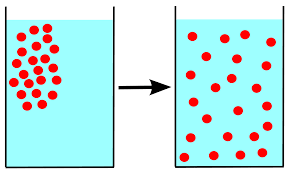


Which of the following is a correct description for solids?
closely arranged and in fixed positions
closely arranged and vibrate in fixed positions
closely arranged and can move around
Which statement about the molecules in the gas carbon dioxide is correct?
The molecules are close together.
The molecules are diatomic.
The molecules move randomly.
The molecules all move with the same speed.
An evidence that proves that particles are in random motion is___________.
Diffusion
Osmosis
Surface Tension
Brownian's Motion

The above image of KMnO4 (Potassium Permanganate) dissolving in water is an example of which evidence (s) of the particulate theory of Matter?
Diffusion
Osmosis
Surface Tension
Brownian's Motion
Brownian's motion BEST serves as evidence for which of the following?
Matter is made up of substances.
The particles are in constant motion.
There are forces of attraction and repulsion between particles.
There is space between the particles.
The Kinetic theory can be used to explain how solids, liquids, and gases differ in _____________ and ___________.
movement and arrangement
space and weight
movement and weight
energy and temperature

