
 Worksheets
Nucleic Acids and DNA Replication
Total questions: 30
Worksheet time: 21mins
Genes contain instructions for assembling
operons
chromatin
protein
mutagens
Which type of RNA functions as a blueprint of the genetic code?
mRNA
rRNA
tRNA
RNA Polymerase
The hereditary information in DNA is encoded in the sequence of
nitrogen bases
hydrogen bonds
sugars
phosphate groups
The amino acids are actually carried by the rRNA.
This statement is True.
This statement is False - change the underlined word to mRNA.
This statement is False - change the underlined word to tRNA.
This statement is False - change the underlined word to DNA.

The Figure shows the % of bases in a DNA sample. How much Thymine should you expect to find in the sample?
44%
28%
24%
22%
During DNA replication, a DNA strand that has the bases CTAGGT produces a complementary strand with the bases
GAUCCA
AGCTTG
GATCCA
TCGAAC
Who was credited for discovering the structure of DNA?
Franklin and Wilkins
Hershey and Chase
Franklin and Griffith
Watson and Crick

What does the figure show?
anticodons
exons
introns
the genetic code
In eukaryotes, DNA
is circular.
is located in the ribosomes.
floats freely in the cytoplasm.
is located in the nucleus.
ribose sugar and phosphate
deoxyribose sugar and the bases
Gene splicing
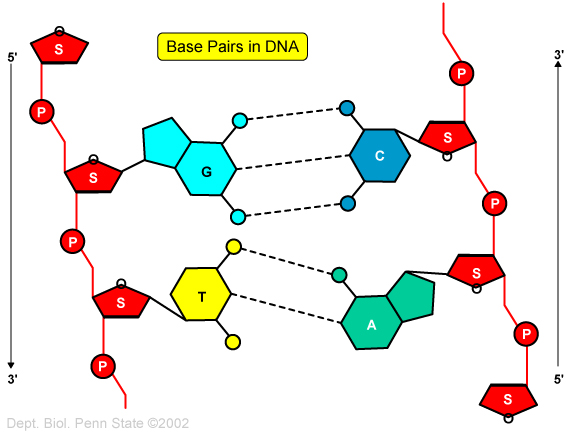


Which enzyme is responsible for adding nucleotides to the free three prime end
Helicase
Topoisomerase
DNA Polymersase 3
DNA Polymersase 1
The separation of the two single strands of DNA creates a ‘Y’ shape?
enzyme
unzip
replication fork
strand

Structure C is
helicase
primase
DNA polymerase III
gyrase
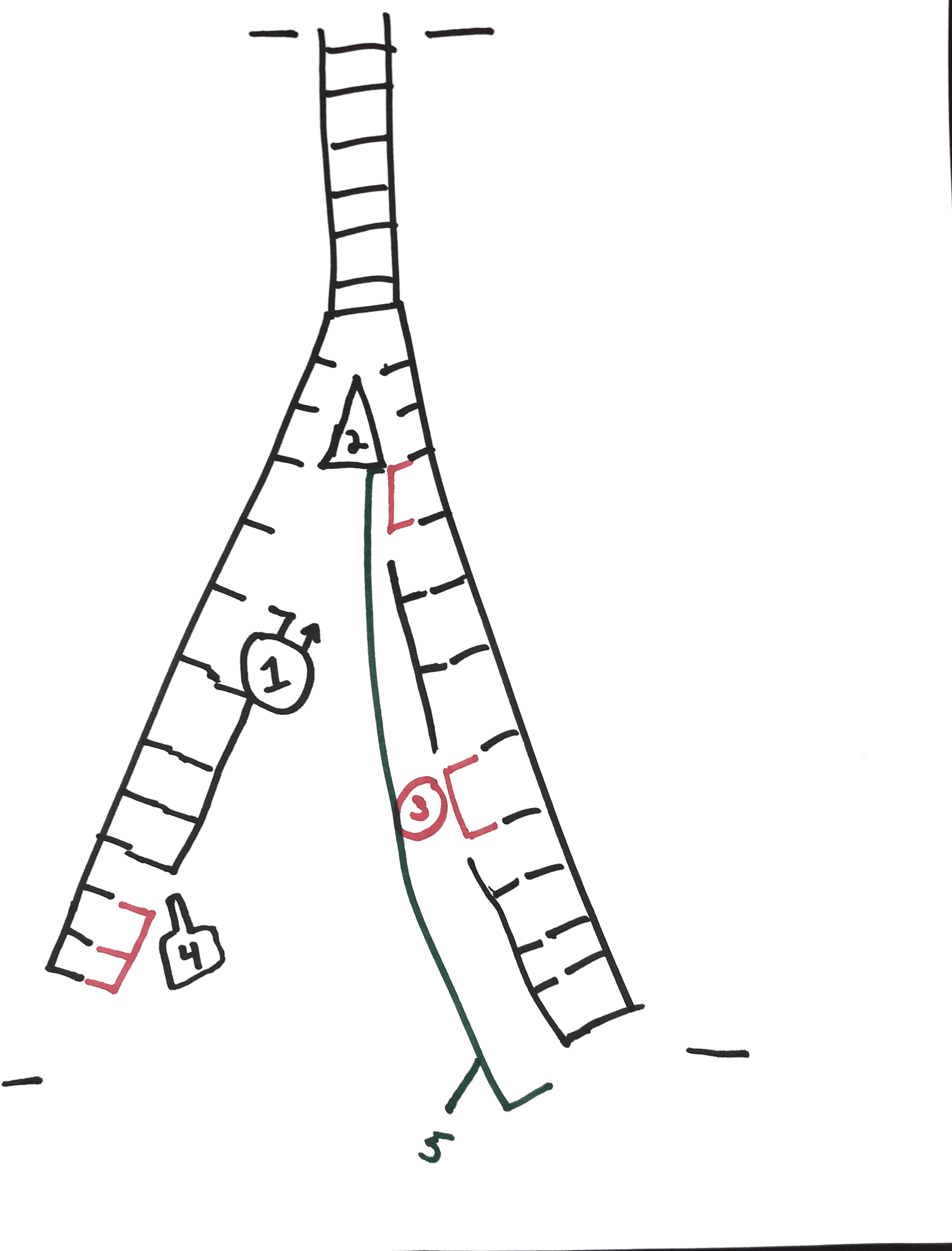
#5
Leading strand
Lagging Strand
Replication fork
Helicase
Which of the following explains the base pairing rules?
G pairs with T with 3 hydrogen bonds and A pairs with C with 2 hydrogen bonds
G pairs with T with 2 hydrogen bonds and A pairs with C with 3 hydrogen bonds
A pairs with T with 2 hydrogen bonds and G pairs with C with 3 hydrogen bonds
A pairs with T with 3 hydrogen bonds and G pairs with C with 2 hydrogen bonds
Which of the following describes how DNA replication differs between a prokaryotes and eukaryotes?
Prokaryotes have circular DNA requiring one origin of replication while eukaryotes have multiple origins on linear DNA
Prokaryotes have linear DNA requiring one origin of replication while eukaryotes have multiple origins on circular DNA
Prokaryotes have circular DNA requiring multiple origins of replication while eukaryotes have one origin on linear DNA
Prokaryotes have linear DNA requiring multiple origins of replication while eukaryotes have one origin on circular DNA
What is the difference between leading and lagging strands?
DNA is synthesized in a 5' to 3' direction on the lagging strand and a 3' to 5' direction on the leading strand
DNA is synthesized in a 3' to 5' direction on the lagging strand and a 5' to 3' direction on the leading strand
DNA is synthesized continuously on the leading strand and discontinuously on the lagging strand
DNA is synthesized discontinuously on the leading strand and continuously on the lagging strand

