wayground logo

Free Printable Worksheets

NEW

Font size

S
M
L
XL
Worksheets

Chemical Kinetics - 01

Total questions: 25

Worksheet time: 41mins

Name
Class
Date
1.
What is the parameter to measure the rate or speed of a reaction beside time?
a)
Change in volume
b)
Change in consentration
c)
Change in pressure
d)
Change in temperature
2.
Which of the following is expressions represents correctly rate of following reaction?
X + Y → Z + Q     ΔH = +22kj/mol
a)
Rate = +Δ[X] / Δt
b)
Rate = +Δ[Y] / Δt
c)
Rate = +Δ[Z] / Δt
d)
Rate = -Δ[Q] / Δt
3.
What is the theory which explains how chemical reaction occurs?
a)
Diffusion 
b)
Big Bang
c)

Collison

d)

Evaluation

4.
What is the energy needed for reactant particles to change into products? 
a)
Potential
b)
Kinetic
c)
Activation
d)
Conversion
5.
A+B →C+D    ΔH = -202kj/mol
How can above reaction be classified in terms of energy exchange during chemical change? 
a)
Combination reaction
b)
Endothermic reaction
c)
Transthermal reaction
d)
Exothermic reaction
6.
Limestone chunks are reaction with hydrochloric acid solution at constant temperature with average speed. If we crash the chunks of limestone into powder how would speed of reaction change?
a)
Reaction speeds up
b)
Reaction does not change
c)
Reaction slows down
d)
Reaction stops
7.
What is the rate equation of following chemical reaction?
2NaOH + H2SO4 → Na2SO4 + 2H2O
a)
Rate = k.[NaOH]2.[H2SO4]
b)
Rate = k.[NaOH].[H2SO4]
c)
Rate = k.[NaOH]2
d)
Rate = k.[NaOH]2.[H2SO4]2
8.
What is explaining behaviors of a system at equilibrium?
a)
Avagadro's Law
b)
Boyles Law 
c)
Le Chatelier Principle
d)
Collusion Theory
9.
Reaction rate means...
a)
amount of product formed
b)
speed of reaction
c)
concentration of reacting particles
d)
combining reactants with products
10.
To slow down a chemical reaction you will do one of the following:
a)
Place the reactants in hot water
b)
Place the products in ice bath
c)
Place the reactants in a ice bath
d)
Keep stirring the reactants with a stirring rod
11.
A possible rate law for a third overall order of a reaction is __________________
a)
Rate = k [A]2[B]2
b)
Rate = k [A][B]3
c)
Rate = k [A]3 [B]
d)
Rate = k [A]2[B]
12.

Given the following rate law,

rate = k[A]2[B]

if [A] were doubled, what must happen to [B] to keep the rate constant?

a)

[B] must tripled

b)

[B] must double

c)

[B] must be havled

d)

[B] must be quartered

13.

The catalyst alters the rate of a chemical reaction by,

a)

providing an alternative pathway with a lower Ea

b)

changing the products formed in the direction of the reaction

c)

providing a surface on which the molecules react

d)

increasing the frequencies of collisions between molecules

14.

The following data were measured for the reaction

BF3(g) + NH3(g) ⟶ F3BNH3(g)

What is the rate law for the reaction?

a)

rate = k[NH3]

b)

rate = k[BF3]2[NH3]

c)

rate = k[BF3][NH3]

d)

rate = k[BF3][NH3]2

15.

What is the rate law for this mechanism?

a)

rate = k[A][B]2

b)

rate = [B][X]2

c)

rate = [A]0.5[B]1.5

d)

rate = [W][Y][Z]

16.

Which factors increase the rate of a reaction?

a)

increasing temperature

b)

increasing concentration

c)

increasing surface area

d)

all of the above

17.

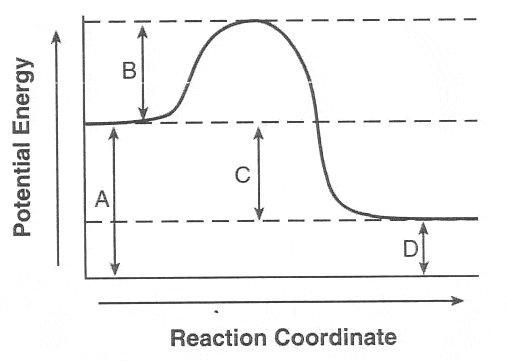
What letter represents the activation energy?

a)

A

b)

B

c)

C

d)

D

18.

What is the parameter to measure the rate or speed of a reaction beside time?

a)

Change in volume

b)

Change in concentration

c)

Change in pressure

d)

Change in temperature

19.
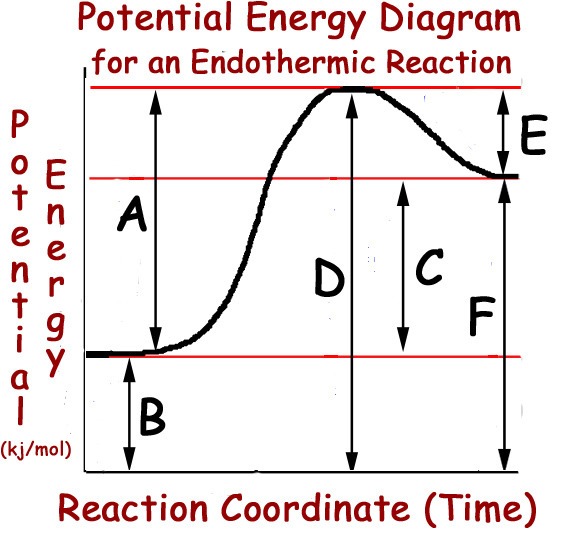
What type of reaction is this?
a)
Endothermic
b)
Exothermic
20.
Catalysts permit reactions to happen with a __________ activiation energy.
a)
lower
b)
higher
21.
Usually lowering the temperature will slow down a reaction.
a)
false
b)
true
22.
What would be my the overall order of this rate law? 
Rate=[A]2[B]1
a)
0 Order
b)
1st Order
c)
2nd Order
d)
3rd Order
23.
If my rate law is second order and I increase my concentration to 4, what would my new rate be? 
a)
4
b)
16
c)
2
d)
8
24.
What two factors govern whether a collision between reacting particles will be effective?
a)
orientation and potential energy 
b)
kinetic energy and temperature 
c)
kinetic energy and orientation 
d)
potential energy and kinetic energy 
25.
Which of the following increase the reaction rate?
a)
less surface area
b)
lower temperature
c)
an inhibitor
d)
increased concentration