
 Worksheets
1.2 Heating & Cooling Curves
Total questions: 36
Worksheet time: 2hrs 24mins
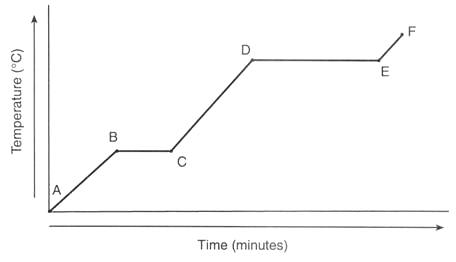
Between which points is the temperature of the substance remaining constant?
A-B only
A-B, C-D, and E-F
B-C only
B-C and D-E

The melting point of the sample is
-60 ºC
20 ºC
60 ºC
100 ºC

Which letter indicates where water is in both the solid and liquid phase at the same time?
A
B
C
D
E

In which region(s) does temperature increase?
Region C only
Regions B and D
Regions A, C, and E
Regions A and B

In which region(s) of the heating curve would water be a liquid and a gas at the same time?
A
B
C
D
E

Describe the substance at letter A.
Solid
Liquid
Melting
Evaporating
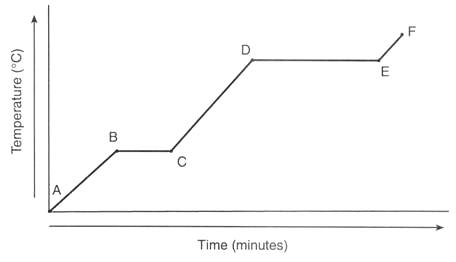
How many states of matter are present during line segment BC?
One
Two
Three
Depends on the temperature

At which letter is the substance changing its state of matter?
A only
A, C, and E
D and E
B and D

NaCl was heated starting at an initial temperature of 0°C. The heating curve is shown in the picture. What is the melting point of this substance?
0°C
801°C
1000°C
1465°C

Describe the substance at letters D.
Gas
Liquid
Melting
Evaporating
At higher temperatures
Particles in an object move slower
Particles in an object move faster
Particles move at the same speed as lower temperature
Thermal energy always moves:
From a high temperature object to a lower temperature object.
From a lower temperature object to a higher temperature object.
From an object with lower kinetic energy to an object with higher kinetic energy.
From an object of higher mass to an object of lower mass.
What does heat do to intermolecular forces?
strengthens them
Weakens them
reverses them
As matter cools what happens to the intermolecular forces?
they strengthen
they weaken
they reverse

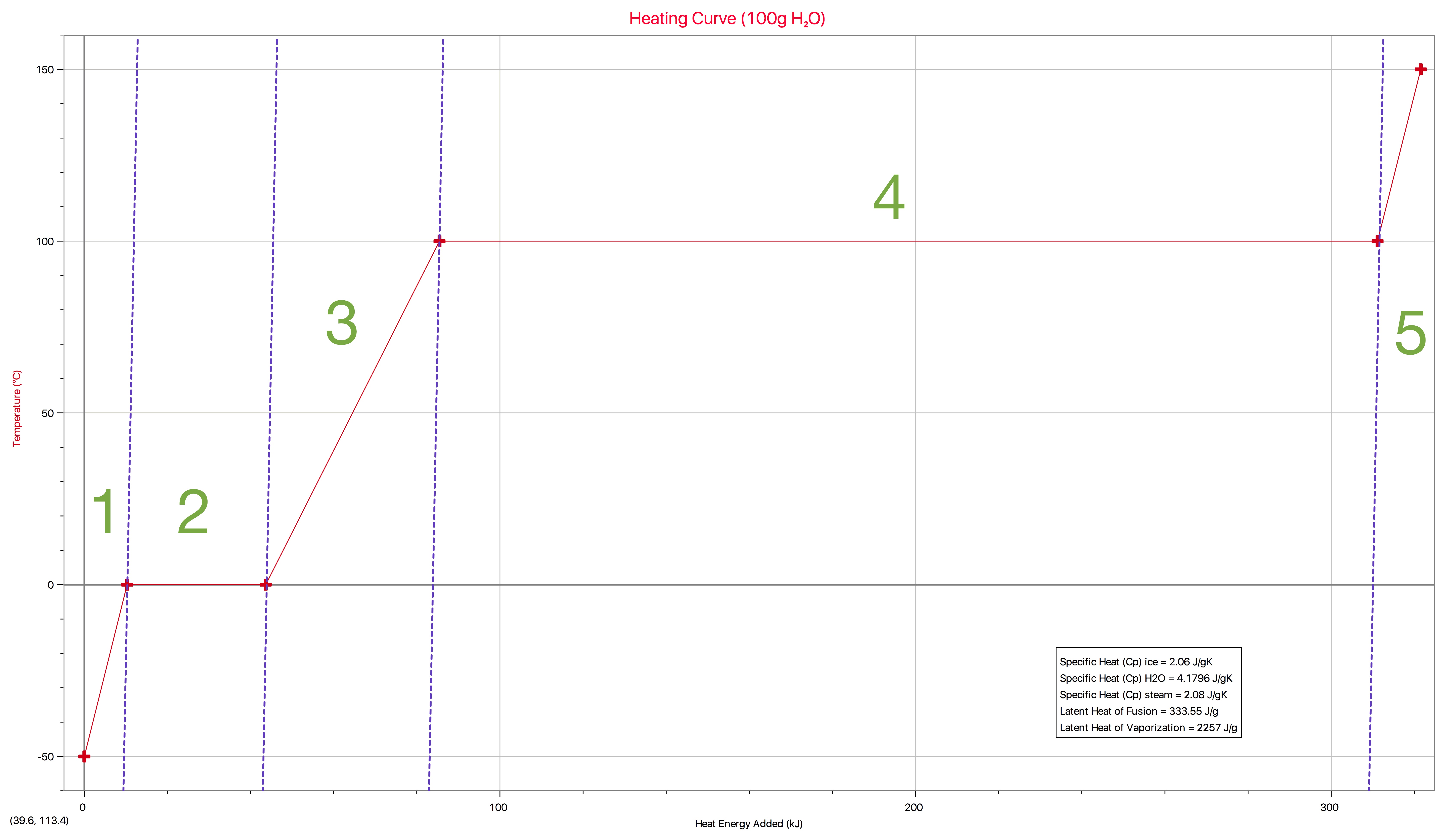
This curve indicates what about the heat energy?
Heat energy is being added or absorbed
Heat energy is being released
In which region(s) of the graph would the substance be a liquid and a gas at the same time?
Region 1
Region 2
Region 3
Region 4
Region 5
What is the freezing point of the substance?
0oC
60oC
120oC
180oC


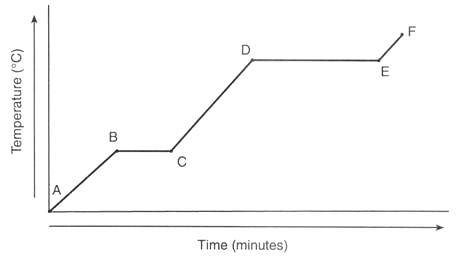
Describe the substance at letter E


Describe the substance at letter C
Describe the substance at letter A.

The heating curve for a sample of pure ethanol is provided
above. The temperature was recorded as a 50.0 g sample of
solid ethanol was heated at a constant rate. What is the boiling point of ethanol?
50K
150K
350K
550K


In which region(s) of the graph would the substance be a solid only?
Region A-C
Region C-E
Region E-G
Region G-I
Region I-K
In which region(s) of the graph would the substance be freezing?
Region A-C
Region C-E
Region E-G
Region G-I
Region I-K

