
 Worksheets
Unit 4 Genetics and evolution
Total questions: 25
Worksheet time: 23mins
Coat color in a dog breed is determined by incomplete dominance where three colors are produced (Brown, tan and white), and the brown coat allele (B) has incomplete dominance over the white coat allele (b). Which offspring ratio would be expected from a cross between a tan dog and a white dog?
A. 2 BB: 2 Bb
B. 4 Bb
C. 1 BB: 2 Bb: 1 bb
D. 2 Bb: 2bb
A woman develops skin cancer after prolonged exposure to ultraviolet radiation from sun tanning. Would her future children be at risk of inheriting this skin cancer?
A. Yes, if she had a baby after developing skin cancer.
B. Yes, this is a mutation in the DNA of her somatic cells.
C. No, this condition does not affect the woman's gametes
D. No, babies cannot get skin cancer because they are immune.

Which principle best explains why the gametes only each contain a single allele?
A. Mendel's Law of Dominance states that dominant alleles must separate from recessive alleles in gamete formation.
B. Mendel's Law of Inheritance states that only one allele is inherited from each parent and the dominant allele is inherited first.
C. Mendel's Law of Segregation states that alleles must segregate during gamete formation in order to create haploid sex cells need for reproduction.
D. Mendel's Law of Independent Assortment states that each trait is inherited separately and the resulting gametes each only contain the DNA for a single trait.

Where do adaptations come from?
The individual organism decides to adapt
Mutations that give an organism an advantage in its environment
Genetic recombination during meiosis
Both mutations and genetic recombination are sources of adaptation

All rabbits of the same species living in a particular area would be an example of a(n)
population
species
community
ecosystem
_________ characters have similar structure but different function indicating they developed from a common ancestor.
All existing Cheetahs share 99% of their DNA. Which is/are true?
They are more likely to evolve into a new species than other cats due to gene flow.
They are likely to go extinct because they have so little variation.
They likely underwent a bottleneck in their history.
The founder's effect made it so they have several different subspecies.
Cheetahs never prosper and winners never cheat.

Vertebrate embryos passing through similar stages of development is evidence for

Mechanism of evolution responsible for a random change in a population is known as:
Speciation
Selection
Genetic Drift
Variation
The combined genetic information of all memebers of a particular population forms a:
gene pool
allele frequency
phenotype
population
Which of the following contiditions is MOST likely to result in changes in allele frequencies in a population?
no migration
small population size
absence of natural selection
random mating
Situation in which allele frequencies change as aresult of the migration of small subgroup of a population is known as:
founder effect
genetic bottleneck
random mating
natural selection
Which of the following is an example of natural selection?
Bald Eagles are hunted until near extinction, population recovers.
Small group of iguanas floats to an island, starts a new population.
Red fox pups are more likely to survive in a snowy environment if they are born white.
Farmer chooses seeds from largest apples to plant next year. This results in larger apples from year to year.

A bubble guppy with a yellow tail has offspring with a bubble guppy with a red tail. The offspring have orange tails. What is this an example of?
Codominance
Incomplete Dominance
Multiple Alleles
Polygenic Triats
Hemophilia is a recessive x-linked disorder. Which genotype represents a female who is a carrier for haemophilia?

The individual represented here is ...
a healthy male
a healthy female
Diseased male
Diseased female
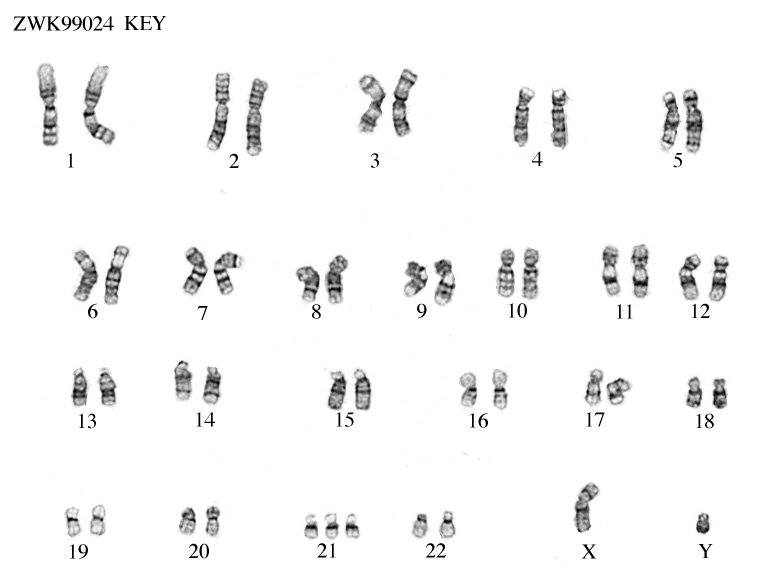
Spot the mutation in the karyotype.
What condition does this male have?
Down's syndrome
Turner's syndrome
Kleinfelter's syndome
Monosomy X
This male has a chromosomal abnormality. What process is responsible for the extra chromosome?
Non-disjunction
Crossing over
Meiosis
Fertilisation

