wayground logo

Free Printable Worksheets

Font size

S
M
L
XL
Worksheets

Unit 1 Review

Total questions: 53

Worksheet time: 46mins

Name
Class
Date
1.
What branch of Earth Science does this picture represent?
a)
Environomental Science
b)
Meterology
c)
Oceanography
d)
Geology
2.
What branch of Earth Science does this picture represent?
a)
Oceanography
b)
Meteorology 
c)
Geology
d)
Astronomy
3.
What branch of Earth Science does this picture represent?
a)
Oceanography
b)
Meteorology 
c)
Geology
d)
Astronomy
4.
What branch of science does this picture represent?
a)
Oceanography
b)
Meteorology 
c)
Geology
d)
Astronomy
5.
What branch of Earth Science does this picture represent?
a)
Astronomy
b)
Geology
c)
Meteorology
d)
Environmental Science
6.

What branch of Earth Science does this picture represent?

a)

Environmental Science

b)

Astronomy

c)

Meteorology

d)

Geology

7.

Which topic would an astronomer study?

a)

pollution

b)

galaxies

c)

mountains

d)

rain

8.

Which topic might an environmental scientist study?

a)

energy resources

b)

mountains

c)

hurricanes

d)

comets

9.

Which topic(s) might an oceanographer study?

a)

tides

b)

clouds

c)

stars

d)

minerals

10.

What is Meteorology?

a)

The study of meteors.

b)

The study of the atmosphere.

c)

The study of rocks.

d)

The study of organisms.

11.

What is Geology?

a)

The study of geography.

b)

The study of rocks.

c)

The study of weather.

d)

The study of the solid Earth.

12.

What is Astronomy?

a)

The study of astrological signs.

b)

The study of Earth.

c)

The study of asteroids.

d)

The study of all physical things beyond Earth.

13.
Studies the solid portions of the earth, including volcanoes, earthquakes, and fossils.
a)
Geology
b)
Geography
c)
Cartography
d)
Oceanography
14.
Weather, climate, and the atmosphere are studied in this branch of Earth Science.
a)
Astronomy
b)
Meteorology
c)
Cartography
d)
Geology
15.
This branch studies how humans interact with and impact ecosystems (pollution, population growth, and resource use).
a)
Geology
b)
Ecology
c)
Environmental Science
d)
Oceanography
16.

What is the term given to the study of Earth's oceans and the movement of water?

a)

Environmental Science

b)

Astronomy

c)

Geology

d)

Oceanography

17.
When is it OK to eat or drink in the lab?
a)
Always
b)
Never
18.
What should you do if you break glass in the lab?
a)
Tell the teacher.
b)
Sweep up the glass.
c)
Pick up the glass with your hands.
d)
Ignore it; the teacher will clean it up when she sees it later.
19.
When should you tie back long hair or baggy clothing?
a)
When working with chemicals
b)
When working with a Bunsen burner
c)
When doing dissections.
d)
Any time you are working in the lab.
20.
I must follow all instructions, written and verbal, about the laboratory procedures given by the teacher.
a)
True
b)
False
21.
Horseplay, jokes, and pranks are appropriate in the science classroom at any time.
a)
True
b)
False
22.
When in the lab...
a)
long sleeves and loose clothing should be rolled up
b)
closed toe shoes should be worn
c)
long hair should be pulled back
d)
all of the above
23.
It's fine to smell chemicals directly from their containers.
a)
True
b)
False
24.
At the end of the lab you see some leftover chemical that looks just like the stuff you were using.  You should:
a)
put the chemical back in the jar it came from.
b)
sweep it into your hand and throw it out.
c)
tell the teacher so you can dispose of it properly.
d)
tell your classmates that your lab partner is really messy.
25.
The basic unit of length in the metric system is 
a)
foot
b)
inch
c)
meter
d)
mile
26.
The amount of space an object takes up is called
a)
volume
b)
mass
c)
weight
d)
length
27.
The formula for density is
a)
volume/mass
b)
mass/weight
c)
mass/volume
d)
volume X mass
28.
How many meters are there in a kilometer?
a)
10
b)
1
c)
1000
d)
100
29.
What is the SI unit of time?
a)
minute
b)
second
c)
hour
d)
day
30.
Series of steps scientists follow to solve problems
a)
Scientific method
b)
Investigation methods
c)
Experiment guidelines
d)
Standard procedures
31.
The kilogram is the basic metric unit of
a)
length
b)
weight
c)
mass
d)
volume
32.
Mass & weight are different because
a)
Weight depends on the force of gravity
b)
Mass depends on the force of gravity
c)
Weight depends on the amount of matter an object contains
d)
Mass does not depend on the amount of matter an object contains
33.
During an experiment, which factors must be controlled so that researchers can draw a logical conclusion from the experiment?
a)
variables
b)
inquiries
c)
theories
d)
operational definitions
34.
The standard to which you compare the results of an experiment is called
a)
constant
b)
control group
c)
independent variable
d)
dependent variable
35.
During an experiment, if you purposely change the temperature to test a hypothesis, the temp is called the
a)
independent variable
b)
operational variable
c)
dependent variable
d)
responding variable
36.
Observations that deal with a number or amount are called
a)
manipulated observations
b)
operational observations
c)
qualitative observations
d)
quantitative observations
37.
Which of the following is a valid reason why a scientist might reject a scientific theory?
a)
It covers too broad a topic
b)
New evidence contradicts it
c)
It is too old
d)
Some people disagree with it
38.
Observations that deal with descriptions that cannot be expressed in numbers are called
a)
quantitative observations
b)
qualitative observations
c)
manipulated observations
d)
operational observations
39.
An explanation that ties together many hypotheses and explanations is called a(n)
a)
model
b)
concept
c)
theory
d)
investigation
40.
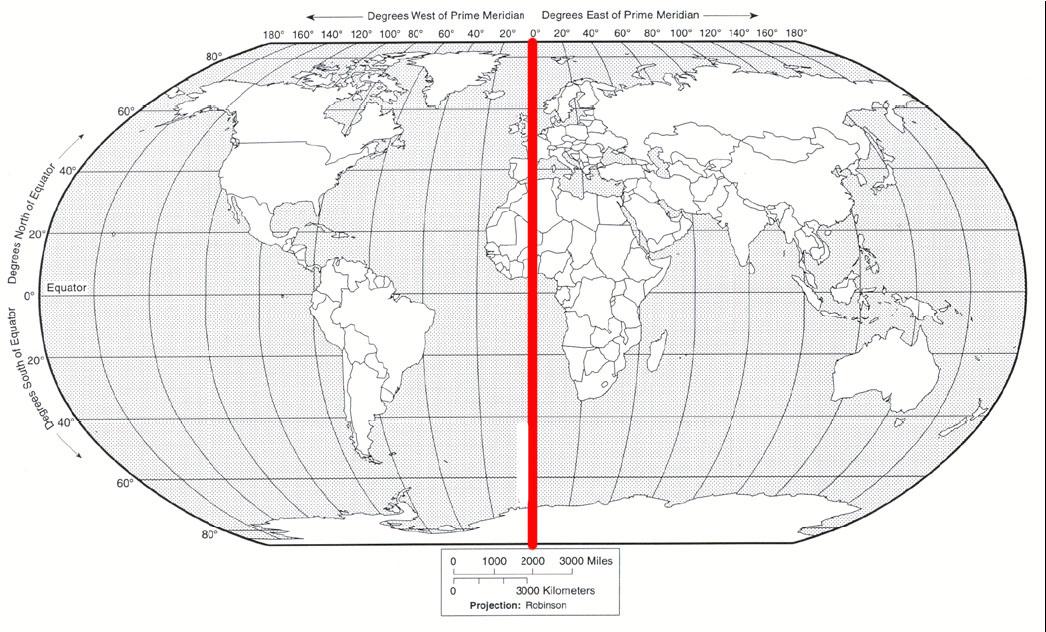
What is the name of the line at zero degrees longitude?
a)
Equator
b)
Prime Meridian
c)
North Pole
d)
South Pole
41.
Latitude and Longitude are measured in______.
a)
kilometers
b)
degrees
c)
miles
d)
hours
42.
Which of the following letter is at approximately 60 degrees S, 40 degrees W? 
a)
A
b)
D
c)
E
d)
H
43.
Which letter would you find at 15oS, 60oW?
a)
A
b)
C
c)
L
d)
H
44.
a)
The map shows lines of longitude.
b)
The map shows lines of latitude.
45.
A set of degrees of latitude and longitude that help you locate a place on a map.
a)
coordinates
b)
positions
c)
hemispheres
d)
locations
46.
To locate a place on the earth, you need to look at...
a)
where the lines of latitude and longitude meet
b)
the lines of latitude only
c)
the lines of longitude only
d)
the compass rose
47.
Which STATE is located at...
120°W, 45°N
a)
WA
b)
OR
c)
UT
d)
ND
48.
Which STATE is located at...
105°W, 47°N
a)
MT
b)
SD
c)
UT
d)
AZ
49.
Which STATE is located at...
100°W, 48°N
a)
NM
b)
ND
c)
SD
d)
CO
50.
a)
Australia is located in the Eastern and Souther Hemispheres 
b)
Asia is located in the Southern and Eastern Hemispheres
c)
North America is located in the Southern and Western Hemispheres
d)
South America is located in the Northern and Eastern Hemispheres.
51.
Which cities lie between 80°W and 85°W?
a)
Charleston and Nashville
b)
Little Rock and New Orleans
c)
Atlanta and Talahassee
d)
New Orleans and Jackson
52.
Which city is closest to the Equator?
a)
Los Angeles
b)
Minneapolis
c)
Miami
d)
Unable to determine
53.
What is the approximate location of letter B?
a)
80oN, 0o
b)
0o, 80oW
c)
80oS, 0o
d)
0o, 80oE