
 Worksheets
Earth Science CET Review
Total questions: 184
Worksheet time: 4hrs 38mins
How old is the Earth?
4.543 billion years
4.543 million years
4.534 billion years
4.534 million years
The Law of Superposition helps scientists to determine what?
The absolute age of rock layers
The age of fossils
The relative age of rock layers
the super powers of squirrels


Which of the following correctly lists the layers in order from oldest to youngest?
A, B, C, D, E
E, B, C, D, A
E, D, C, B, A
C, B, A, D, E


What is the relative age of a rock?
The age determined by the things around it.
The age of an igneous rock.
The age determined by radioactive dating.
The time it takes for 1/2 of the radioactive atoms to decay in an element.

The law of superposition states that in undisturbed sedimentary rocks, each layer is younger than the layer below it and older than the layer above it
true
false
The law of superposition states that in undisturbed sedimentary rocks, each layer is older than the layer below it and younger than the layer above it
true
false
The presence of what kind of rocks make it difficult to determine the age of rocks
igneous rocks
sedimentary rocks
metamorphic rocks
How did scientists reliably tell the Earth's age
through the Law of Superposition
through the use of radioactive dating
through the age of fossils dug
Radioactive dating is a method of dating rocks and minerals using what?
radioactive isotopes
radioactive exposure
ultraviolet rays
ultraviolet waves
The time required for half of the parent isotope to decay into daughter isotopes.
Absolute Age
Relative Age
Fossil
Half-life
The age of rocks and geologic features compared with other rocks and features nearby.
Relative Age
Absolute Age
Geologic processes that occur today are similar to those who have occurred in the past
Principle of Superposition
Principle of Uniformitarianism
Cross Cutting Relationships
Absolute Dating
Average numerical age, in years of a rock or object.
Absolute Age
Relative Age
Represent species that existed on Earth for a short length of time, were abundant and inhabited many locations.
Rocks
Radioactive Decay
Index Fossils
Half-Life
What materials can prevent decay
ice
amber
silicon
copal
Which type of rock are most fossils found?
sedimentary rock
metamorphic rock
igneous rock
If a scientist found a fish fossil in the desert, what can they infer?
an animal ate the fish
the fish of today look the same
water covered that area in the past
the fish is endangered
a solid copy of the shape of an organism is...
a fossil record
a mold
a carbon film
a cast
What are the geologic times
precambrian era
palezoic era
mesozoic era
cenozoic era
mesocambrian era
How long was the precambrian era
4.059 billion years
289 million years
186 million years
about 65 million years
How long was the paleozoic era
4.059 billion years
289 million years
186 million years
about 65 million years
How long was the mesozoic era
4.059 billion years
289 million years
186 million years
about 65 million years
How long was the cenozoic era
4.059 billion years
289 million years
186 million years
about 65 million years
From longest to shortest, arrange the geologic times by their number of years
paleozoic -> precambrian -> cenozoic -> mesozoic
precambrian -> paleozoic -> mesozoic -> cenozoic
paleozoic -> mesozoic -> precambrian -> cenozoic
precambrian -> cenozoic, paleozoic, mesozoic
The second broadest category of geologic time is______________?. The Cenozoic is one of them.
era
eon
epoch
period
There have been how many major extinction events on planet Earth?
3
4
5
2
What are the names of ALL parts of the geologic time scale in correct order from broadest to narrowest?
era, period, eon
eon, era, period, epoch
era, eon, epoch, period
eon, era, epoch, period

Mammals are a dominant group in which era?
Cenozoic
Mesozoic
Paleozoic
Cambrianozoic

What era did the formation of the earth occur?
Paleozoic
Precambrian
Cenozoic
Cambrian

The dinosaurs and reptiles were dominant in which Era?
Precambrian
Mesozoic
Paleozoic
Cenozoic

90% of Earth’s history occurred during which era?
Precambrian
Paleozoic
Mesozoic
Cenozoic

At the end of this era, multi-cellular organisms like sponges, jellyfish and worms filled the oceans.
Precambrian Era
Paleozoic Era
Mesozoic Era
Cenozoic Era
Most of the Precambrian rocks are what kind of rocks
igneous
metamorphic
sedimentary
By the middle of the Paleozoic era, marine life forms had developed shells
true
false
What was the first animal that succeeded in adapting itself to breathe air
an amphibian that came out of the sea during the Devonian Period
a mammal that came out of the sea during the Devonian Period
an amphibian that came out of the sea during the Silurian Period
a mammal that came out of the sea during the Silurian Period
The late Paleozoic era showed the appearance of...
reptiles
amphibians
mammals
parasites
Which era saw the formation of several continents
Precambrian
Paleozoic
Mesozoic
Cenozoic
a Greek philosopher and mathematician who thought that the Earth had a spherical shape
Pythagoras
Eratosthenes
Isaac Newton
Henry Cavendish
a Greek astronomer who proved that the Earth had a spherical shape. He also made the measurements of the Earth's circumference
Pythagoras
Eratosthenes
Isaac Newton
Henry Cavendish
an English mathematician and physicist who predicted that the Earth was not a perfect sphere
Pythagoras
Eratosthenes
Isaac Newton
Henry Cavendish
an English scientist who was the first one to determine the mass of the Earth
Pythagoras
Eratosthenes
Isaac Newton
Henry Cavendish
The earth is a...
perfect sphere
not a perfect sphere
perfect circle
Topographic maps are scale models of some part of the Earth's surface
true
false
What distinguishes physical layers of Earth?
the elements and compounds in each layer
how rigid each layer is
the thickness of each layer
the temperature of each layer
What distinguishes chemical layers of Earth?
the elements and compounds in each layer
how rigid each layer is
the thickness of each layer
the temperature of each layer
Which of the following represents physical layers of Earth?
core, mantle, crust
core, mantle, oceanic crust, continental crust
inner core, outer core, mesosphere, asthenosphere, lithosphere
inner core, outer core, mantle, oceanic crust, continental crust
Which of the following represents chemical layers of Earth?
core, mantle, crust
core, mantle, lithosphere
inner core, outer core, mesosphere, asthenosphere, lithosphere
inner core, outer core, mantle, oceanic crust, continental crust
Which layer is best described as liquid iron and nickel?
inner core
outer core
mantle
crust
Which describes the difference between continental and oceanic crust chemical composition?
continental crust has more SiO2 so it sinks
continental crust has more Fe so it floats
oceanic crust has more SiO2 so it floats
oceanic crust has more Fe so it sinks
The inner core is a...
solid
liquid
gas
The outer core is a...
solid
liquid
gas
The lithosphere is ______ and the asthenosphere is _______.
both brittle
brittle, plastic/flexible
plastic/flexible, brittle
both plastic/flexible
Which layer exists as a collection of tectonic plates?
asthenosphere
mantle
lithosphere
outer core
Which two layers have convection currents?
asthenosphere & outer core
asthenosphere & inner core
lithosphere & outer core
lithosphere & inner core
Convection currents in the ______ create Earth's magnetic field.
asthenosphere
inner core
mantle
outer core
What made it possible to conclude that the earth's interior is made up of layers one inside the other
P-waves
S-waves
T-waves
V-waves
Does temperature increase or decrease the farther down into the earth you go?
increase
decrease
What are the materials found on the Earth's crust
silicon and aluminum
oxygen
calcium and sodium
potassium
iron
the three types of solid rocks could be found in the Earth's crust
true
false
The movement of the tectonic plates is caused by
the rotation of the Earth.
convection currents in the Asthenosphere
the gravity of the iron-nickel core.
the Moho discontinuity.
In some areas of the world, like California and Japan, earthquakes are a common occurrence. How can this best be explained?
The strong ocean currents are undermining both areas causing earthquakes.
Both areas are located near the edge of the Pacific Ocean, the unstable sand causes earthquakes.
Both areas are subjected to strong ocean wind and waves that causes earthquakes.
Both areas are on the boundary of active plates, the motion of the plates causes earthquakes.
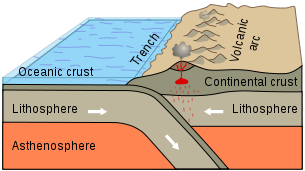
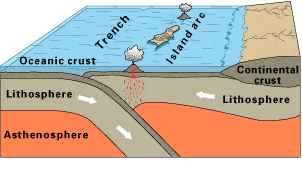
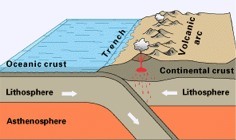
Observe this diagram of a plate boundary. One statement BEST describes what is happening. It is that
the oceanic crust is melting.
the denser ceanic crust is subducting under the less dense oceanic crust
volcanic islands are forming.
the tectonic plates are moving away from each other.
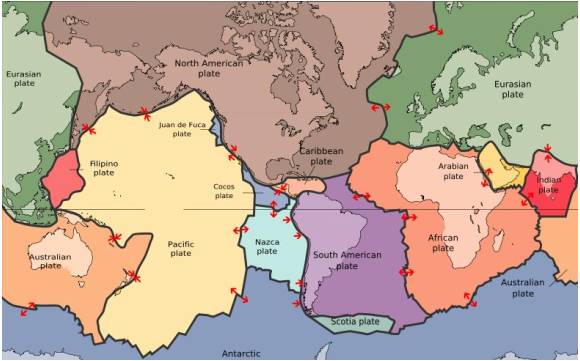
The map in the picture shows tectonic plate boundaries. This map would be useful in predicting the location of future
droughts
hurricanes
earthquakes
tornadoes
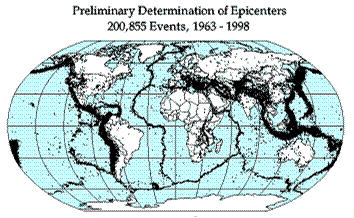
Earthquake epicenters (center of where the earthquakes started) were mapped for a 35 year period in the diagram above. The black dots indicate these epicenters. The black dots appear along what feature on Earth?
hot spots
plate boundaries
rift zones
sea floor spreading
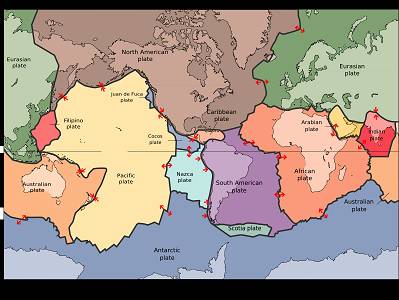
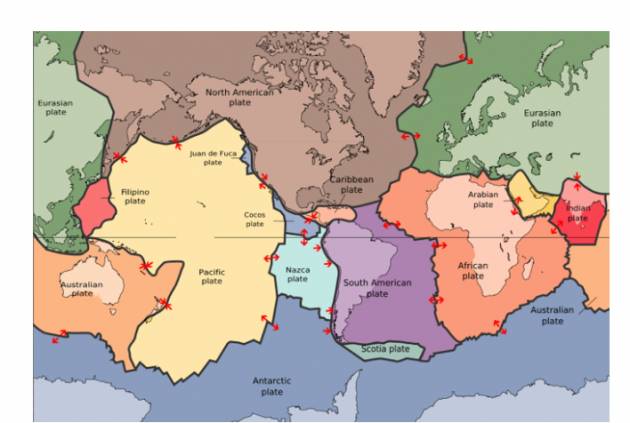
Where are earthquakes MOST LIKELY to occur?
close to the equator
close to the center of tectonic plates
at divergent or convergent plate boundaries
at transform plate boundaries
The 2004 Indian Ocean tsunami was caused by a shift in two plates that pushed one section of the sea floor under another section of the sea floor by 5 meters. What type of boundary is this?
divergent
convergent
transform
metamorphic
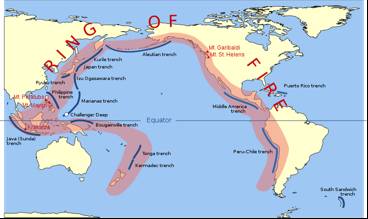
___________ currents in the Earth's asthenosphere cause plate to shift at their boundaries. This movement also causes earthquakes and volcanic activity.
conduction
convection
radiation
ocean
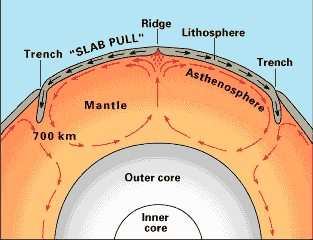
What is the source of energy that drives plate movement?
the subducton of the sea floor
the different densities of the oceanic and crustal plates
convection currents in the asthenosphere
the friction force between the plates that move past each other
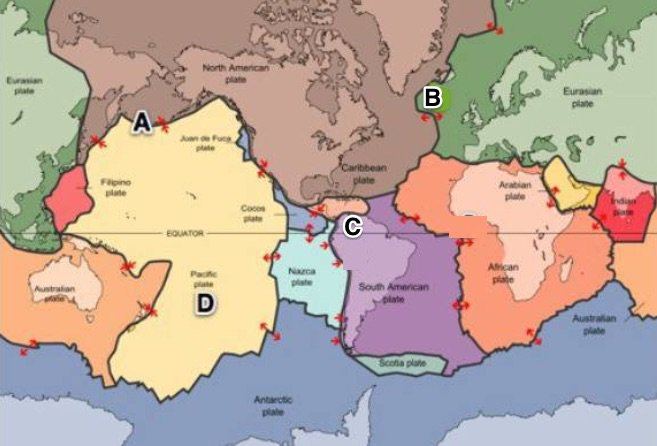
Where would sea floor spreading most likely occur?
At convergent boundaries (oceanic vs. oceanic)
At convergent boundaries (oceanic vs. continental)
At divergent plate boundaries (oceanic vs. oceanic)
At transform plate boundaries
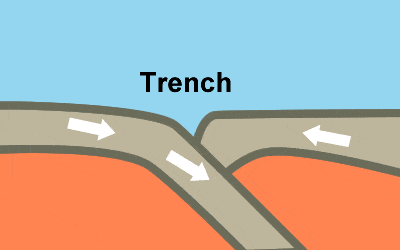
The Marianas Trench, where the Pacific Plate descends under the leading edge of the Eurasian Plate, is the deepest sea floor in the world. These ocean trenches form when two oceanic plates collide
and the older, less dense of the two plates rides over the edge of the older plate.
when convection currents in the mantle force the older plate downward.
and the younger, denser of the two plates, rides over the edge of the older plate.
and the plates are approximately the same age and density.

What type of plate boundary is shown in the picture?
Convergent
Divergent
Transform

What type of plate boundary is shown in the picture?
Convergent
Divergent
Transform

What type of plate boundary is shown in the picture?
Convergent
Divergent
Transform
What geologic event would most likely be found at a transform boundary?
Volcano
Mountain
Earthquake
Mid-Ocean Ridge
What landform would you most likely find at a divergent boundary between two pieces of oceanic crust?
Rift Valley
Mountain
Mid-Ocean Ridge
Volcano
What landform would you most likely find at a divergent boundary between two pieces of continental crust?
Mid-Ocean Ridge
Rift Valley
Mountain
Volcano
What landform would you most likely find at a convergent boundary between two pieces of continental crust?
Mid-Ocean Ridge
Oceanic Trench
Mountain
Volcano
What landform would you most likely find at a convergent boundary between two pieces of oceanic crust?
Rift Valley
Mid-Ocean Ridge
Mountain
Ocean Trench
When one tectonic plate sinks under another, this is called...
Convegent
Divergent
Subduction
Transform
Which type of boundary do plates move away from each other?
Convergent
Divergent
Transform
Plates slide past one another at ____ boundaries.
Convergent
Divergent
Transform
When plates collide together, this boundary occurs...
Convergent
Divergent
Transform
What are the two types of crust?
Thick and thin
Ocean and basin
Lower and upper
Continental and oceanic
According to Wegener's hypothesis of continental drift,
Earth's surface is made up of seven major landmasses
The continents were once joined together in a single landmass
Earth is slowly cooling and shrinking
the continents DO NOT move
What is Pangaea?
The name of a German scientist
Another name for continental drift
The name of the super-continent that existed millions of years ago
The name of ancient fossil
What type of evidence was NOT used by Alfred Wegener to support his continental drift theory?
evidence from landforms
evidence from human remains
evidence from fossils
evidence from climate
Most geologists rejected Alfred Wegener's idea of continental drift because...
it did not agree with their current theory
Wegener was interested in what Earth was like millions of years ago
Wegener used several different types of evidence to support his hypothesis
Wegener could not identify the force that moved the continents

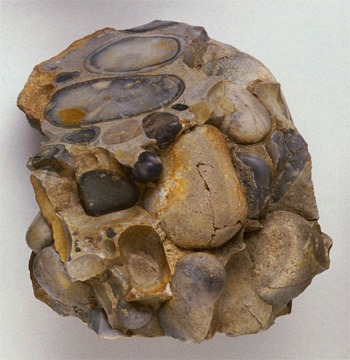
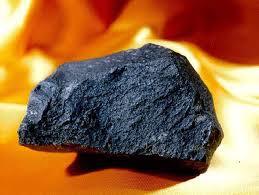


What type of rock is this?
Sedimentary
Igneous
Metamorphic
Sand

How do extrusive igneous rocks differ from intrusive igneous rocks?
Extrusive rocks are larger in size.
Intrusive rocks break down quicker.
Extrusive rocks are arranged in layers.
Intrusive rocks have larger crystals.
In which location would you most likely find an igneous rock?


Which force plays a major role in the formation of metamorphic rock?
Acceleration
Friction
Pressure
Centrifugal force

Compaction and cementation are two common processes associated with:
Extrusive igneous rocks
Intrusive igneous rocks
Sedimentary rocks
Metamorphic rocks

Which of the following is a TRUE statement?
Magma is called lava after it emerges from the ground
Lava cools off to form magma
Magma and lava form sedimentary rocks
Magma and lava are two types of metamorphic rock

Place the following events in sequence: A) Mineral grains are formed; B) A volcano erupts; C) Lava begins cooling
A, B, C
B, A, C
B, C ,A
C, A, B

Sedimentary rocks often form horizontal strata. What are strata?
Crystals
Layers
Mineral grains
Pieces of older rocks


Ore minerals can form in all of the following places EXCEPT
at the surface of an area that was once covered by water
at the bottom of a water body
in fractures within rocks
in a bed of hot, flowing lava
Sand, gravel, and granite are examples of
metallic minerals
metallic elements
nonmetallic minerals
aluminum
Which of the following describes a metallic mineral?
silver
a mineral that conducts electricity, has a shiny surface, and is opaque
copper
all of the above
___ are pure substances that cannot be broken down into simpler substances by ordinary chemical means.
Minerals
Compounds
Crystals
Elements


Contains the Ozone Layer.
Troposphere
Stratosphere
Mesosphere
Thermosphere
All of the above.
Where ALL weather takes place.
Troposphere
Stratosphere
Mesosphere
Thermosphere
All of the above.
Located CLOSEST to Earth's surface.
Troposphere
Stratosphere
Mesosphere
Thermosphere
All of the above.
Where most water vapor is found.
Troposphere
Stratosphere
Mesosphere
Thermosphere
All of the above.
Meteors burn up in this layer.
Troposphere
Stratosphere
Mesosphere
Thermosphere
All of the above.
Coldest layer.
Troposphere
Stratosphere
Mesosphere
Thermosphere
All of the above.
Contains molecules that absorb harmful ultraviolet rays.
Troposphere
Stratosphere
Mesosphere
Thermosphere
All of the above.
Hottest layer, thinnest air.
Troposphere
Stratosphere
Mesosphere
Thermosphere
All of the above.
Where satellites orbit.
Troposphere
Stratosphere
Mesosphere
Thermosphere
All of the above.
Greatest air pressure because it has the most molecules.
Troposphere
Stratosphere
Mesosphere
Thermosphere
All of the above.
Auroras and Northern Lights occur here.
Troposphere
Stratosphere
Mesosphere
Thermosphere
All of the above.
Eventually fades into space.
Troposphere
Stratosphere
Mesosphere
Thermosphere
All of the above.
Air pressure decreases as altitude increases.
Troposphere
Stratosphere
Mesosphere
Thermosphere
All of the above.
Temperature increases with altitude (height). PICK TWO.
Troposphere
Stratosphere
Mesosphere
Thermosphere
All of the above.
Temperature decreases with altitude (height). PICK TWO.
Troposphere
Stratosphere
Mesosphere
Thermosphere
All of the above.

