
 Worksheets
Topic 4: Work, Energy and Power
Total questions: 35
Worksheet time: 35mins
The unit of work is
watt
hertz
joule
pascal
How do you determine the work done from a force-displacement graph?
Find the area under the curve
Find the slope
y divided by x for a single point
Not possible

Which two forces do NO work on the gold block? (tick more than 1 answer)
Fa
Fg
Ff
Fn

A block slides down a ramp at constant speed of 6 m/s. Which force does a negative value of work?
Fn
Fg
Ff
Fa
A block slides down a ramp at constant speed of 6 m/s. Which force does NO work?
Fn
Fg
Ff
Fa
What is the common formula for work?
W=F v cos (angle between the direction of motion and the force)
W=F d cos (angle between the direction of motion and the force)
W=F m cos (angle between the direction of motion and the force)
W=F t cos (angle between the direction of motion and the force)
When is work positive?
Work is positive if a force is opposite the direction of motion.
Work is positive if a force is in the same direction as the direction of motion.
Work is positve if a force is perpendicular to the direction of motion.
When is work negative?
Work is negative when a force is in the same direction as the direction of motion.
Work is negative when a force is opposite the direction of motion.
Work is negative when a force is perpendicular to the direction of motion.
Work is a _____.
vector; the direction of the work vector
vector; whether the work adds or removes energy from the object
scalar; the direction of the work vector
scalar; whether the work adds or removes energy from the object

The SI Unit for Energy is
Joule
Potential
Calorie
Kilojoule
The equation for KINETIC ENERGY is
KE = mass x gravity
KE = 1/2 height x speed
KE = mass2
KE = 1/2 mass x speed2
Which equation would you use to find distance when you know mass, Vf, Vi, and Force?
W = KEf - KEi
F⋅d = KE
W = 1/2 mvf2 - 1/2 mvi2
F⋅d = 1/2 mvf2 - 1/2 mvi2
A stretched rubber band represents what type of potential energy?
gravitational potential energy
elastic potential energy
chemical potential energy
kinetic potential energy
Gravitational potential energy depends on which two factors?
mass and height above the ground
distance and speed
speed and height above the ground
mass and speed
According to Hooke's law; Force is equal to -
Spring Constant × Extension
Spring Constant ÷ Extension
Spring Constant + Extension
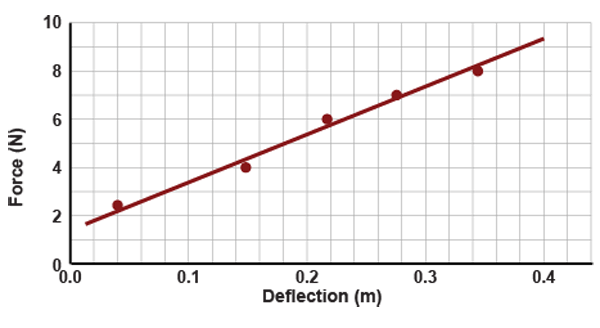
What Quantity can you calculate from the area under the graph?
distance
Force
spring constant
Work done

Which are the Equations for Power?
Power = Energy Transferred / Time
Power = Work Done / Time
Power = Energy Transferred x Time
Power = Work Done x Time
Which of the following is the equation of power (can tick more than 1)
P =F ⋅s
P = F ⋅v
P =t2E
P = t E
Power is also defined as dot product of
Force and displacement
Force and mass
Force and velocity
Force and time
If mass of a moving object is doubled, its K.E becomes:
2 times
4 times
5 times
16 times
Kinetic energy depends on
mass and height
mass and speed
height and speed
mass and force
Work-energy theorem can be expressed as
Fa = Kfinal − Kinitial
ma = Kfinal − Kinitial
Fs = Kfinal − Kinitial
F v = Kfinal − Kinitial
The speed of an object is doubled. Its kinetic energy is therefore
The same
Doubled
Tripled
Quadrupled
What happens to the kinetic energy of a moving object if the net work done is positive?
The kinetic energy increases.
The kinetic energy decreases
The kinetic energy remains the same.
The kinetic energy is zero.
An object of mass M, being pushed to a distance along a horizontal surface. What is the work done by gravity?
−Mgd
Zero
Mgd
Fd
The energy stored in the spring of a watch is
K.E
Electrical Energy
Elastic P.E
Solar Energy

