
 Worksheets
Ancient China
Total questions: 28
Worksheet time: 14mins
In Inner China, which natural events enriched the soil?
earthquakes
hurricanes
floods
sandstorms
A member of the ruling class/nobility that were typically wealthy landowners are called...
Aristocrats
Bureaucrats
Viziers
Envoys
A "bureaucracy" describes....
a group of non-elected government officials who help run the government efficiently.
a Chinese philosophy that emphasized the importance of following laws.
a type of government, usually headed by a powerful king or queen.
a type of government in which the leader is the political and religious leader.
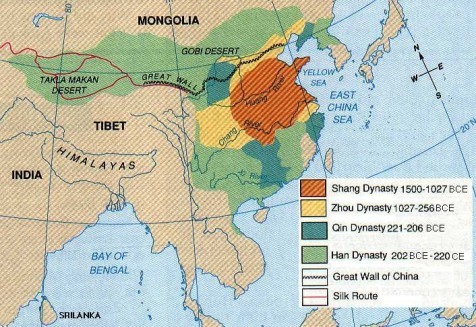
Where is the Pacific Ocean in relation to China?
South of China
China is surrounded by the Pacific Ocean
To the east of China
Where is the Gobi Desert?
Northern China
at the equator
Southern China
Ancient China's economy was mainly based on?
agriculture
trade
industry
What is the major trade route of Ancient China?
The Rocky Road
The Silk Road
The Great Northern Trading Route
The Route of Caravans
The ___________________ was largely key to the Mongols success. It provided transportation, food and fear.
Cow
Lizard
Horse
Ox
True/False The Mongols rarely imposed thier beliefs or way of life on people the conquered. While ferocious in war, they were quire tolerant in peace.
True
False
Mongol warriors made their livelihood do which of the following (check all that apply)?
trading
hunting
raiding
herding
all of these options
What is true about the boundaries of the Mongol Empire?
It included North and South America
It was very small compared to other empires.
It stretched across Europe and Asia.
It was never peaceful or stable.

Which of the following is a TRUE statement about Zheng He?
He used the largest fleet ever.
He was a spy for the Muslim Empire.
He lost his hand during one of his voyages.
He was spoke 5+ languages.
When comparing Zheng He's voyages to that of other explorers during the Age of exploration, they were __.
similar in size (ex: number of crew and ships)
much bigger in terms of ships and crew
much smaller in terms of ships and crew
One treasure ship was bigger than a _. (pick the best answer)
football field
basketball court
bike
olympic-sized swimming pool
What did Zheng He bring back from China?
rats, spiders and other insects
bananas, peaches and pears
Giraffes, rubies, carpets and spices
slaves
Which Dynasty restored the Great Wall?
Han
Qin
Ming
Song
Which of the following was not traded on the silk road?
Oranges
Silk
Woven Goods
Porcelain and Ceramics
Which of the following is NOT a river in China?
Yangtze
Xi
Ming
Yellow
Which dynasty had a strong military, children attending public schools, poets that wrote about nature and artists that painted landscaping.
Tang
Han
Sui
Ming
Why did Buddhism spread through ancient China?
Trade
Missionaries
Poor Economy
High Up Leaders Supported it
All of the above are reasons for the spread of Buddhism
Many ancient Chinese groups didn't get along, this is called
Fighting
Disunion
Delusion
Mad

