
 Worksheets
movement of animals
Total questions: 25
Worksheet time: 13mins
There are --------------- bones in the human body.
200
201
206
210
Which of these is not a function of bones?
Filtering harmful materials from the blood
Storing minerals
Protecting the body
Supporting the body
Osteoporosis is a disease that can be caused due to lack of
Vitamin A
Vitamin B
Vitamin C
Vitamin D
Animals without limbs which move above the ground may use this type of locomotion-
Serpentine movement
Peristalsis
Swimming
Gliding
The soft and muscular organ using which a snail crawls is its
stomach
foot
skin
leg
In a cockroach, if the right leg on the 1st row stepped forward, which of these would be correct with respect tot he positions of the other legs?
[Can choose multiple options]
2nd row, right leg forward
3rd row, right leg forward
2nd row, left leg forward
3nd row, left leg forward

snails body secretes a______________substance to help the movement.
Rough
Mucous
Enzymes
Blood

The strong substance protects the Snail from danger is called
foot
shoot
shell
bones
the insect which can climb, fly and have hard outer skeleton.
Snail
Cockroach
Earthworm
snake
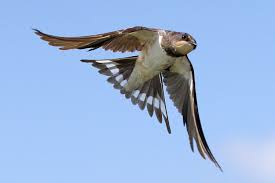
Which part of birds is modified as wings?
Hindlimbs
Shoulder
Forelimbs
Beak

Choose the adaptation which is correct for movement of fish.
Shape of the body is streamlined
tail helps to push the body forward
Fins help to balance the body inside the water
all of the above
Which of the following parts of our body help us in movement?
(i) Bones
(ii) Skin
(iii) Muscles
(iv) Organs
choose the correct answer from the option below.
(i) and (iii)
(ii) and (iv)
(i) and (iv)
(ii) and (iii)
Which of the following joints is immovable?
Shoulder and arm
Knee and thigh
Upper jaw and skull
The lower jaw and upper jaw
The skull covers and protects the
Ears
neck
fingers
brain
Which of the following organisms does not have both muscles and skeleton for movement?
Dog
snail
Earthworm
Human being
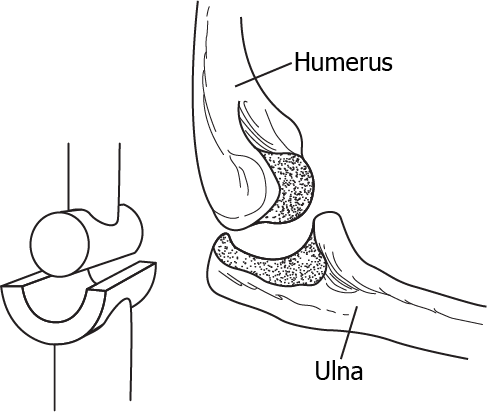
The image shows a joint found at the elbow. What is the type of joint present between the humerus and ulna?
Ball and socket
Fixed
Hinge
Pivot
How can fishes flow around easily in the water?
Due to small-sized body
Due to streamlined body
Due to the presence of thin skin
Due to the presence of scales on their body
Which of these represents one of the reasons that enable birds and NOT humans to fly?
They have long bones.
They have strong beaks
They have strong hind limbs
They have hollow and light bones.
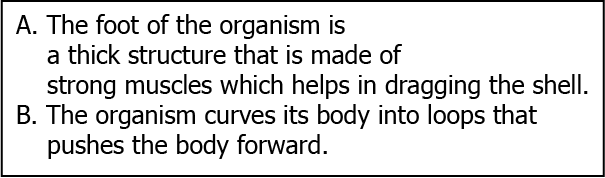
The table lists the characteristic features of the body movements of various organisms. Which organisms show these movements?
(a) A=fish, B=snail
(b)A=snail, B=snake
(c)A=bird, B=cockroach
(d)A=snake, B=earthworm
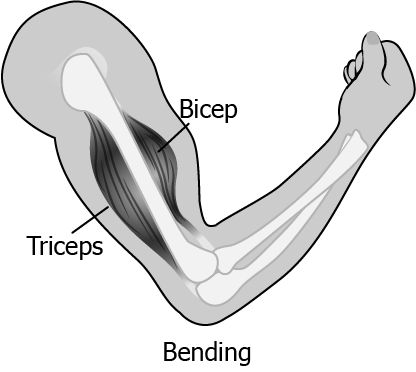
The image shows how the muscles help in the movement of the arm. Based on the image, what will be the length of the muscles during bending?
Both bicep and triceps relax
Both bicep and triceps contracts
The bicep contracts while triceps relax
The bicep relaxes while triceps contracts
How does the structure of the skeleton system support the body?
It protects the outer skin of the body from any injury.
It provides a framework that gives shape to the body.
It provides the site for storing all the nutrients in the body.
It allows free movement of all the bones during locomotion.
The Pivot joint occur in our skeleton at:
Hip
Knee
Neck
Femur
Tanvi completed her Science chapter where she wrote some statements. She wants to know whether the statements are correct. Help her to find the incorrect statement.
The movement and locomotion of all animals are exactly the same.
The cartilages are harder than bones.
The finger bones do not have joints.
All of the above.
How many muscles work together to move a bone?
One
Two
Three
Four
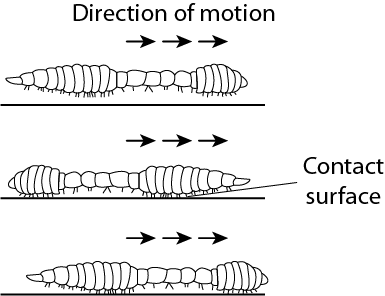
A student observes the movement of an organism that lacks bones. Based on the manner of movement, which organism this can likely be?
(a) Ant
(b)Cockroach
(c)Earthworm
(d)Snake

