
 Worksheets
Chapter 1 Test - Scientific Processes
Total questions: 30
Worksheet time: 3600secs
Why do we test one independent variable at a time?
Because it is hard to setup a data table with more.
To know what is causing the change, which helps us understand cause and effect.
It is what has always been done.
To gain an understanding as to why the experimenter changes the constants.
The variable that is being measured or observed is called the _. Hint: this is the responding variable.
independent variable
dependent variable
control variable
What is a constant in an experiment?
It's the variable that stays the same.
It's the variable that the scientist changes on purpose in the experiment.
It's the variable that is being measured in an experiment.
If I ride my bicycle to school instead of walking, then I will get to school faster. What is the dependent variable?
Riding a bicycle to school.
The time it takes to get to school.
Walking to school.
The school.

What is being changed on purpose in this experiment?
dependent variable
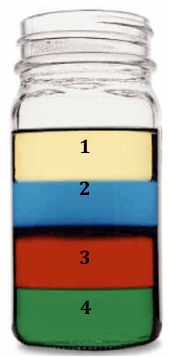
Put the liquids in order from most dense (left) to least dense (right).


The density of a material is 2 g/cm3. The volume is 24 cm3 . What is the mass?
There are 4 objects listed with their densities. Which of the following will float on water? (SELECT 2)
Object A:
0.7 g/cm3
Object B:
1.2 g/cm3
Object C:
0.25 g/cm3
Object D:
11.4 g/cm3

What is the independent variable?
atomic number
electron volts
first ionization energy
Jim Askew's Graph
Which type of graph is usually just a comparison of numbers?
line graph
bar graph
circle graph
Which is the graph most often used in science as it compares only two variables?
line graph
bar graph
circle graph
Julie took a survey. She asked her classmates, "What is your favorite place to swim in the summer?" She received the following responses: lake, pool, pool, lake, ocean, lake, pool, ocean, ocean, lake, pool, lake, ocean, pool, lake, pool, pool. Which table shows the data that Julie collected?


What was the height of the plant at 4 weeks?
18 cm
19 cm
20 cm
22 cm
Write 7.113 x 10⁷ in standard form.
71,130,000
7,113,000
0.0000007113
7,113
216,000,000 ; 2.2 x 10³ ; 3.1 x 10⁷ ; 310,000
Determine the number of Significant Figures in 13,410,000 m.
4
3
2
1
4.56 x 10³
How many kilograms of calcium are there in 173 pounds of calcium? (1 pound = 454 grams; 1 kg = 1000 g)
1.10 kg
78.5 kg
110 kg
78500 kg
Which conversion factor would you use to convert from cm to inches?
(1 inch = 2.54 cm)
2.54 cm1 in
1 in2.54 cm
1 cm2.54 in
2.54 in1 cm
2,500 mg
How many yards are in 1 mile? (3 ft = 1 yd) (5280 ft = 1 mi)
1,670 yds
5,280 yds
1,760 yds
5,820 yds

