
Font size
 Worksheets
Homeostasis CFU
Total questions: 32
Worksheet time: 23mins
Homeostasis
allows for a WILDLY fluctuating internal environment
is the maintenance of a relatively STABLE internal environment
UNSTABLE
Effectors: skeletal MUSCLES contracting to WARM YOU UP is called ______________
shivering
sweating
thermoreceptors
homeostasis
Homeostasis in the human body is often MAINTAINED by ___________feedback loops
positive
negative
When the BODY TEMPERATURE DROPS below normal ranges, blood vessels in the skin will
HINT: Your skin color undertones (red/pale) is caused by BLOOD
DILATE (expand) to allow LESS blood to flow to skin surface, conserving heat and making you pale
CONSTRICT (get smaller) to allow LESS blood to flow to skin surface, conserving heat and making you pale
DILATE (expand) to allow MORE blood and heat to flow to skin surface, making you red
CONSTRICT (get smaller) to allow MORE blood and heat to flow to skin surface, making you red
Which of the following is NOT regulated by homeostasis?
body temperature
blood sugar levels
blood water content
body movements
MAINTAINING body temperature is an example of a:
amplify changes
Which of the following is an example of POSITIVE feedback?
Thermoregulation (temperature control)
Blood Pressure Regulation
Childbirth
Blood Sugar Regulation
Rapid growth during puberty causes your body to release MORE and MORE growth hormones. As you grow, MORE and MORE growth hormones are released until puberty is reached, and then the hormones stop.
Which is an example of a POSITIVE feedback mechanism?


The ULTIMATE cause of death
Over Heating
Diabetes
Heart attack
Loss of Homeostasis
With low oxygen levels, your breathing rate will increase. When your oxygen levels rise, what is the appropriate response?
stop breathing
increase heart rate
keep breathing rate high
return breathing rate to normal "set point"
In which case(s) would your body need to carry out negative feedback processes? CHOOSE TWO.
body temperature at 102.2oF
body temperature at 94.4oF
body temperature at 97.9oC
body temperature at 98.6oF
Homeostatic Mechanisms: This is the CAUSE of the change
Stimulus
Receptor (Receives information)
Effector (Cause the EFFECT we want- muscles/glands)
Response
Homeostatic Mechanisms: This is the FINAL output we want
Stimulus
Receptor (Receives information)
Effector (Cause the EFFECT we want- muscles/glands)
Response
Homeostatic Mechanisms: These GATHER information and send it to the control center. They are usually associated with the senses.
Stimulus
Receptor
Effector
Response
Homeostatic Mechanisms: These are the workers (MUSCLES + GLANDS) of the body that actually create the effect we want
Stimulus
Receptor
Effector
Response
Homeostatic Mechanisms: Thermoregulation example--> It is 103 degrees outside
Stimulus
Receptor (Receives information)
Effector (Cause the EFFECT we want- muscles/glands)
Response
Homeostatic Mechanisms: Thermoregulation example--> Thermoreceptors gather that the person's body has increased in body temperature
Stimulus
Receptor (Receives information)
Effector (Cause the EFFECT we want- muscles/glands)
Response
Homeostatic Mechanisms: Thermoregulation example--> Sweat glands release sweat and smooth muscles in the skin cause vasodilation (vessels expanding) to bring heat to the surface of the body and the skin turns red
Stimulus
Receptor (Receives information)
Effector (Cause the EFFECT we want- muscles/glands)
Response
Homeostatic Mechanisms: Thermoregulation example--> The sweat evaporates off the skin LOWERING body temperature back to normal (98.6)
Stimulus
Receptor (Receives information)
Effector (Cause the EFFECT we want- muscles/glands)
Response
Which of the following IS NOT an example of a homeostatic mechanism?
Shivering when body temp drops below "set point"
increasing adrenaline release in times of stress
Pulling blankets over yourself when cold at night
Secreting insulin after a meal to decrease blood sugar concentration
Homeostasis is a condition whereby body parts function efficiently only when the concentrations of water, food, oxygen, and the conditions of heat and pressure...
remain the same and DO NOT vary
remain within certain limited ranges
fluctuate GREATLY between very high and very low values
Positive feedback mechanisms
regulate long term changes
move conditions AWAY from the normal state
bring conditions back to the normal state
usually produce stable conditions
Which of the following is NOT an example of positive feedback control?
maintaining blood pressure
blood clotting after an injury
adrenaline secretion during immediate danger
uterine contractions at childbirth
Which statement is MOST closely associated with the function of the control center?
gathers and sends information
the cause of the change
change is compared to "set point" and sends directions to fix
muscles and glands that elicit responses
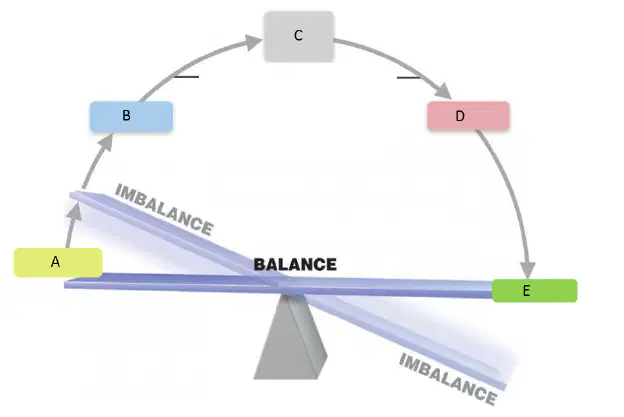
What is the correct homeostatic mechanism for A
Effectors
Receptors
Control center
Stimuli
Response
What is the correct homeostatic mechanism for B
Effectors
Receptors
Control center
Stimuli
Response
What is the correct homeostatic mechanism for C
Effectors
Receptors
Control center
Stimuli
Response
What is the correct homeostatic mechanism for D
Effectors
Receptors
Control center
Stimuli
Response
What is the correct homeostatic mechanism for E
Effectors
Receptors
Control center
Stimuli
Response

