wayground logo

Free Printable Worksheets

Font size

S
M
L
XL
Worksheets

Introduction of Physics

Total questions: 49

Worksheet time: 53mins

Name
Class
Date
1.
3 cm = ? mm
a)
30
b)
300
c)
3000
d)
0.3
2.
Which one is not in the metric system?
a)
Kilometer
b)
Yard
c)
Centimeter
d)
Meter
3.
Convert 8 kilometers to meters
a)
800 m
b)
80,000 m
c)
8,000 m
d)
.008 m
4.

The metric system is based on multiples of:

a)

100

b)

20

c)

10

d)

1

5.

Which of these units is the largest?

a)

Centimeter

b)

Millimeter

c)

Decameter

d)

Hectometer

6.

Which of the following is not an example of a base unit.

a)

Inches

b)

Meters

c)

Grams

d)

Liters

7.
5 kg = ? g
a)
50 
b)
500
c)
5000
d)
50,000
8.
32 km = ? m
a)
320 
b)
3,200
c)
0.032
d)
32,000
9.
150 cL = ? mL
a)
5 mL
b)
1500 mL
c)
10 mL
d)
150 mL
10.
5000 m = ? km
a)
5
b)
10
c)
15
d)
20
11.
400 cg = ? g
a)
4
b)
40
c)
50
d)
400
12.

10 centimeters =

a)

10 decimeters

b)

1 decimeter

c)

100 decimeters

d)

1 meter

13.

The SI unit for mass is the ___________.

a)

meter

b)

kilogram

c)

liter

d)

second

e)

Newton

14.

The SI unit for measuring length is the __________.

a)

meter

b)

kilogram

c)

liter

d)

Newton

e)

second

15.

The SI unit for volume is the __________.

a)

meter

b)

kilogram

c)

liter

d)

second

e)

Newton

16.
The abbreviation for kilogram is _______.
a)
KG
b)
Kl
c)
cg
d)
kg
17.
The abbreviation for millimeter is ________.
a)
mm
b)
mi
c)
MM
d)
ml
18.
The abbreviation cg stands for ____________.
a)
kilogram
b)
centipede
c)
centigallon
d)
centigram
19.
Change from standard form to scientific notation: 12,000,000
a)
12.0  x  107
b)
0.12  x  107
c)
1.2  x  106
d)
1.2  x  107
20.
Change from standard form to scientific notation:  450,000
a)
4.5  x  105
b)
45  x  105
c)
4.5  x  104
d)
4.5  x  106
21.
Change from standard form to scientific notation:  0.000398
a)
39.8  x  10-5
b)
3.98  x  10-5
c)
3.98  x  10-4
d)
39.8  x  10-6
22.
Change from standard form to scientific notation: 0.004078
a)
4.078  x  10-3
b)
4.078  x  103
c)
40.78  x  10-4
d)
.4078  x  10-2
23.
125,678,000: Change to scientific notation
a)
1.25678  x  1012
b)
.125678  x  10-9
c)
12.5678  x  108
d)
1.25678  x  108
24.
Which number is correctly written in scientific notation?
a)
5.67 x 10⁵
b)
56.7 x 10³
c)
0.567 x 10⁶
25.
Which number is correctly written in scientific notation?
a)
8.2 x 10²
b)
82 x 107
c)
3.45 x 94
26.
Multiply:
(9.4 x 10⁶)(3.2 x 10⁵)
a)
30.08 x 10¹¹
b)
3.8 x 101
c)
3.008 x 10¹²
d)
2.9375 x 101
27.
Multiply:
(9.4 x 10⁶)(3.2 x 10⁵)
a)
30.08 x 10¹¹
b)
3.8 x 101
c)
3.008 x 10¹²
d)
2.9375 x 101
28.
Which is the smallest?
1.3 x 10²⁰
2.9 x 10²¹
9.5 x 1032
8.4 x 10¹⁹
a)
1.3 x 10²⁰
b)
2.9 x 10²¹
c)
9.5 x 1032
d)
8.4 x 10¹⁹
29.

What is physics?

a)

Study of animals

b)

Study of rocks and how they form

c)

Study of matter and energy

d)

Study of chemicals

30.

What are some things that physics has been used for?

a)

Making airplanes

b)

Making cars

c)

Getting satellites into space

d)

Treating diseases

31.

What is a basic tool of physics?

a)

Hammers

b)

Mathematics

c)

Periodic table

d)

Oxygen

32.
A place or object used for comparison to determine if another object is in motion is called a
a)
comparison point
b)
reference point
c)
point of view
d)
motion detector
33.

Relative motion

a)

the motion of an object in comparison to other objects in a specific frame of reference

b)

the point of view used to measure the position and movement of objects

c)

how fast something moves

d)

the distance

34.

The best reference points are stationary (not moving).

a)

true

b)

false

35.

The location of an object related to a zero point.

a)

position

b)

speed

c)

distance

d)

displacement

36.

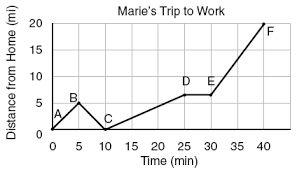
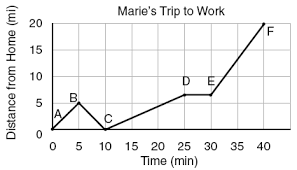
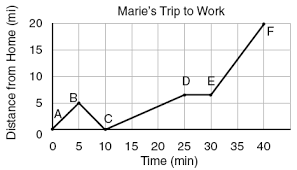
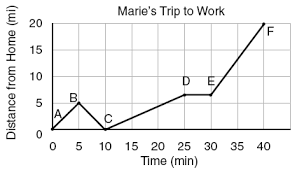
When was Marie driving the fastest?

a)

C to D

b)

D to E

c)

E to F

37.

During what period of time was Marie stopped?

a)

0-5 minutes

b)

5-10 minutes

c)

10-25 minutes

d)

25-30 minutes

38.

What could account for Marie’s motion at 27 minutes?

a)

She was late so she broke the speed limit

b)

She forgot something at home and ran back to get it

c)

She was stopped at a red light

d)

She was driving across the top of a hill
39.

How does her speed at 3 minutes compare with her speed at 7 minutes?

a)

She is driving faster at 3 minutes.

b)

She is driving faster at 7 minutes

c)

She is driving forward at 3 minutes and back at 7.

d)

She is moving up at 3 minutes and down at 7 minutes

40.

In Segment DE Marie was stopped at a red light. How long was she stopped for?

a)

1 min.

b)

10 min.

c)

30 min.

d)

5 min.

41.
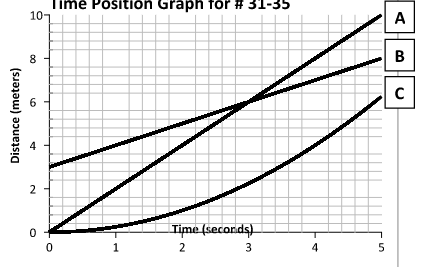
Which runner had a head start?
a)
A
b)
B
c)
C
42.

from 3rd second to 5th second, the object is

a)

moving at a constant speed

b)

speeding up

c)

not moving

d)

slowing down

43.

What is happening at E?

a)

Stationary

b)

Accelerating

c)

Fast steady speed; moving away from the starting position

d)

Steady speed; returning to start position
44.
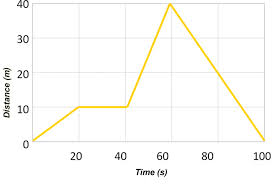
How long did it take this object to travel back to its reference/starting point?
a)
20 s
b)
30 s
c)
60 s
d)
100 s
45.

This position vs. time graph shows an object...

a)

not moving

b)

moving with constant velocity

c)

moving with changing velocity

46.

This position vs. time graph shows an object...

a)

not moving

b)

moving with constant velocity

c)

moving with changing velocity

47.

Which of these position vs. time graphs shows an object changing direction?

a)
b)
c)
d)
48.
In which of the following graphs (click the image) are both runners moving at the same speed (note that graph c is the bottom right graph, and graph d is the bottom left graph)? 
a)
Graph A
b)
Graph B
c)
Graph C
d)
Graph D
49.

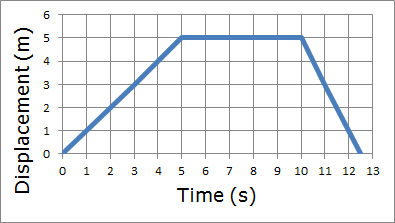
According to the graph, what was the Speed for the first 5 seconds?

a)

1 m/s

b)

0.5 m/s

c)

5 m/s

d)

2 m/s