
 Worksheets
Waves
Total questions: 47
Worksheet time: 35mins
Name
Class
Date
1.
Which of these electromagnetic waves can we see?
a)
radio
b)
x-ray
c)
microwave
d)
visible light
2.
Which of these waves can travel in a vacuum (empty space)/
a)
sound wave
b)
radio wave
c)
compressional wave
d)
water wave
3.
Gamma rays have the shortest waveslength, and therefore the ____ frequency.
a)
lowest
b)
highest
4.
How are sound and light waves similar?
a)
both transmit energy
b)
both require a medium
c)
neither require a medium
d)
both transmit matter
5.
All waves carry
a)
energy
b)
light
c)
matter
d)
particles
6.
Which of these CANNOT travel in empty space?
a)
electromagnetic waves
b)
mechanical
7.
If you want to change the pitch of a sound, you have to change the ___
a)
frequency
b)
amplitude
c)
speed
d)
volume
8.
High energy waves have a ____.
a)
high frequency
b)
low frequency
c)
small amplitude
d)
big wavelength
9.
If a sound was has a big amplitude, it will be a ____ sound.
a)
soft
b)
loud
c)
high frequency
d)
low frequency
10.
Sound travels fastest through
a)
solids
b)
liquids
c)
gases
d)
empty space
11.
A wave that is an oscillation of matter, and therefore transfers energy through a medium.
a)
mechanical wave
b)
medium
c)
surface wave
12.
the top of something, especially a mountain or hill.
a)
rarefaction
b)
crest
c)
compression
13.
A wave vibrating at right angles to the direction of its propagation.
a)
ssurface wave
b)
medium
c)
transverse wave
14.
The material through which a wave travels
a)
Medium
b)
Crest
c)
Surface wave
d)
Rarefraction
15.
A wave in which the vibration of the medium is parallel to the direction the wave travels
a)
Longitudinal Wave
b)
Surface Wave
c)
Transversal wave
d)
Mechanical Wave
16.
The time required for one cycle,a complete motion that returns to its starting point
a)
Frequancy
b)
Amplitude
c)
Period
d)
Periodic motion
17.
The number of complete cycles in a given time
a)
Period
b)
Amplitude
c)
Hertz
d)
Frequancy
18.
Which is produced when two crests undergo constructive interference of waves
a)
a reflection
b)
a node
c)
an antinode
d)
a flat line
19.
What does it mean to refract?
a)
bounce off
b)
to bend
c)
curve outward
d)
reflect
20.
the particles in a surface wave travel how?
a)
back and forth
b)
up and down
c)
in a circular pattern
d)
horizontally
21.
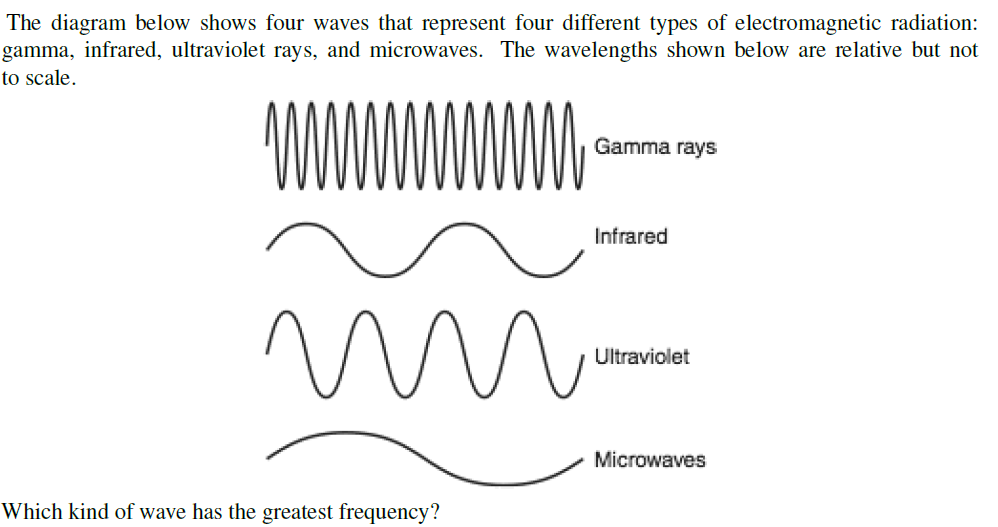
Which kind of wave has the greatest frequency?
a)
gamma rays
b)
infrared
c)
ultraviolet
d)
microwaves
22.

Determine the wavelength of this wave?
a)
1m
b)
2m
c)
3m
d)
4m
23.

High frequency waves have _________ wavelength.
a)
varying
b)
high
c)
the same
d)
low
24.

Which letter represents amplitude?
a)
A
b)
B
c)
C
d)
D
25.

Which letter represents the wave trough?
a)
A
b)
B
c)
C
d)
D
26.

Which letter represents the wave crest?
a)
A
b)
B
c)
C
d)
D
27.

Which letter represents wavelength?
a)
A
b)
B
c)
C
d)
D
28.

What kind of wave is pictured below?
a)
compressional wave
b)
transverse wave
c)
sound wave
d)
mechanical wave
29.
What is the name of a material in which waves, like sound waves, seismic waves, and waves in a slinky
a)
Vacuum
b)
Medium
c)
Mechanical
d)
Space
30.
Why would a wave change direction?
a)
Because it kept traveling through the same medium
b)
Because it went from one medium to another
c)
the amplitude was too large
d)
the frequency was too small
31.
What is the result of two or more waves overlapping?
a)
Refraction
b)
Refelction
c)
Interference
d)
Diffraction
32.
What type of interference is two waves of the same amplitude approaching each other?
a)
Constructive
b)
Destructive
c)
Neither
d)
Both
33.
A shorter wavelength equals ____________ energy
a)
more
b)
double the amount
c)
less
d)
half the amount
34.
What wave can travel WITHOUT a medium?
a)
longitudinal wave
b)
electromagnetic wave
c)
transverse wave
d)
surface wave
35.
Sound is caused by?
a)
force
b)
vibrations
c)
instruments
36.
Sound travels FASTEST through which of these materials?
a)
Air
b)
Empty space
c)
Metal
d)
Water
37.

What is frequency?
a)
the number of vibrations per second
b)
how high or low a sound is
c)
the loudness or softness of a sound
d)
the back and forth movement of matter
38.
What is vibration?
a)
how loud a sound is
b)
the back and forth movement of matter
c)
how high or low a sound is
d)
the loudness or softness of a sound
39.
What causes an echo?
a)
sound waves bouncing off large, hard surfaces
b)
sound waves bouncing off carpet
c)
sound waves bouncing off tables and chairs
d)
you repeating yourself
40.
Without matter, sound waves could not travel.
a)
True
b)
False
41.
_____ is a method of locating things underwater using echolocation.
a)
trees
b)
solar
c)
sonar
d)
turpentine
42.
Bats use ________ TO LOCATE MOSQUITOES IN THE AIR.
a)
solar
b)
ecology
c)
echolocation
d)
evolution
43.
The amount of energy a wave carries corresponds with its ____.
a)
crest
b)
wavelength
c)
amplitude
d)
period
44.
_____________________________ is an area of particles that moves outward in all directions from a vibrating object.
a)
frequency
b)
sound wave
c)
pitch
d)
intensity
45.
How do the air molecules move in a sound wave?
a)
in all directions
b)
at right angles to the wave
c)
in the same path as the wave
d)
the air molecules themselves do not move.
<
<
46.
What effect causes musical instruments to produce sound?
a)
harmony
b)
resonance
c)
magnitude
d)
wind
47.
How has resonance been responsible for collapsing bridges?
a)
resonace has led to earthquakes that tear down bridges
b)
resonance in bridges causes them to begin to vibrate and eventually collapse.
c)
resonance cannot tear down a bridge
d)
resonance causes the bridge to wear away over many years, and eventially fall
100 %

