
NEW
Font size
 Worksheets
Chemical and Physical Changes
Total questions: 35
Worksheet time: 22mins
Which is the best example of a new substance forming?
lighting a match
cutting a piece of paper
popping a balloon
hitting a nail with a hammer
Which is an example of a different substance being formed?
glass breaking
metal melting
water freezing
wood burning
Identify the change:
Glass breaking
Physical
Chemical
Students observed a piece of iron change from shiny to rusty. What caused this change?
a chemical reaction
a heat reaction
a cold reaction
a physical reaction
Identify the change:
Wood burning
Physical
Chemical
Bending metal
Physical Change
Chemical Change
Boiling Water
Physical Change
Chemical Change
Ice cream melting
Physical Change
Chemical Change
Dissolving Sugar
Physical Change
Chemical Change
Crumpling paper
Physical Change
Chemical Change
A Candle Burning
Physical Change
Chemical Change
Nail Rusting
Physical Change
Chemical Change
Bleaching Clothes
Physical Change
Chemical Change
Egg Cooking
Physical Change
Chemical Change
Ice melting
Physical Change
Chemical Change
A chemical change is a change
where a new substance is created.
where the look of the substance has changed.
A physical change is a change
where the look of the substance has changed.
where a new substance is created.
What is matter?
Anything that has mass and takes up space.
A form of energy.
A physical combination of 2 or more substances.
What are the three states of matter?
solid, liquid and gas
physical change, chemical change, mixture
mass, mixture, volume
A change in which NEW substances are formed.
Chemical change
Physical change

Melting butter for popcorn is a
chemical change
physical change

What kind of change is freezing water into ice cubes?
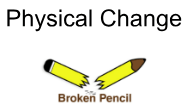
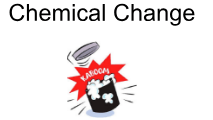

What kind of change is cutting your hair?
A property that can be observed WITHOUT changing the chemical composition of an object
chemical property
physical property
Which of the following is NOT a physical property?
flammability
solubility
density
luster
Which of the following is defined as the likelihood of a substance to undergo a chemical reaction?
combustibility
rusting
reactivity
flammability


We study properties so we can _______________ a substance.
smell
measure
identify
change

Luster means ________________________.
suitable to be shaped and rolled.
capable of being stretched out into thin wires.
the way a surface appears when it reflects light.
the ability to conduct electrical or thermal energy.
Which is a chemical property?
reactivity
boiling point
density
conductivity
Which is an example of a physical property?
malleability
corrosion
reactivity
flammability
the ability to be hammered or rolled into thin sheets
magnetism
malleability
ductility
electrical conductivity
Which of the following is a chemical property of water?
Reacts with pure sodium
Boils at 100 oC
Is liquid at room temperature
Has a density of 1 gm/mL

