wayground logo

Free Printable Worksheets

Font size

S
M
L
XL
Worksheets

Limits Calculus

Total questions: 134

Worksheet time: 28hrs 22mins

Name
Class
Date
1.

The graph of the function, f(x) is shown above. What is limx2f(x)?\lim_{x\rightarrow2}f\left(x\right)?  

a)

1

b)

2

c)

3

d)

dne

2.

The graph of the function, f(x) is shown above. What is limx3f(x)?\lim_{x\rightarrow3}f\left(x\right)?  

a)

1

b)

2

c)

3

d)

dne

3.

The graph of the function, f(x) is shown above. What is limx0f(x)?\lim_{x\rightarrow0}f\left(x\right)?  

a)

1

b)

2

c)

3

d)

dne

4.

The graph of the function, f(x) is shown above. What is limx2+f(x)?\lim_{x\rightarrow2+}f\left(x\right)?  

a)

1

b)

2

c)

3

d)

dne

5.

The graph of the function, f(x) is shown above. What is limx0+f(x)?\lim_{x\rightarrow0+}f\left(x\right)?  

a)

1

b)

2

c)

3

d)

dne

6.

The graph of the function, f(x) is shown above. What is limx2f(x)?\lim_{x\rightarrow2-}f\left(x\right)?  

a)

1

b)

2

c)

3

d)

dne

7.

The graph of the function, f(x) is shown above. What is limx1f(x)?\lim_{x\rightarrow1}f\left(x\right)?  

a)

1

b)

2

c)

3

d)

dne

8.

The graph of the function, f(x) is shown above. What is limx2f(x)?\lim_{x\rightarrow2}f\left(x\right)?  

a)

1

b)

2

c)

3

d)

dne

9.

The graph of the function, h(x) is shown above. What is limx4h(x)?\lim_{x\rightarrow4}h\left(x\right)?  

a)

-1

b)

0

c)

2

d)

dne

10.

The graph of the function, h(x) is shown above. What is limx4+h(x)?\lim_{x\rightarrow4+}h\left(x\right)?  

a)

-1

b)

0

c)

2

d)

dne

11.

The graph of the function, h(x) is shown above. What is limx4h(x)?\lim_{x\rightarrow4-}h\left(x\right)?  

a)

-1

b)

0

c)

2

d)

dne

12.

The graph of the function, h(x) is shown above. What is h(4)?h\left(4\right)?  

a)

-1

b)

0

c)

2

d)

dne

13.

From the graph of f(x) what is limx1f(x)?\lim_{x\rightarrow1}f\left(x\right)?  

a)

0

b)

3

c)

2

d)

dne

14.

From the graph of f(x) what is limx3f(x)?\lim_{x\rightarrow3}f\left(x\right)?  

a)

0

b)

3

c)

2

d)

dne

15.

From the graph of f(x) what is limx3+f(x)?\lim_{x\rightarrow3+}f\left(x\right)?  

a)

0

b)

- \infty  

c)

\infty  

d)

dne

16.

From the graph of f(x) what is limx3f(x)?\lim_{x\rightarrow3-}f\left(x\right)?  

a)

0

b)

- \infty  

c)

\infty  

d)

dne

17.

From the graph of f(x) what is limx1f(x)?\lim_{x\rightarrow1-}f\left(x\right)?  

a)

0

b)

33

c)

\infty  

d)

dne

18.

The table above gives values of the function at selected values of . What is limx11f(x)?\lim_{x\rightarrow11}f\left(x\right)?  

a)

11

b)

32

c)

32.03

d)

dne

19.

The table above gives values of the function at selected values of . What is limx3f(x)?\lim_{x\rightarrow3}f\left(x\right)?  

a)

-8000

b)

0

c)

8000

d)

dne

20.

The table above gives values of the function at selected values of . What is limx5f(x)?\lim_{x\rightarrow5}f\left(x\right)?  

a)

5

b)

9

c)

9.02

d)

dne

21.
Find the limit as x approaches 3 from the left
a)
4
b)
3
c)
2
d)
DNE
22.
Find the limit of the function as x approaches 2+.
a)
1
b)
-1
c)
5
d)
DNE
23.
What is the limit of the function as x approaches -4 from the left?
a)
2
b)
-4
c)
DNE
d)
-2
24.
What is the limit of the function as x approaches 1 from the left?
a)
DNE
b)
1
c)
4
d)
-2
25.
What is the limit of the function as x approaches 1 from the right?
a)
DNE
b)
1
c)
4
d)
-2
26.
Find the limit of the function as x approaches 4 from the right.
a)
-1
b)
2
c)
-2
d)
DNE
27.
What is the limit as x approaches -1
a)
0
b)
Infinity
c)
-Infinity
d)
What are you talking about?!?!?
28.
Find the limit as x approaches 0-
a)
0
b)
c)
-∞
d)
1
29.

Use the limit laws to evaluate the given limit.

limx0[4x22x+3]\lim_{x\rightarrow0}\left[4x^2-2x+3\right]  

a)

3

b)

-3

c)

13\frac{1}{3}  

d)

3\sqrt[]{3}  

30.

Use the limit laws to evaluate the given limit.

limx(2)(x26x+3)\lim_{x\rightarrow\left(-2\right)}\sqrt[]{(x^2-6x+3)}  

a)

232\sqrt[]{3}  

b)

21\sqrt[]{21}  

c)

6-\sqrt[]{6}  

d)

19\sqrt[]{19}  

31.

A _____ may be used to estimate a limit. If the limit of a function at a point does not exist, it is still possible that the limits from the left and right at that point may exist.

a)

limiting process

b)

limit laws

c)

table of values

d)

squeeze theorem

32.

Use direct substitution to evaluate each limit.

limx7(x2)\lim_{x\rightarrow7}\left(x^2\right)  

a)

-49

b)

49

c)

149\frac{1}{49}  

d)

49-\sqrt[]{49}  

33.

Use direct substitution to evaluate the limit.

limx1(27xx+6)\lim_{x\rightarrow1}\left(\frac{2-7x}{x+6}\right)  

a)

57\frac{5}{7}  

b)

75\frac{7}{5}  

c)

57-\frac{5}{7}  

d)

75-\frac{7}{5}  

34.

Use direct substitution to show that the limit leads to the indeterminate form 0/0.

limx9(x9x3)\lim_{x\rightarrow9}\left(\frac{x-9}{\sqrt[]{x}-3}\right)  

a)

27

b)

6

c)

16

d)

3\sqrt[]{3}  

35.

Which of the following functions is continuous on all values of x?

a)

polynomial functions

b)

rational functions

c)

exponential values

d)

radical functions

36.

The following conditions must be satisfied for a function to be continuous EXCEPT one. Which is it?

a)

f(c) existsf\left(c\right)\ exists  

b)

limxcf(c) exists\lim_{x\rightarrow c}f\left(c\right)\ exists  

c)

f(c)=limxcf(c)f\left(c\right)=\lim_{x\rightarrow c}f\left(c\right)  

d)

f(c)=0f\left(c\right)=0  

37.

What values of x will the function f(x) = x3 + 5x + 3 continuous?

a)

1

b)

3

c)

5

d)

all values of x

38.

A function is continuous. Which of the following is TRUE about its graph?

a)

It has a hole or gap.

b)

It can be drawn without lifting your pen.

c)

It approaches positive infinity.

d)

It represents a rational function.

39.

Find the limit

a)

0

b)

8

c)

16

d)

Does Not Exist (DNE)

40.

Find the Limit

a)

0

b)

-1/4

c)

-5/4

d)

1

e)

DNE

41.

Find the limit as x approaches 1+

a)

1

b)

-1

c)

-3

d)

Infinity

e)

DNE

42.

Find the limit as x approaches 1

a)

1

b)

-1

c)

-3

d)

Infinity

e)

DNE

43.

Select all statements that are TRUE.

a)
b)
c)
d)
e)
44.

Determine the Limit at Infinity

a)

0

b)

-1

c)

-5/2

d)

DNE

e)

infinity

45.

Find the limit at infinity

a)

0

b)

infinity

c)

4/3

d)

-3/2

e)

DNE

46.

Find the limit at infinity

a)

0

b)

1

c)

infinity

d)

DNE

47.

Which of the following statement(s) are false?

a)

f is continuous at a

b)

the limit as x approaches a exists

c)

f is differentiable at a

d)

f(a) exists

e)

None, all statements are true

48.

Find the value for that makes f(x) continuous.

a)

0

b)

1

c)

1.5

d)

2

e)

No such value exists

49.
a)

-12

b)

-4

c)

3

d)

7

e)

No such value exists

50.
What is the limit?
a)
DNE
b)
Infinity
c)
6
d)
12
51.
What is the limit?
a)
DNE
b)
Infinity
c)
6
d)
12
52.
Evaluate
a)
-7
b)
0
c)
1
d)
DNE
53.
a)
Does Not Exist
b)
9
c)
1
d)
0
54.
a)
6
b)
3
c)
1/6
d)
-1/6
55.

Which of the following best describes the continuity at x = 5?

a)

Continuous

b)

Removable discontinuity

c)

Non-removable discontinuity

56.

Determine whether the graph of the function has a vertical asymptote or a removeable discontinuity at x = -1.

a)

Vertical Asymptote

b)

Removable Discontinuity

57.
Find the value that will make the following continuous
a)
-3
b)
-2
c)
-1
d)
c=0
58.
What is the limit?
a)
b)
20
c)
DNE
d)
12
59.
What is the limit?
a)
DNE
b)
2/3
c)
1/4
d)
60.
What is the limit?
a)
b)
-∞
c)
3
d)
-3
61.
Determine whether f(x) approaches + or - infinity as x approaches 4 from the left.
a)
+ Infinity
b)
- Infinity
c)
Either one.
62.
Find the vertical asymptote(s) (if any) of the graph of the function.
 3x / (x2 + 9)
a)
x=3
b)
x=0
c)
None
d)
X=3, x=-3
63.
What is the limit of the function as x approaches -4 from the left?
a)
2
b)
-4
c)
DNE
d)
-2
64.
Find the limit of the function as x approaches 2+.
a)
1
b)
-1
c)
5
d)
DNE
65.

limx→0 sin(6x) ∕ sin(2x)

a)

1/3

b)

3

c)

1

d)

DNE

66.
a)

A

b)

B

c)

C

d)

D

67.
a)

A

b)

B

c)

C

d)

D

68.
a)

A

b)

B

c)

C

d)

D

69.
a)

A

b)

B

c)

C

d)

D

70.
a)

A

b)

B

c)

C

d)

D

71.
a)

A

b)

B

c)

C

d)

D

72.
a)

A

b)

B

c)

C

d)

D

73.
a)
0
b)
2
c)
3
d)
4
74.
a)

0

b)

2

c)

3

d)

4

75.
a)
0
b)
c)
- ∞
d)
DNE
76.
a)
3
b)
1
c)
Infinity
d)
Does not exist
77.
a)
Does not exist
b)
6
c)
4
d)
3
78.
What is the limit of the function as x approaches -4 from the left?
a)
2
b)
-4
c)
DNE
d)
-2
79.
What is the limit of the function as x approaches 1 from the right?
a)
DNE
b)
1
c)
4
d)
-2
80.

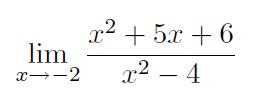
Find the limit as x approaches -2.

a)

4

b)

3

c)

2

d)

DNE

81.
Which of the following best describes the continuity at x = 1?
a)
Continuous
b)
Removable Point Discontinuity
c)
Non-removable Infinite Discontinuity
d)
Non-removable Jump Discontinuity
82.
Which of the following best describes the continuity at x = 5?
a)
Continuous
b)
Removable Point Discontinuity
c)
Non-removable Infinite Discontinuity
d)
Non-removable Jump Discontinuity
83.
Which of the following best describes the continuity at x = 5?
a)
Continuous
b)
Removable Point Discontinuity
c)
Non-removable Infinite Discontinuity
d)
Non-removable Jump Discontinuity
84.
Which of the following best describes the continuity at x = 0?
a)
Continuous
b)
Removable Point Discontinuity
c)
Non-removable Infinite Discontinuity
d)
Non-removable Jump Discontinuity
85.
Find where the function is continuous
a)
(-∞,-1)(-1,3)(3,∞)
b)
(-∞,∞)
c)
(-∞,-3)(-3,1)(1,∞)
d)
(-∞,-2)(-2,3)(3,∞)
86.

Classify the function as continuous or classify its discontinuity.

a)

Continuous!

b)

Discontinuous with a removable discontinuity

c)

Discontinuous with a jump discontinuity

d)

Discontinuous with an infinite discontinuity

87.

Classify the function as continuous or classify its discontinuity.

a)

Continuous!

b)

Discontinuous with a removable discontinuity

c)

Discontinuous with a jump discontinuity

d)

Discontinuous with an infinite discontinuity

88.

Which of the following must be true for a function to be continuous at a point, a? (select all that apply)

a)

f(a) must exist

b)

the limit as x approaches a must exist

c)

the function has to go to infinity

d)

f(a) and the limit as x approaches a must be equal

e)

you won't need to do any factoring/simplifying when finding the limit

89.

For a limit to exist, the left and the right hand limits must be equal.

a)

true

b)

false

90.

It is the value that function approaches as the independent variable of the function approaches a given value.

a)

Limit

b)

Derivative

c)

Constant

d)

Tangent

91.

Find the limits limx22x\lim_{x\rightarrow2}2x  

a)

0

b)

2

c)

4

d)

Does not exist

92.

What is the limit limx6x236x6\lim_{x\rightarrow6}\frac{x^2-36}{x-6}  ?

a)

0

b)

6

c)

12

d)

Does not exist

93.

Using the graph of f(x)= sin (x+π)f\left(x\right)=\ \sin\ \left(x+\pi\right)  , evaluate limx π2sin(x+π)\lim_{x\rightarrow\ \frac{\pi}{2}}\sin\left(x+\pi\right)  

a)

-1

b)

0

c)

1

d)

2

94.

Aside from graphing and solving, what is another way to illustrate the limit of a function?

a)

Observing

b)

Using table of values

c)

Using diagram

d)

Using calculator

95.

Evaluate limx0 5sin2xx\lim_{x\rightarrow0}\ \frac{5\sin2x}{x}  

a)

0

b)

15\frac{1}{5}  

c)

5

d)

10

96.

What is the limit of the function when x approaches c?

a)

1

b)

2

c)

3

d)

Does not exist

97.

Using the graph, evaluate limx4 f(x)\lim_{x\rightarrow-4^{-\ }}f\left(x\right)  

a)

-2

b)

4

c)

5

d)

3

98.

Using the graph, evaluate limx1 f(x)\lim_{x\rightarrow1^{-\ }}f\left(x\right)  

a)

-2

b)

3

c)

5

d)

does not exist

99.

Using the graph, evaluate limx1+ f(x)\lim_{x\rightarrow1^{+\ }}f\left(x\right)  

a)

3

b)

4

c)

5

d)

does not exist

100.

Using the graph, evaluate limx2 f(x)\lim_{x\rightarrow2^{\ }}f\left(x\right)  

a)

-2

b)

4

c)

5

d)

does not exist

101.

Evaluate: limx2(x2+3x+2x24)\lim_{x\rightarrow-2}\left(\frac{x^2+3x+2}{x^2-4}\right)  

a)

00\frac{0}{0}  

b)

14\frac{1}{4}  

c)

14-\frac{1}{4}  

d)

does not exist

102.

What do you call the process of simplifying rational expressions which contains radicals in the denominator or numerator?

a)

Substituting

b)

Rationalizing

c)

Radicalizing

d)

Differentiating

103.

What happens when the right hand limit and the left hand limit of a function are not equal?

a)

The limit does not exist.

b)

The right hand limit is the limit of the function.

c)

The left hand limit is the limit of the function.

d)

None of the above.

104.

What is the conjugate of x+3\sqrt[]{x}+3  ?

a)

x+3\sqrt[]{x}+3

b)

x3\sqrt[]{x}-3

c)

x+3\sqrt[]{x+3}

d)

x3\sqrt[]{x-3}

105.

Evaluate the limx9 x3x9\lim_{x\rightarrow9}\ \frac{\sqrt[]{x}-3}{x-9}  .

a)

6

b)

16\frac{1}{6}  

c)

indeterminate

d)

does not exist

106.

What is the limit of a constant?

a)

the constant itself

b)

zero

c)

indeterminate

d)

1

107.

Which of the following is true about the function f(x) = x23x4x+1f\left(x\right)\ =\ \frac{x^2-3x-4}{x+1}  ?

a)

It is continuous at x=-1.

b)

It is discontinuous at x=-1.

c)

It is continuous at 1x01\le x\le0  .

d)

f(1)=limx1f(x)f\left(-1\right)=\lim_{x\rightarrow-1}f\left(x\right)  

108.

A point at which a function is not defined. The graph has a break at this point.

a)

Continuity

b)

Discontinuity

c)

Limit

d)

Zero

109.

Which of the following is a continuous function at all real numbers?

a)

f(x)=x1f\left(x\right)=\sqrt[]{x-1}  

b)

f(x)=x2+2x+1x+1f\left(x\right)=\frac{x^2+2x+1}{x+1}

c)

f(x)=x1f\left(x\right)=x-1

d)

f(x)=1xf\left(x\right)=\frac{1}{x}

110.

It is either of the two limits of a function of a real variable x as x approaches a specified point either from the left or from the right.

a)

Left-hand limit

b)

One sided limit

c)

Right hand limit

d)

Infinite Limit

111.

At what value of x will the function f(x) = x24x2f\left(x\right)\ =\ \frac{x^2-4}{x-2}  be discontinuous?

a)

-2

b)

0

c)

2

d)

does not exist

112.

Which of the following conditions must be satisfied to say that a function is continuous?

a)

When f(c) exists.

b)

When limxcf(x)\lim_{x\rightarrow c}f\left(x\right)  exists.

c)

When limxcf(x) = f(c)\lim_{x\rightarrow c}f\left(x\right)\ =\ f\left(c\right)  exists.

d)

All of the above.

113.

Find the limit. Hint: Where is the horizontal asymptote?

a)

3/7

b)

0

c)

\infty

d)

-\infty

114.

Find the limit. Hint: Where is the horizontal asymptote?

a)

-2/9

b)

0

c)

\infty

d)

-\infty

115.

limx 2x34x +1\lim_{x\rightarrow\infty}\ \frac{2x-3}{4x\ +1}  

a)

0

b)

DNE

c)

1/2

d)

2

116.

limx(2x3+3x1)=\lim_{x\rightarrow\infty}\left(2x^3+3x-1\right)=  
Hint:  Think of the end behavior

a)

\infty  

b)

-\infty  

c)

2

d)

2/3

117.

limx(x2+3x1)=\lim_{x\rightarrow-\infty}\left(x^2+3x-1\right)=  
Hint:  Think of the end behavior of an even and positive polynomial.

a)

\infty  

b)

-\infty  

c)

2

d)

3

118.

limx sin xx+4\lim_{x\rightarrow\infty}\ \frac{\sin\ x}{x}+4  

a)

1

b)

0

c)

DNE

d)

4

119.

limx cos xx\lim_{x\rightarrow-\infty}\ \frac{\cos\ x}{x}  

a)

DNE

b)

1

c)

0

d)

-\infty  

120.

Find the limit

a)

6/5

b)

0

c)

\infty

d)

-\infty

121.

limx x3x2+153xx4=...\lim_{x\rightarrow\infty}\ \frac{x^3-x^2+1}{5-3x-x^4}=...  


a)

0

b)

-1

c)

-5

d)

\infty   

e)

-\infty  

122.

limx 12x+2x3x3+x+1= ...\lim_{x\rightarrow\infty}\ \frac{1-2x+2x^3}{x^3+x+1}=\ ...  

a)

- 4

b)

- 2

c)

1

d)

2

e)

\infty  

123.

limx x+74x2+3x=...\lim_{x\rightarrow\infty}\ \frac{x+7}{\sqrt{4x^2+3x}}=...  


a)

-\infty  

b)

\infty  

c)

12\frac{1}{2}  

d)

0

e)

12-\frac{1}{2}

124.

Determine the value of the limit

a)

\infty

b)

-\infty

c)

DNE

d)

0

125.
a)

0

b)

1/4

c)

1

d)

\infty

126.

Evaluate

limx0+(1x4)\lim_{x\rightarrow0^+}\left(\frac{1}{x^4}\right)  

a)

++\infty  

b)

-\infty  

c)

undefinedundefined  

d)

00  

127.

Evaluate

limx0+(1x3)\lim_{x\rightarrow0^+}\left(\frac{1}{x^3}\right)  

a)

++\infty  

b)

-\infty  

c)

undefinedundefined  

d)

00  

128.

Evaluate

limx0(12x7)\lim_{x\rightarrow0^-}\left(\frac{1}{2x^7}\right)  

a)

++\infty  

b)

-\infty  

c)

undefinedundefined  

d)

00  

129.

Evaluate

limx0(12x8)\lim_{x\rightarrow0^-}\left(\frac{1}{2x^8}\right)  

a)

++\infty  

b)

-\infty  

c)

undefinedundefined  

d)

00  

130.

Evaluate

limx5+(4x5)\lim_{x\rightarrow5^+}\left(\frac{4}{x-5}\right)  

a)

++\infty  

b)

-\infty  

c)

undefinedundefined  

d)

00  

131.

Evaluate

limx2(2xx24)\lim_{x\rightarrow2^-}\left(\frac{2x}{x^2-4}\right)  

a)

++\infty  

b)

-\infty  

c)

undefinedundefined  

d)

00  

132.

Evaluate

limx3(3xx327)\lim_{x\rightarrow-3^-}\left(\frac{3x}{x^3-27}\right)  

a)

++\infty  

b)

-\infty  

c)

undefinedundefined  

d)

00  

133.

Evaluate

limx2+(4xx416)\lim_{x\rightarrow-2^+}\left(\frac{4x}{x^4-16}\right)  

a)

++\infty  

b)

-\infty  

c)

undefinedundefined  

d)

00  

134.

Evaluate

limx5+(4x5+12x)\lim_{x\rightarrow5^+}\left(\frac{4}{x-5}+\frac{1}{2x}\right)  

a)

undefinedundefined  

b)

++\infty  

c)

00  

d)

-\infty