wayground logo

Free Printable Worksheets

NEW

Font size

S
M
L
XL
Worksheets

Unit 1 &2 Chemistry

Total questions: 51

Worksheet time: 3hrs 33mins

Name
Class
Date
1.

How many sig fis in this number 34601

a)

4

b)

5

c)

6

d)

none

2.
How many sig figs are there?
100.00
a)
1
b)
3
c)
4
d)
5
3.
How many sig figs are there?
100000000
a)
1
b)
9
c)
10
4.
Change from standard form to scientific notation: 12,000,000
a)
12.0  x  107
b)
0.12  x  107
c)
1.2  x  106
d)
1.2  x  107
5.
Change from standard form to scientific notation:  450,000
a)
4.5  x  105
b)
45  x  105
c)
4.5  x  104
d)
4.5  x  106
6.
Change from standard form to scientific notation:  0.000398
a)
39.8  x  10-5
b)
3.98  x  10-5
c)
3.98  x  10-4
d)
39.8  x  10-6
7.
Change from standard form to scientific notation: 0.004078
a)
4.078  x  10-3
b)
4.078  x  103
c)
40.78  x  10-4
d)
.4078  x  10-2
8.
Which is the smallest?
1.3 x 10²⁰
2.9 x 10²¹
9.5 x 1032
8.4 x 10¹⁹
a)
1.3 x 10²⁰
b)
2.9 x 10²¹
c)
9.5 x 1032
d)
8.4 x 10¹⁹
9.

How many significant figures are there in 0.024574?

a)

0

b)

3

c)

5

d)

7

10.
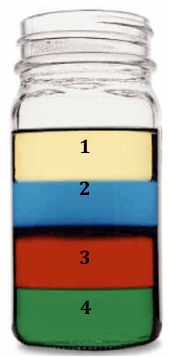
Put the liquids in order from most dense to least dense?
a)
4, 3, 2, 1
b)
1, 2, 3, 4
c)
3, 4, 2, 1, 
d)
4, 3, 1, 2
11.
What is the formula for density?
a)
density = mass x volume
b)
density = mass / volume
c)
density = mass + volume
d)
density = mass - volume
12.
True or False: a physical change may produce a new substance.
a)
True
b)
False
13.
Which of the following is an example of a physical change?
a)
sugar and oxygen reacting to produce water and carbon dioxide
b)
honey dissolving in tea
c)
a raw egg being cooked
d)
metal rusting after being left out in the rain
14.
A copper penny turning greenish after a few years is an example of ...
a)
Chemical Change
b)
Physical Change
15.
A change in which NEW substances are formed.
a)
Chemical change
b)
Physical change
c)
Casual change
d)
Formal change
16.
Bubbles form when two or more substances are combined ...
a)
Chemical Change
b)
Physical Change
17.
An explosion occurs ...
a)
Chemical Change
b)
Physical Change
18.
A change in the size, shape, or state of matter.
a)
chemical change
b)
physical change
19.

what is the law of conservation of energy?

a)

Energy can not be created or destroyed

b)

Energy can only be created, not destroyed

c)

Energy can only be destroyed, not created

d)

Energy can be both created and destroyed

20.

A car rolling down the drop of a roller coaster has ________ energy.

a)

potential

b)

kinetic

c)

light

d)

sound

21.

A car at the top of the drop on a roller coaster has ________ energy.

a)

potential

b)

kinetic

c)

heat

d)

sound

22.
What is energy?
a)
The ability to do work
b)
Light
c)
Heat
d)
Gas
23.
Which skier will have a greater potential energy? 
a)
Skier 1
b)
Skier 2
24.

Energy from the sun is known as.........

a)

hydroelectric energy

b)

geothermal energy

c)

Radiant energy

d)

wind energy

25.

State of matter that takes the shape of it's container and has a definite volume.

a)

Solid state

b)

Liquid state

c)

Gas state

d)

Plasma state

26.

State of matter that can fill containers with no fixed shape or volume.

a)

Solid state

b)

Liquid state

c)

Gas state

d)

Plasma state

27.

State of matter in which materials have a definite shape and volume.

a)

Solid state

b)

Liquid state

c)

Gas state

d)

Plasma state

28.
a)
Element
b)
Compound
c)
Mixture
29.
a)
Element
b)
Compound
c)
Mixture
30.
a)
Element
b)
Compound
c)
Mixture
31.
a)
Element
b)
Compound
c)
Mixture
32.

A pure substance that cannot be broken down into any other substance.

a)

Elements

b)

Compounds

c)

Mixtures

33.
Which of these is a pure substance?
a)
bread
b)
table salt
c)
garden soil
d)
sea water
34.
Which of the following is NOT a pure substance?
a)
milk
b)
oxygen
c)
water
d)
carbon dioxide
35.
Which of the following is a way in which elements and compounds are similar?
a)
Elements and compounds are pure substances.
b)
Elements and compounds are both made up of different kinds of atoms.
c)
Elements and compounds can both be broken down by physical means.
d)
Elements and compounds are listed on the periodic table.
36.

Brass is a metal that is bright red and gold. It is formed by combining, not chemically, two elements, zinc and copper. Based on the information, how would brass be classified?

a)

an element

b)

compound

c)

mixture

d)

suspension

37.
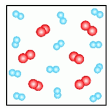
This diagram represents a _____.
a)
pure substance that is a compound
b)
mixture of elements
c)
pure substance that is an element
d)
mixture of compounds
38.

A student placed a small chip of limestone into a hydrochloric acid solution, and carbon dioxide gas was released. The carbon dioxide provided evidence that

a)

only a physical change occurred.

b)

a chemical change occurred.

c)

only a loss of mass occurred.

d)

the formation of an element occurred.

39.

What makes elements and compounds different from mixtures? Elements & compounds-

a)

have a constant composition (pure substances)

b)

are made of gases

c)

Will not change when heated

d)

conduct electric current

40.

Which of the following is a heterogeneous mixture?

a)

brass

b)

sand

c)

Kool-aid

d)

vanilla yogurt

41.

What type of mixture would coffee be?

a)

homogeneous

b)

heterogeneous

42.

What type of mixture would fruit salad be?

a)

homogeneous

b)

heterogeneous

43.

Charcoal powder is insoluble in water. When water is filtered, the charcoal powder becomes the _______.

a)

solute

b)

residue

c)

filtrate

d)

solvent

44.

Name the separation technique

a)

Chromatography

b)

Filtration

c)

Distillation

d)

Evaporation

45.

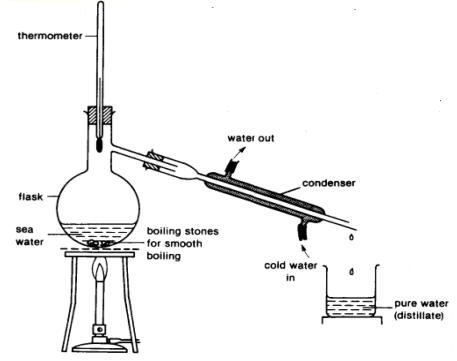
What is the name of this separation technique?

a)

Simple distillation

b)

Fractional distillation

c)

Boiling

d)

Evaporation

46.

What is the name of this separation technique?

a)

distillation

b)

filtration

c)

evaporation

d)

chromatography

47.
Which technique is shown the diagram below
a)
seiving
b)
filtration
c)
decanting
d)
crystallization
48.

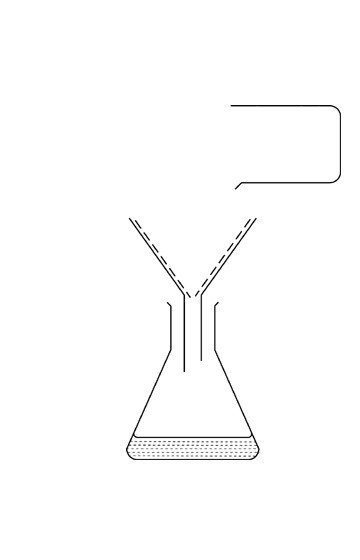
Filtration can be used to separate...

a)

an insoluble solid from a solution

b)

a soluble solid from a solution

c)

a dissolved solid from a solution

49.

After filtration of a sand-water mixture. Water that flows into the conical flask is the....

a)

discarded material

b)

solvent

c)

filtrate

d)

residue

50.

The liquid that condenses during distillation is called the

a)

residue

b)

filtrate

c)

distillate

d)

suspension

51.

Extraction takes advantage of ___________ to separate a mixture.

a)

different boiling points

b)

different solubilities

c)

different melting points

d)

different sizes