
 Worksheets
Topic 3: Properties of Matter Review
Total questions: 60
Worksheet time: 48mins

size of an object
physical change
physical property
chemical change
chemical property
the amount of space an object takes up
density
particles
mass
volume
the amount of matter in an object
mass
solubility
matter
evaporation
anything that has mass and takes up space
mass
matter
volume
physical property
how much one substance can dissolve into another substance
evaporation
volume
solubility
conductivity
the amount of matter in a certain amount of space
density
mass
matter
volume

How much matter an object contains for it´s size
Mass
Density
Matter
Volumen
If an object don´t absorb the heat we say it is a great...
Heat conductor
Heat insulator
Miami Heats
Heat point
A material that allows heat to move through it easily...
thermal oxidizer
thermal insulator
electrical conductor
thermal conductor
Why do ice cubes float in a glass of water?
The ice cubes are more dense than the water.
The water is more dense than the glass.
The water is more dense than the ice.
The ice is more dense than the glass.
Blue color: Chemical or Physical Property
Reacts with acid: Chemical or Physical Property
Melting point: Chemical or Physical Property
Which one of these is a chemical property?
Melting point
Boiling point
Color
Toxicity

the ability of a material to bend or be hammered into other shapes without breaking.
Ductility
Malleability
Toxicity
Solubility

a resistance to being scratched or dented.
Luster
Flammability
conductivity
hardness

the ability to pass electricity or heat through a substance
conductivity
ductility
oxidation
malleability
Serena is mixing a material into a beaker filled with a liquid. She notices that the material seems to disappear into the liquid. What physical property of the material is Serena most likely observing?
solubility
conductivity
magnetism
density
A student determined the mass and volume of a gold ring. What physical property of the gold can be determined using these two measurements?
Its reactivity
Its expansion rate
Its density
Its melting point

Students measured and recorded the density of 4 samples. Using the density column and the data table shown above, which of the samples will probably float on top of the oil?
Sample A
Sample B
Sample C
Sample D


What is the formula for finding volume?
V = l + w + h
V = l x w x h
V = l x h
V = M + D

What is the volume of the rock in the picture?
30 mL
40 mL
40 cm3
10 cm3

What is the volume of the marble?
20 mL
17 mL
5 mL
3 mL

What is the volume of the blocks?
8 mL
10 mL
60 mL
5 mL

An object has a density of 1.5 g/mL. If the object is placed in water the object will
Sink
Float
Suspend
Which of the following is a true statement? (There is only one correct choice)
An object with a density of 1.2 g/mL will float in water.
An object with a density of .8 g/mL will float in water.
An object with a density of 1.0 g/mL will sink in water.
Why does oil float when pour into the water?
Oil is more dense than the water.
Oil is less dense than the water.
Oil has equal density with water.
Both oil and water has no density.
Which of the following describes the compactness of the molecules or particles present in an object?
volume
mass
density
solubility
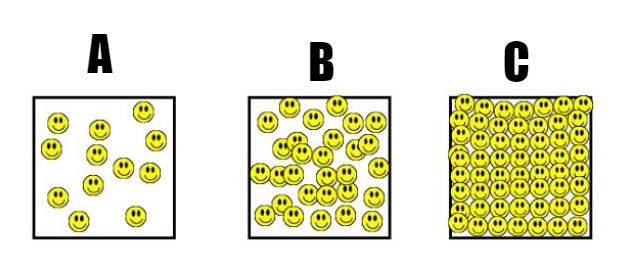
Which box shows the particles of an object that is the MOST DENSE?
A
B
C
they are all the same

Which object has the greatest density?
A- Yellow object
B- Orange Object
C-Green

Based on the information about other materials in the list, if steel has a thermal conductivity of 2.4, steel can be considered a
good insulator
good conductor
poor conductor
not enough information to tell
Which of the following is true about density and states of matter for most substances?
A substance is denser as a gas than as a solid.
A substance is denser as a solid than as a gas.
A substance is denser as a liquid than as a solid.
A substance is denser as a gas than as a liquid.
Tony has a piece of wood. He wants to know how to increase the wood's density slightly. Which method could increase its density?
increasing its temperature
pulling on the ends to stretch it
cutting it into several pieces
putting it under a lot of pressure
Sarah has two samples of water.
Sample A has a volume of 1mL and Sample B has a volume of 10mL.
How do the boiling points of these two samples compare?
Whichever sample receives heat first will have a lower boiling point.
Sample X and sample Y will boil at the same temperature.
Sample X will boil at a lower temperature because it has less volume.
Sample Y will boil at a lower temperature because it has more volume.
Choose ALL the chemical properties.
density
flammability
solubility
corrosion
reactivity
Tell whether the question describes a chemical or physical property.
Is the object soft or hard?
chemical property
physical property
neither
Tell whether the question describes a chemical or physical property.
Does the object rust?
chemical property
physical property
neither
Tell whether the question describes a chemical or physical property.
What color is the object?
chemical property
physical property
neither
Tell whether the question describes a chemical or physical property.
How dense is the object?
chemical property
physical property
neither
Describe the solubility of sand.
Sand is soluble
Sand is insoluble
Describe the solubility of sugar.
Sugar is soluble
Sugar is insoluble
Billy examined different minerals on a class field trip to a rock museum. He notices the minerals are different in color and luster. He determines the red, metallic mineral can scratch the colorless, glassy mineral.
He can conclude the red mineral is _____ than the colorless mineral.
softer
harder
heavier
lighter
At room temperature, vinegar is a transparent liquid. In the refrigerator, vinegar can turn to a solid.
Which property of vinegar can be used to explain this occurence?
luster
freezing point
color
melting point
In a beaker containing several liquid layers, the least dense layer is located.....
floating at the top
in the middle layer
in the highest colored liquid
settled at the bottom
Physical and chemical properties, such as color, density, boiling point, solubility, conductivity, and flammability,
do not depend on the amount of the substance.
are always different between substances.
have the same values for all substances.
depend on the amount of the substance.

