
 Worksheets
Evaporation & Crystallisation
Total questions: 21
Worksheet time: 21mins

Name the separation technique
Crystallisation
Filtration
Simple Distillation
Evaporation till dryness
In the process of evaporation, which laboratory apparatus would NOT be used?
In a salt water solution ...
Salt is the solute and water is the solvent
Salt is the solvent and water is the solute
solute + solvent =
solution
equation
How would you obtain pure sand from a mixture of salt and sand?
Dissolve in water --> Filter --> Wash and dry
Dissolve in water --> Evaporate --> Crystallisation
Filter --> Wash and dry
Evaporate --> Crystallisation
Which of the following is true about evaporation to dryness?
Evaporation to dryness does not require all the solvent to be evaporated.
Evaporation to dryness is suitable for compounds that decompose under heat.
Evaporation to dryness uses the evaporating dish, wire gauze and tripod stand.
Evaporation to dryness is used to obtain insoluble solids from a mixture.
Salt X that decomposes on strong heating is dissolved in water.
Which separation technique is best used to recover the solid salt?
Crystallisation
Evaporation to dryness
Filtration
Simple distillation

Name the separation technique
Filtration
Evaporation
Distillation
Separation
Filtration can be used to separate...
an insoluble solid from a solution
a soluble solid from a solution
a dissolved solid from a solution
The change of a liquid to a gas to remove solvent and collect solute is called
Decantation
Filtration
Evaporation
Centrifuge
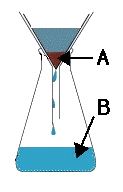
True or False: Filtration can be used to separate solutions
True
False
Which of the following statements tells us that a sample of liquid is pure water?
It is colourless.
It leaves no residue when filtered.
It boils at 100oC.
It is odourless.
Which separation technique is used to obtain pure water from seawater?
Simple distillation
Filtration
Chromatography
Evaporation
During filtration, the solid that is trapped in the filter paper is called the (a)
During filtration, the liquid that has passed through the filter paper is called the (a)
What method is used to obtain copper(II) sulfate crystals from its solution?
Crystallisation
Evaporation to dryness
Paper chromatography
Fractional distillation
Which one of the following is a disadvantage of evaporation to dryness?
It always requires heat
It cannot be used for insoluble solids
All of the solute is recovered
The solvent (liquid part) is not recovered
Solvent + Solute -> (a)
Which of the following equipment is NOT required for filtration?
Filter funnel
Conical flask
Filter paper
Measuring cylinder
Salt X that decomposes on strong heating is dissolved in water.
Which separation technique is best used to recover the solid salt?
Crystallisation
Evaporation to dryness
Filtration
Simple distillation

