wayground logo

Free Printable Worksheets

NEW

Font size

S
M
L
XL
Worksheets

AP Geography Political Concepts

Total questions: 75

Worksheet time: 56mins

Name
Class
Date
1.
A region where boundaries are very thinly or weakly developed, zones where territoriality is unclear and not well established.
a)
Frontier
b)
Shatterbelt
c)
Buffer State
d)
Satellite State
e)

Nation

2.
A state or group of states that exists within a sphere of competition between larger states and is often culturally, economically, and politically fragmented and splintered.
a)
Frontier
b)
Satellite States
c)
Shatterbelt
d)
Buffer State
e)

Multi-Ethnic State

3.
Countries controlled by another, more powerful state.
a)
Slav State
b)
Imperialist State
c)
Buffer State
d)
Satellite State
e)

Frontier

4.
An independent country located between two larger countries that are in conflict.
a)
Satellite State
b)
Buffer State
c)
Shatterbelt
d)
Frontier
e)

Nation

5.
A state with only one nation within its borders
a)
Stateless-Nation
b)
Nation-State
c)
Ethnocentric Nation
d)
Statehood
e)

Country

6.
a state that contains more than one ethnicity.
a)
United States
b)
Multi-Cultural State
c)
Multi-Ethnic State
d)
Nation-State
e)

Country

7.
a country that contains more than one ethnicity with traditions of self-determination.
a)
Multi-Ethnic State
b)
Multi-National State
c)
Stateless Nation
d)
Nationalism
e)

Country

8.
a sovereign state that comprises a town and the surrounding countryside.
a)
Nation-State
b)
City-State
c)
Stateless Nation
d)
National State
e)

Multi-Ethnic State

9.
The concept that ethnicities have the right to govern themselves.
a)
Self-determination
b)
Nationalism
c)
Predestination
d)
Nation-State
e)

Confederation

10.
The UN is an example of what?
a)
Alliance
b)
Multinational state
c)
Confederation
d)
Supranational organization
e)

Government

11.
A state with only one nation within its borders
a)
Stateless-Nation
b)
Nation-State
c)
Ethnocentric Nation
d)
Statehood
e)

Country

12.
Extreme patriotism or love for one's country.
a)
Pride
b)
Nationalism
c)
Patriotism
d)
Power
e)

Egotism

13.
Boundaries established by rivers, oceans, deserts, mountains, etc. 
a)
Political boundaries
b)
Physical boundaries
c)
Cultural boundaries
d)
Geographic boundaries
e)

Geometric Boundaries

14.
The Sahara desert and Himalayan mountains are examples of which type of boundary?
a)
Physical
b)
Cultural
c)
Boundaries
d)

Geometric

e)

Relic

15.
A state that encompasses a very small land area
a)
Island state
b)
Megastate
c)
Ministate
d)
Microstate
e)

Enclave

16.
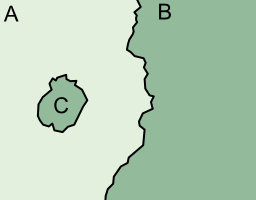
In this image if C belongs to B it is considered a ___________ of country B and a _______ of country A
a)
core, periphery
b)
enclave, exclave
c)
exclave, enclave
d)
heartland, periphery
e)

satellite, country

17.
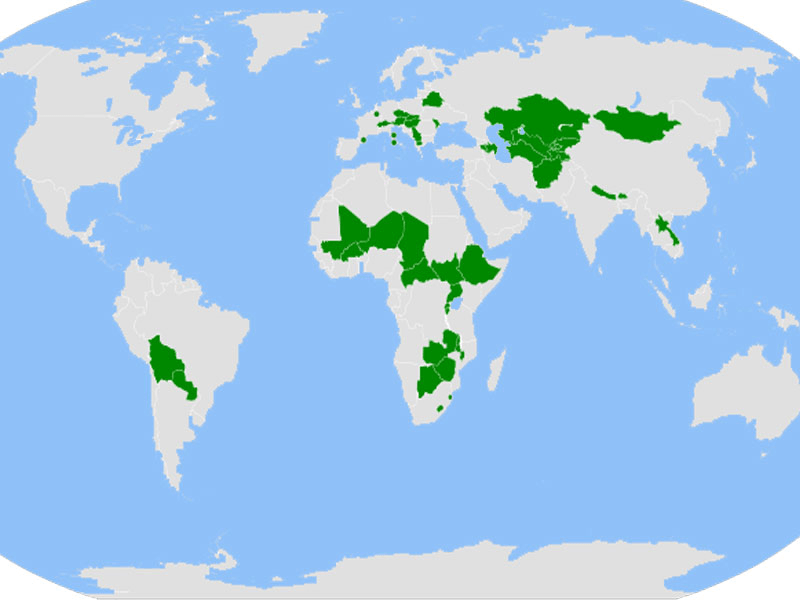
Which characteristic do all the nations seen here share?
a)
All are compact
b)
All are landlocked
c)
All are federal states
d)
All are members of OPEC
e)

All are enclaves

18.
Which type of boundary would use lines of latitude and longitude?
a)
Antecedent
b)
Subsequent
c)
Geometric
d)
Relic
e)

Physical

19.
A nationality is
a)
a group of people tied to a place through legal status and tradition.
b)
a country.
c)
any cohesive group of people.
d)
a group with shared religion, language, and origin of birth.
20.
Denmark is a good example of a nation-state because
a)
nearly all Danes speak Danish and live in Denmark.
b)
Danish and German nationalities intermingle in Schleswig-Holstein.
c)
the people living on the Faeroe islands, which are controlled by Denmark, speak Faeroese.
d)
Denmark consolidated its boundaries by giving Greenland to Norway.
21.
Which of the following is not a strong centripetal force in the United States?
a)

Common traditions of education

b)
the flag
c)
the many ethnic groups living in the United States
d)
"The Star Spangled Banner"
e)

The 4th of July

22.
What is the military alliance set up by West Europe and the US to align against communism?
a)
NATO
b)
UNHCR
c)
Warsaw Pact
d)
NAFTA
e)

EU

23.
Citizens in a totalitarian government would experience -
a)
  multiple political parties
b)
censorship, religious laws, and repression
c)
  a written constitution
d)
  direct elections for every governmental decision
e)

a complete lack of government and laws

24.
A theocratic government is often characterized by—
a)
the existence of multiple political parties
b)

religious leaders having the power of government

c)
a written constitution
d)
direct elections for governmental decisions
e)

a complete lack of government and laws

25.
This person is in charge of what type of government?
a)
Democracy
b)
Theocracy
c)
Dictatorship
d)
Oligarchy
e)

Anarchy

26.
A straight line boundary is known as a _____ boundary.
a)
Consequent
b)
Geometric
c)
Subsequent
d)
Natural
e)

Physical

27.

State that has freedom and control over its own affairs has 

a)
centrifugal forces
b)
nationalism
c)
sovereignty
d)
pluralism
e)

confederacy

28.

Japan, where the population is more than 90% ethnic Japanese, would be an example of a ______.

a)
Compact State
b)
Nation-State
c)
Multinational State
d)
Perforated States
e)

Stateless Nation

29.
A group of people who share a common culture and identity as a cohesive group is a called a ___.
a)
Nation State
b)
Nation
c)
Country
d)
Sovereign State
e)

Stateless Nationality

30.

Elbridge Gerry came up with the concept of ___ to redraw voting districts to make sure voters would elect the desired candidates.

a)
salamandering
b)
gerrymandering
c)
legislative redistricting
d)
electoral college
e)

bribery

31.
Something pushes people apart is referred to as a ____.
a)
Centripetal Force
b)
Centrifugal Force
c)
Nationalism
d)
Ethnic conflict
e)

Migration impulse

32.
September 11th, was an example of a____ force which brought the United States together.
a)
Centrifugal
b)
Nationalistic
c)
Centripetal
d)
Ethnic
e)

Causal force

33.

The attempt by one country to force its political control over another territory is

a)

constitutionality.

b)

colonialism

c)

self-determination

d)

sovereignty.

e)

balkanizing

34.
Country ran is run according to the interests of its ruler rather than its people is called a ____.
a)
Autocracy
b)
Anocracy
c)
Democracy
d)
Constitutional Monarchy
e)

Republic

35.

A system of government in which the people are invested with the power to choose their leaders and determine government policy.

a)

Monarchy

b)

Federation

c)

Sovereignty

d)

Democracy

e)

Autocracy

36.
Boundaries set by ethnic differences, especially those based on language and religion.
a)
Physical boundaries
b)
Economic Boundaries
c)
Political boundaries
d)
Cultural Boundaries
e)

Relic Boundaries

37.
The world's largest state is
a)
China
b)
Canada
c)
United States
d)
Russia
e)

Australia

38.
The European Union is an example of an ____ alliance.
a)
Military
b)
Nationalistic
c)
Political
d)
Economic
e)

Cultural

39.
A boundary between countries is a ....
a)
line on the ground only
b)
point of separation on and below the surface of the land
c)
vertical plan that cuts through the rocks below and the air above the land
d)
line shown only on maps
40.
A country that has no access to water is a ___ country.
a)
Compact
b)
Landlocked
c)
Island Nation
d)
Elongated
e)

State

41.
What does NATO stand for?
a)
North Atlantic Trade Organization
b)
North American Trade Organization
c)
North Atlantic Treaty Organization
d)
North Alaskan Trade Organization
42.

Lesotho must depend on South Africa because...

a)

Lesotho is landlocked inside of South Africa.

b)

South Africa has political sovereignty over Lesotho.

c)

It is part of a treaty with South Africa.

d)

It just thinks South Africa is rad.

e)

Lesotho is a colony of South Africa

43.

What shape best describes Myanmar?

a)

Compact

b)

Perforated

c)

Protruded

d)

Elongated

e)

Fragmented

44.

What is a challenge for an elongated state such as Norway?

a)

Access to ports

b)

Lack of natural resources

c)

It is landlocked

d)

Communication

e)

No close neighbors

45.

Which country is no longer part of the EU?

a)

Britain

b)

Germany

c)

France

d)

Italy

e)

Russia

46.

How might being landlocked challenge a country’s economy?

a)

Can only specialize in a few things

b)

No access to shipping ports

c)

Unfavorable trade deals

d)

Not enough resources

e)

No close neighbors

47.

What is the purpose of the EU?

a)

To keep trade only within EU countries

b)

To prevent EU citizens from traveling to or working in other countries

c)

To form a military treaty between European countries

d)

To make economic cooperation easier between member countries

e)

To rid Europe of all its separate countries

48.

What is the purpose of the UN Security Council?

a)

Global peacekeeping

b)

Facilitate trade

c)

Arrange military treaties

d)

Monitor immigration

e)

Make the world one government

49.

Because NAFTA promotes trade between the U.S., Canada, and Mexico, it is an example of a...

a)

Non-governmental organization

b)

Supranational organization

c)

Transnational corporation

d)

Military alliance

e)

Multi-national state

50.

The Red Cross and World Health Organization are...

a)

Supranational organizations

b)

Government-sponsored agencies

c)

Non-governmental organizations

d)

International corporations

e)

Multi-nation governments

51.

What is the name for organizations that operate completely independently of government control, usually in poor and impoverished countries?

a)

United Nations

b)

NGOs

c)

EU

d)

ASEAN

e)

Autacracies

52.

What is the term for a person who has been forced to flee their country due to war, persecution, or natural disaster?

a)

Evacuee

b)

Immigrant

c)

Refugee

d)

Migrant

e)

Displaced person

53.

form of government in which powers are divided between the national government and state or provincial governments

a)

federal system

b)

theocracy

c)

unitary system

d)

republic

e)

anarchy

54.

system in which small groups hold power

a)

autocracy

b)

anarchy

c)

democracy

d)

oligarchy

e)

dictatorship

55.
A queen rules a nation. When she dies, the throne will pass to her daughter. What kind of government does this nation have? 
a)
a monarchy 
b)
a theocracy
c)
a dictatorship
d)
a representative democracy
e)

an anarchy

56.
A military leader seizes control of a government during a revolution. He has complete control and kills anyone who opposes him. What kind of government does this nation have? 
a)
a monarchy
b)
a theocracy
c)
a dictatorship
d)
an oligarchy
e)

an anarchy

57.
People overthrow their government, but no ruler takes charge. Without leadership, the nation is in chaos. What is this situation called? 
a)
autocracy
b)
oppression 
c)
anarchy
d)
revolution
e)

dictatorship

58.
Brady lives in a representative democracy. What does that mean?
a)
He will be brought up on charges if he does not vote
b)
As a citizen, he is a member of the government and sits in Congress. 
c)
He votes for representatives who decide on the issues and laws
d)
He personally votes on every issue and law. 
59.

Who leads in a theocracy?

a)

Religious Leaders

b)

Dictator

c)

King or Queen

d)

President

e)

The people

60.

An example of a stateless nation...

a)

Rwanda

b)

the Kurds

c)

the Taiwanese

d)

Bangladesh

e)

the Japanese

61.

A major reason Russia has sought to destabilize and control Ukraine is...

a)

create a buffer between Russia and Moldova.

b)

prevent Ukraine from joining the European Union and becoming allied with western Europe.

c)

to colonize a former member of the Soviet Union.

d)

to stop Ukraine from breaking into several smaller sovereign states.

e)

to make Ukraine a colony of Russia

62.

ASEAN [Association of Southeast Asian Nations] is a collective group of states that seeks to create a collaborative group to promote the goals and aims of countries in Southeast Asia. This is an example of...

a)

a supernational organization

b)

a supranational organization

c)

devolution states

d)

sanctuary states

e)

unitary states

63.

A small state such as Switzerland might benefit from a _____ system of government, whereas a large state such as Russia might benefit from a ______ system of government

a)

unitary / federal

b)

democratic / autocratic

c)

federal / unitary

d)

autocratic / democratic

e)

city-state / nation-state

64.

Albania seeks to unify the lands that many Albanians consider to form their national homeland, based on claims on the present-day or historical presence of Albanian populations in those areas. This is an example of...

a)

anocracy

b)

a unitary system

c)

fragmented state

d)

irredentism

e)

devolution

65.

Saudi Arabia and Iran are enemies and constantly seek a political advantage over the other. Iraq is located in between them and is disrupted by this conflict. Iraq could be classified as a...

a)

shatterbelt

b)

stateless nation

c)

consequent boundary

d)

chokepoint

e)

frontier

66.

Which is not a devolutionary force in political geography?

a)

irredentism

b)

physical geography

c)

ethnic separatism

d)

education

e)

terrorism

67.

The largest supranational organization is...

a)

NATO

b)

the League of Nations

c)

the European Union [EU]

d)

the United Nations [UN]

e)

NAFTA

68.

Vatican City is a microstate completely surrounded by Italy, which classifies the Vatican City as an...

a)

exclave

b)

enclave

c)

relic boundary

d)

demilitarized zone

e)

stateless nation

69.

Ethnic enclaves such as Chinatown in San Francisco, CA are generally formed through...

a)

contagious diffusion

b)

devolution

c)

gerrymandering

d)

relocation diffusion

e)

balkanization

70.

A nation of people with common ethnicity that matches the boundaries of a state and are sovereign.

a)

multination state

b)

nation-state

c)

colony

d)

protectorate

e)

exclave

71.

How many states are there in the world

a)

159

b)

187

c)

195

d)

145

72.

An example of a cultural boundary is a

a)

river

b)

mountain

c)

geometric line

d)

language

e)

ocean

73.

Which of the following is not a requirement to be considered a state?

a)

a defined boundary

b)

sovereign government

c)

permanent population

d)

developed industry

74.

The largest multinational state in the world is...

a)

China

b)

India

c)

Russia

d)

United States

e)

Australia

75.

In the 1990s, ethnic conflict caused the country of Yugoslavia to break up into several smaller states. This is an example of:

a)

Ethnic cleansing

b)

Balkanization

c)

Cultural diffusion

d)

Genocide

e)

Terrorism