
Font size
 Worksheets
ENERGY TRANSFRR
Total questions: 25
Worksheet time: 15mins

As the ball is dropped, the potential energy decreases while the kinetic energy increases however the amount of energy stays the same.
True
False
Which is the best example of kinetic energy?
A car sitting on top of a hill
A skateboard on the sidewalk
A wagon rolling down a hill
A powerwheel parked in the yard
What is changed to increase the potential energy of an object being dropped?
Temperature
Gravity
Height
Volume

What kind of energy is being shown in the picture?
Light
Gravitational
Potential
Kinetic

What happens as the ball on the pendulum goes from center to the right in the diagram?
Kinetic energy increases while potential energy decreases
Potential energy increases as kinetic energy decreases
Potential energy increases as kinetic energy increases
Potential and Kinetic energy is lost

How does energy change?
The cart has more kinetic energy at the top than when it is going down the hill.
The cart has potential energy at the top while kinetic energy increases going down.
The cart has potential energy that is lost going down the hill.
The cart has kinetic energy at the top of the hill and no potential energy.
True or False. Energy cannot be created or destroyed, rather it is transformed from one energy type to another.
True
False

Identify the energy transfer
chemical to kinetic
solar to electrical
thermal to light
electrical to light
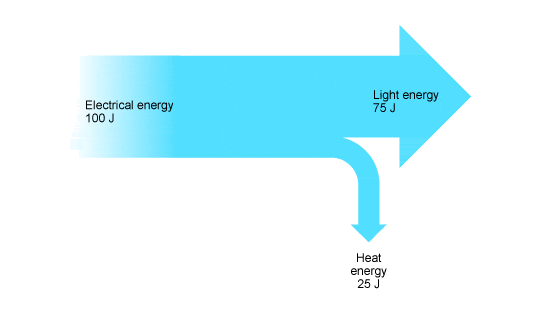
What is this diagram called?
Stankey Diagram
Sankey Diagram
Sankay Diagram
Samkay Diagram
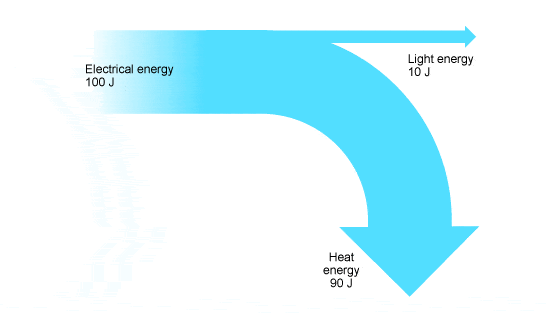

The energy efficiency shown in this diagram is:
About 10%.
About 30%.
About 60%.
Impossible to tell.
A washing machine uses 250J of electrical energy to produce 125J of useful energy. How efficient is it?
5%
50%
55%
100%
An iPhone charger coverts 75J of electricty in to 50J of charge and 25J of thermal energy. How efficient is the charger?
10%
100%
33%
67%
Select the correct equation:
Efficiency = wasteduseful×100
Efficiency = usefulwasted×100
Efficiency = inputwasted×100
Efficiency =inputuseful×100

What is the value of the wasted energy?
(a)

As a percentage, what is the efficiency of the bulb represented by the Sankey diagram?
(a)

What type of energy is useful?
(a)
A device transfers 600 J of electrical energy into 350 J of useful sound energy. Calculate the efficiency of the device to 2 significant figures.
(a)
A bulb is 70% efficient. It produces 49 J of light energy. How much energy is inputted?
(a)
A bulb is 70% efficient. It produces 49 J of light energy. How much energy is inputted?
(a)
______ is heat transfer or movement by direct contact and is usually through solids.
Conduction
Convection
Radiation
Heat that is transferred or moved in circular currents through fluids is called _____.
Conduction
Convection
Radiation
Which statement is true?
The quicker a molecule moves, the colder it is.
The slower a molecule moves, the warmer it is
The quicker a molecule moves, the warmer it is.
The movement of molecules doesn't affect temperature.
In heat transfer, the heat always moves from the _____ object to the _____ object.
warmer to cooler
cooler to warmer
warmer to warmer
cooler to cooler

