
 Worksheets
AP Chem Unit 1 Review
Total questions: 33
Worksheet time: 18mins
When an electron is in a higher energy level, it is ___________ the nucleus and therefore has _______ Coulombic attraction to the nucleus and is ________ to remove (...it has a _________ 1st ionization energy.)
closer to
greater
harder
higher
farther from
less
easier
lower
farther from
greater
easier
higher
closer to
less
harder
lower
Moving across a row on the periodic table, the Zeff (nuclear charge) _______, therefore the valence electrons are ________ attracted to the nucleus, therefore the atomic radius __________ and the ionization energy ____________.
decreases
less
increases
decreases
increases
less
increases
increases
increases
more
decreases
increases
decreases
more
decreases
decreases
When reading a PES graph, the higher the peak, _______________
the more energy the electrons contain
the more electrons are in that sublevel
the further the electrons are from the nucleus
the higher the first ionization energy
When reading a PES graph, a larger binding energy means
there are more electrons in that sublevel
the closer the electrons are to the nucleus
the lower the ionization energy
the further away the electrons are from the nucleus
Cations (+) are _________ than their atoms. Anions (−) are _________ than their atoms.
smaller
larger
larger
smaller
smaller
smaller
larger
larger
What is the electron configuration for the zinc atom in the ground state?
1s2 2s2 2p6 3s2 3p6 4s2 3d10
1s2 2s2 2p6 3s2 3p6 4s2 4d10
1s2 2s2 2p6 3s2 3p6 4d10
1s2 2s2 2p6 3s2 3p6 3d10
What is the electron configuration for the zinc ion?
1s2 2s2 2p6 3s2 3p6 3d10
1s2 2s2 2p6 3s2 3p6 4s2 3d8
1s2 2s2 2p6 3s2 3p6 4s2 3d10 4p2
1s2 2s2 2p6 3s2 3p6 4d10
In a PES graph, 1s electrons will have a _______ binding energy than 2s electrons.
higher
lower
same
When Ca becomes an ion, it _______ electrons and gets _________.
loses
smaller
loses
larger
gains
smaller
gains
larger
If a metal and a nonmetal are in the same period, the ______ will have the higher ionization energy because it has ___________________.
metal
higher effective nuclear charge
nonmetal
higher effective nuclear charge
metal
more energy levels
nonmetal
more energy levels
Based on Coulomb's law, an electron is more tightly held to the nucleus if the charge of the nucleus is ___________ and the distance between them is ____________.
greater
greater
greater
smaller
smaller
smaller
smaller
greater
When a nonmetal atom becomes an ion, the ion is ____________ than the atom because of greater ________________.
smaller
effective nuclear charge
larger
electron-electron repulsion
smaller
electron-electron repulsion
larger
effective nuclear charge

Calculate the average atomic mass from the mass spec.
85.56 amu
85.75 amu
86.44 amu
86.74

What element has the following mass spec data?
Thulium
Copper
Europium
Zinc

How many isotopes are shown in this mass spec?
1
2
6
7

Based on the mass spec data, which Iron isotope is the most abundant?
Fe-54
Fe-56
Fe-57
Fe-58

What element has the following mass spec data?
Tin
Tellurium
Chromium
Polonium

The PES spectrum below is for the element _______________.
O
Ne
N
F

Examine the spectrum below. Where would you expect the 2p peak for F be if it were on the same spectrum?
To the left of the peak at 3.04
To the right of the peak at 3.04
To the left of the peak at 1.31
To the right of the peak at 1.31

How many valence electrons does the element pictured in the PES spectrum below have?
1
2
3
4

Where would you expect the 2s peak for Sodium to fall relative to the presented spectrum of a different element below?
Just to the left of the peak at 126
Just to the right of the peak at 126
Just to the left of the peak at 9.07
Just to the right of the peak at 9.07
Which of the following explains why atomic radius increases as you go down a group?
The number of particles in the nucleus of the atom increases
The number of electrons in the outermost shell of the atom increases
The attractive force between the valence electrons and the nuclei of the atoms decreases
the repulsive force between the valence electrons and the electrons in the inner shell decreases.
Which of the following explains why sulfur has a lower first ionization energy than phosphorus in spite of the typical periodic trend? (draw an orbital diagram)
The atomic radius of sulfur is greater than fluorine.
Sulfur has a set of paired electrons in 3p which repel the other 3p electrons
Phosphorus has a greater nuclear charge than sulfur and holds its electrons tighter
Sulfur on average has more neutrons than phosphorus which interrupt and weaken the coulombic attraction between protons and electrons.
The mass, in grams, of 1.35 x 10^26 molecules of water is equal to
(a)

Chloroform, a toxic substance that may cause severe liver, kidney, and heart damage, has the percent composition by mass of this compound is 10.06% carbon, 0.84% hydrogen, and 89.09% chlorine. What is the empirical formula of this compound?
C3H3Cl
CH6Cl3
CH3Cl3
CHCl3
For the reaction represented by the equation Pb(NO3)2+2KI → PbI2+2KNO3 how many moles of lead iodide (PbI2) are produced if 300 grams potassium iodide (KI) react with Pb(NO3)2 in excess?
114.78 mol PbI2
0.904 grams PbI2
0.904 mol PbI2
114.78 grams PbI2
For the reaction represented by the equation 2KClO3→ 2KCI+302 how many grams of potassium chlorate are required to produce 160. g of oxygen?
408 g KClO3
804 g KClO3
598 g KClO3
There is not enough information.
Which electron configuration belongs to a Chloride (Cl-) ion?
1s2 2s2 2p6 3s2 3p5
1s2 2s2 2p6 3s2 3p6
1s2 2s2 2p6 3s2 3p7
1s2 2s2 2p6 3p7
Choose the atoms and ions that are isoelectronic:
Ar
K+
P3−
Br−
Al3+
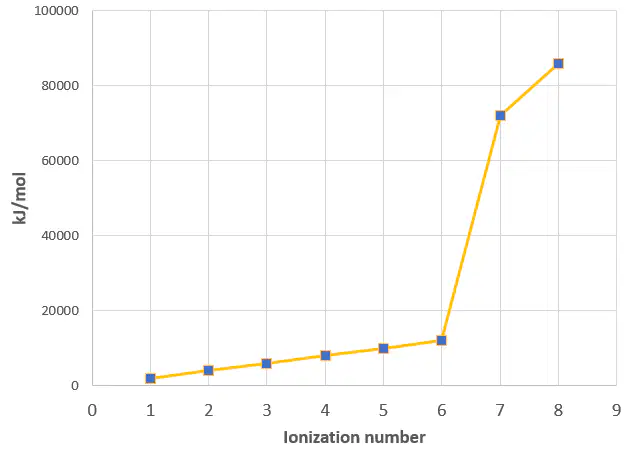
The graph shows the successive ionization energies of an unknown element. In which group would you expect to find this element?
7
6
16
17
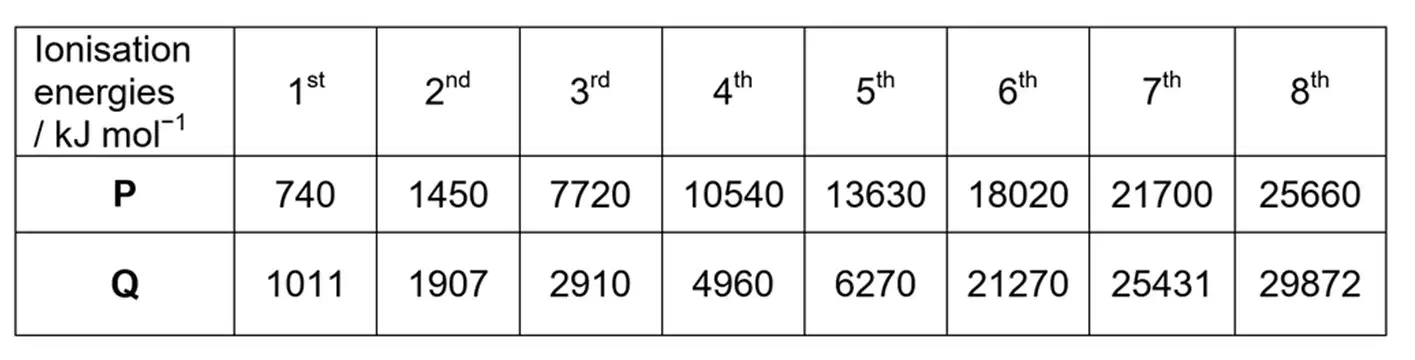
Using the table, how many valence electrons does unknown element P have? ***P IS NOT PHOSPHORUS IN THIS CASE!***
5
2
3
4
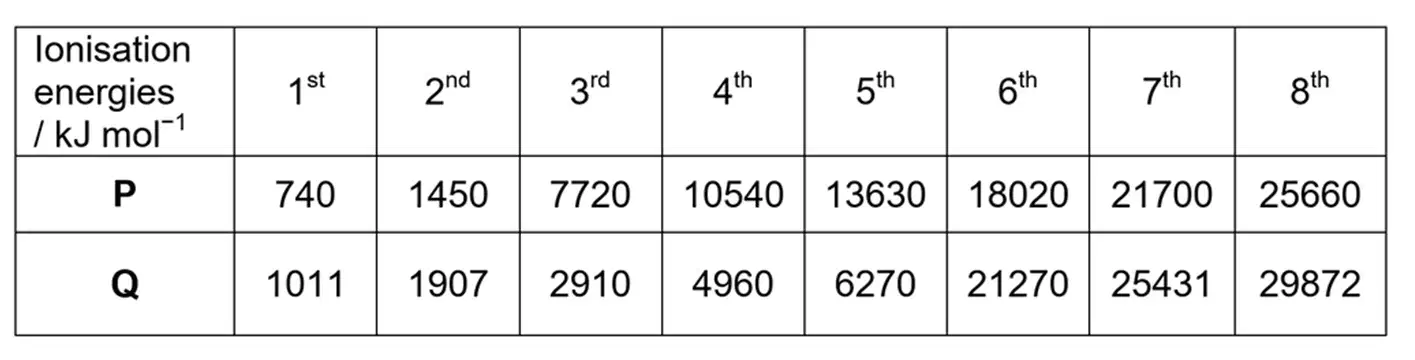
What would the charge of Q be if it were to become an ion?
3-
3+
5-
5+
Calculate the number of sulfate ions in 100.0 grams of Aluminum Sulfate.
3.519 x 10^23 sulfate ions
5.279 x 10^23 sulfate ions
6.121 x 10^24 sulfate ions
2.057 x 10^24 sulfate ions

