
 Worksheets
Unit 1 Review: Geometry Basics
Total questions: 48
Worksheet time: 12hrs 0mins

Are the points shown collinear?
Yes
No

Are the points shown coplanar?
Yes
No

Choose the points that are collinear.
A, B, and C
A, C, and D
A, E, and F
B, C, and D

Are the points D, G, and F coplanar?
Yes
No


A flat surface made up of points that has two dimensions and extends without end.

Any 2 collinear points on the plane or a lowercase script letter.

Write an equation that correctly models the lengths shown.
2x + 20 + x + 21 = 9
2x + 20 + 9 = x + 21
9 + x + 21 = 2x + 20
2x + 20 - 9 = x + 21

Part of a line that has a beginning, but no end is called a...
line segment
ray
angle
plane

Example 2: Find x if the length of PR is 45 units in length. [Refer to the figure]
3
44
5
6

Suppose AC = 48, find the value of x. Then, find the length of AB.
13
16
12
15

If m∠ABC = 103° find x.
(a)

Given m∠QST = 135°, find the value of x.
x = 26
x = 28
x = 27
x = 29

x = 6°
x = 7°
x = 12°
x = 144°

50°
58°
115°
226°


Which of the following is the correct midpoint formula given two endpoints (x1, y1) and (x2, y2)?
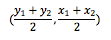
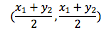
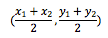

Which of the following formulas is the distance formula?
(2x1+x2, 2y1+y2)
(x2−x1)2+(y2−y1)2
a2+b2=c2
x2−x1y2−y1
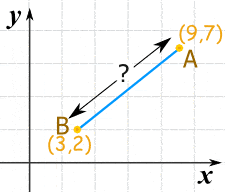
Find the distance between each pair of points.
(-6,-10) and (-2,-10)
d=6
d=4
d=15
d=12
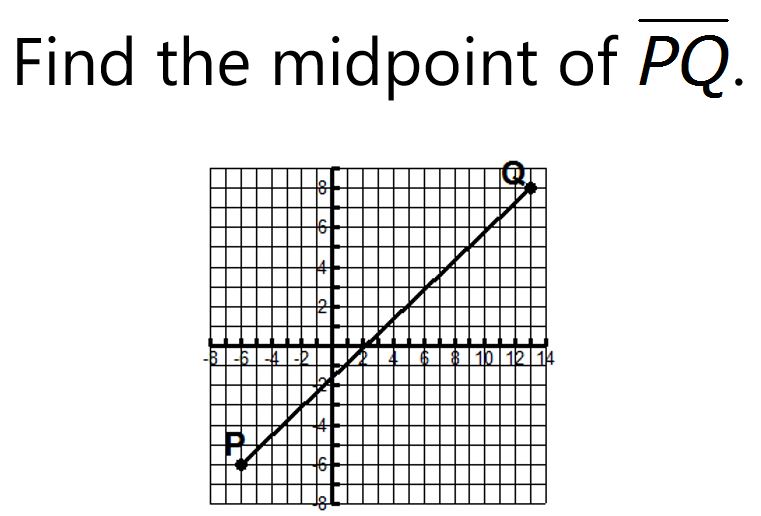
(3, 1)
(3.5, 1)
(4, 1)
(2, 0)
A single angle that measures exactly 180 degrees.
Straight Angle
Vertical angles are always
90 degrees
180 degrees
congruent
adjacent

Name the angle relationship shown.
Adjacent
Vertical
Complementary
Supplementary
No relationship


Select ALL of the following ways to name angles 1 and 2 in the diagram.
Adjacent Angles
Vertical Angles
Complementary angles
Supplementary Angles
Linear Pair

Select ALL of the following ways to name angles 1 and 2 in the diagram.
Adjacent Angles
Vertical Angles
Complementary angles
Supplementary Angles
Linear Pair

Select ALL of the following ways to name angles 1 and 2 in the diagram.
Adjacent Angles
Vertical Angles
Complementary angles
Supplementary Angles
Linear Pair

Select ALL of the following ways to name angles 1 and 2 in the diagram.
Adjacent Angles
Vertical Angles
Complementary angles
Supplementary Angles
Linear Pair

Which construction is shown in the picture?
Line Parallel to a Line through a Point
Congruent Angles
Perpendicular Bisector of a Segment
Perpendicular through a Point NOT on a LINE
Perpendicular through a Point ON a LINE

Which construction is shown in the picture?
Line Parallel to a Line through a Point
Congruent Angles
Perpendicular Bisector of a Segment
Angle Bisector
Perpendicular through a Point ON a LINE

Which construction is shown in the picture?
Line Parallel to a Line through a Point
Perpendicular through a Point NOT on a LINE
Perpendicular Bisector of a Segment
Angle Bisector
Perpendicular through a Point ON a LINE

Which construction is shown in the picture?
Line Parallel to a Line through a Point
Perpendicular through a Point NOT on a LINE
Perpendicular Bisector of a Segment
Angle Bisector
Perpendicular through a Point ON a LINE

Which construction is shown in the picture?
Line Parallel to a Line through a Point
Perpendicular through a Point NOT on a LINE
Perpendicular Bisector of a Segment
Angle Bisector
Congruent Angles

Which construction is shown in the picture?
Line Parallel to a Line through a Point
Perpendicular through a Point NOT on a LINE
Perpendicular Bisector of a Segment
Angle Bisector
Congruent Angles

If bisects ∠PQR, m∠PQS = (7x – 6)°, and m∠SQR = (4x + 15)°, find m∠PQT.
7
137
94
43

