
 Worksheets
Practice with Forces
Total questions: 50
Worksheet time: 28mins
A driver wants to increase the rate at which his racecar can accelerate. Which adjustment to his car would generate the largest increase in acceleration?
Reduce the overall mass of the vehicle by half.
Install an engine that will generate 50% more force.
Increase the radius size of the tires by four times.
Decrease drag by reducing the angle of the windshield.
What will happen to an object in motion with no unbalanced force acting on it?
It will continue to accelerate until it reaches the speed of light.
It will gradually slow down and come to a rest.
It will continue to move at a constant speed.
It will initially accelerate but gradually slow down until it comes to a rest.
Jim drops a basketball on the floor, and it bounces upwards. Which of Newton's laws can be used to explain why this phenomena occurs?
Newton's third law
Newton's second law
Newton's first and second laws
Newton's second and third laws
A person is paddling a canoe with an oar across a calm lake on a summer afternoon. The oar exerts an action force on the water. What can be inferred from this scenario?
The water exerts no reaction force on the oar because the water simply around the oar.
The water exerts a greater reaction force on the oar because it provides resistance for the oar and creates drag as the canoe moves.
The water exerts a lesser reaction force on the oar since water is a fluid and does not retain a definite shape when force is applied.
The water exerts an equal reaction force on the oar regardless of the velocity of the canoe.
Which pair of objects will have the greatest force of gravity between them?
objects that are small and far apart
objects that are small and close together
objects that are large and far apart
objects that are large and close together
Which force does not require contact and can act on objects from a distance?
applied force
friction force
gravitational force
tension force
What term represents the strength of a force?
direction
inertia
friction
magnitude

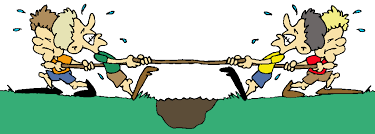
Force can change the speed or direction of motion of an object, or sometimes both. The illustration below shows a game of tug-of-war between two teams of students.
The team of students on the right won the contest. What force helped the winning team?
a balanced force
a balanced force
an unbalanced force
a gravitational force
The forces acting on an object can either be balanced or unbalanced. If an unbalanced force is applied to an object, what might happen to the object?
Only the speed of the object might change
Only the direction of the object might change
Both the speed and direction of the object might change
Neither the speed or direction of the object might change

A marine biologist observed the swimming speed of five different types of fish as shown in the chart below.
What measurements did the marine biologist take to correctly calculate the speed of these fish?
time and density
volume and mass
distance and density
distance and time
What is the speed of a turtle that travels 10 miles in 5 hours?
50 miles/hour
2 miles/hour
5 miles/hour
15 miles/hour
What formula can we use to find speed?
Speed = distance/time
Speed = distance X time
Speed = mass X acceleration
Speed = mass/acceleration
What are the two factors that FRICTION depends upon?
Mass and Strength of the force pushing the two surfaces together
Mass and Distance
Type of surface and Strength of the force pushing the two surfaces together
Type of surface and Distance apart
What are the two factors that gravity depends on?
Mass and Type of surface
Distance and Width
Mass and Distance
Distance and Type of surface
What is the formula to find the force of an object?
Force = Mass X Acceleration
Force = Mass / Acceleration
Force = Distance / Time
Force = Distance X Time
What is Friction ?
The distance an object travels per unit of time
Speed in a given direction
Force that opposes motion
Force that pulls objects towards each other
What is Gravity ?
The distance an object travels per unit of time
Speed in a given direction
Force that opposes motion
Force that pulls objects towards each other

What is the net force acting on the object? (Just write the number)
(a)

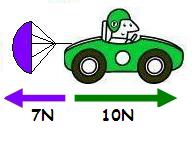
What is the net force?
3 N
3 N, right
17 N, right
3 N, left


A ____________ is a push or a pull on an object.
friction
force
magnet
gravity

Forces that have a net force of zero Newtons
Balanced force
Unbalanced force
When the vectors (arrows) point away what function do you use?
Dividing
Multiplying
Subtracting
Adding

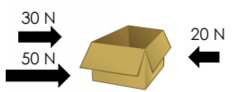
What is the net force acting on the box?
60N, Right
60N, Left
100N, Right
100N, Left
Which refers to an object’s resistance to any change in its motion?
force
acceleration
gravity
inertia
A player throws a ball. The action force is the player pushing on the ball. The reaction force is...
The force of the ball pushing on the player


According to Newton’s Third Law, if someone jumps off a skateboard, the skateboard will roll backwards because -
the mass of the skateboard is the same as the mass of the person jumping off.
the pull of gravity on the person is the same as on the skateboard, regardless of size.
the air resistance on the person is great and the friction on the skateboard is small.
for the force that sent the person forward, there is an equal force pushing back on the skateboard.

The nozzle of a rocket is pointed downward so that as fuel is ignited, the exhaust pushes downward. Why is this arrangement necessary for a rocket to function properly?
The rocket is protected from the heat of the exhaust.
Burned fuel can be collected on the ground.
As fuel is combusted, the rocket pushes the gases backward and the gases push the rocket forward.
This allows the rocket to be steered properly.

The head of a hammer is often made of steel. This makes the head heavy,which helps create a strong force for driving nails. Steel is also strong. The head of a hammer must be strong to resist what force?
The force of the air resistance on the moving hammer
The force of the person using the hammer
The force of gravity pulling down on the hammer
The force of the nail pushing in the opposite direction
which law of motion is demonstrated by a ball rolling to a wall and then stopping?
1st law
2nd law
3rd law
none of this apply to the situation

