Worksheets
Optional EC Practice - Unit 2 Part B
Total questions: 77
Worksheet time: 3hrs 43mins
What is a conditional statement?
if-then statement
if part
then part
a true or false statement
What is a hypothesis?
if-then statement
if part
then part
a true or false statement
What is a conclusion?
if-then statement
if part
then part
a true or false statement
Write this statement as a conditional statement.
"Thanksgiving in the United States falls on the fourth Thursday of November."
If it is a Thursday, then it is November.
If it is the fourth Thursday of November, then it is Thanksgiving in the United States.
If it is Thanksgiving, then it is in the United States.
If it is a Thursday, then it is Thanksgiving in the United States.
Determine if the conditional is true or false. If it is false, find a counterexample.
"If a polygon has 8 sides, then it is an octagon."
True
False
False, if a polygon has 8 sides, then it is a hexagon.
Determine if the conditional is true or false. If it is false, find a counterexample.
"If you live in a country that borders the United States, then you live in Canada."
True
False
False, if you live in a country that borders the United States, then you live in Canada or Mexico.
Determine if the conditional is true or false. If it is false, find a counterexample.
"If you play a sport with a ball and a bat, then you play baseball."
True
False
False, if you play a sport with a ball and a bat, then you play baseball or cricket.
Determine if the conditional is true or false. If it is false, find a counterexample.
"If an angle measures to 80 degrees, then it is acute."
True
False
False, if an angle measures to 80 degrees, then it is obtuse.
Select the inverse of the conditional statement.
"If you are a quarterback, then you play football."
If you play football, then you are a quarterback.
If you are not a quarterback, then you do not play football.
If you do not play football, then you are not a quarterback.
Select the converse of the conditional statement.
"If you are a quarterback, then you play football."
If you play football, then you are a quarterback.
If you are not a quarterback, then you do not play football.
If you do not play football, then you are not a quarterback.

Select the contrapositive of the conditional statement.
"If you are a quarterback, then you play football."
If you play football, then you are a quarterback.
If you are not a quarterback, then you do not play football.
If you do not play football, then you are not a quarterback.
Select the contrapositive of the conditional statement.
"If two lines lie on the same plane, then they are coplanar."
If they are coplanar, then they are two lines that lie on the same plane.
If two lines do not lie on the same plane, then they are not coplanar.
If they are not coplanar, then the two lines do not lie on the same plane.
Select converse of the conditional statement.
"If two lines lie on the same plane, then they are coplanar."
If they are coplanar, then they are two lines that lie on the same plane.
If two lines do not lie on the same plane, then they are not coplanar.
If they are not coplanar, then the two lines do not lie on the same plane.

Select inverse of the conditional statement.
"If two lines lie on the same plane, then they are coplanar."
If they are coplanar, then they are two lines that lie on the same plane.
If two lines do not lie on the same plane, then they are not coplanar.
If they are not coplanar, then the two lines do not lie on the same plane.
If 31 = 2x - 5, then 2x - 5 = 31

If m+a=27 and a=4
then m+4=27
REFLEXIVE PROPERTY
TRANSITIVE PRPERTY
SUBSITUTION PROPERTY
SYMMETRIC PROPERTY
If 8a=3 then a=24
Multiplication Property of Equality (MPE)
Division Property of Equality (DPE)
Addition Property of Equality (APE)
Subtraction Property of Equality (SPE)
C is the midpoint of segment AB
2(x + 3) = 2x + 6
If PQ = RS then RS = PQ


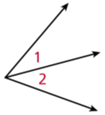
What type of angles are these?
Adjacent Angles
Linear Pair
Complementary Angles
Supplementary Angles
Vertical Angles
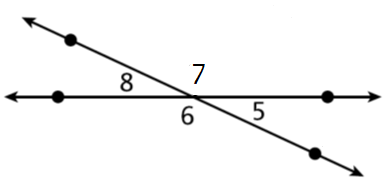
Which angles are vertical angles?
∠8 & ∠7
∠8 & ∠6
∠8 & ∠5

Select the conditional statement of the biconditional statement:
I am a junior if and only if I am in 11th grade.
I am a junior
If I am a junior, then I am in 11th grade.
I am in 11th grade
What counterexample makes the following biconditional false?
"It is Halloween if and only if it is October 31."
This is a true biconditional, so it has no counterexamples.
It is not October 31.
I don't celebrate Halloween.
It is October 30.
Select the conditional statement(s) of the biconditional statement:
Points lie in one plane if and only if they are coplanar.
Coplanar points lie in one plane.
If points lie in one plane, then they are coplanar.
If points are coplanar, then they lie in one plane.
Planes have coplanar points.
Select the conditional statement(s) of the biconditional statement.
Points are collinear if and only if they all lie in one line.
If collinear points lie in one line, then they are a line.
If points all lie in one line, then they are collinear.
Collinear points lie in one line.
If points are collinear, then they all lie in one line.

Identify the hypothesis in the statement.
You like the ocean
You are a good swimmer
If you are a good swimmer, then you like the ocean.
You are not a good swimmer.

Subtraction
Property

Symmetric
Property

Combine
like terms

Distributive
Property

Transitive
Property


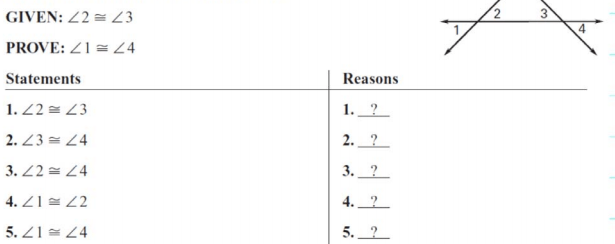
4) What is the reason for Statement 3
Corresponding Angles Postulate
Angles that form a Linear Pair that sums 180°
Same-side Interior Angles Theorem
Vertical Angles Theorem

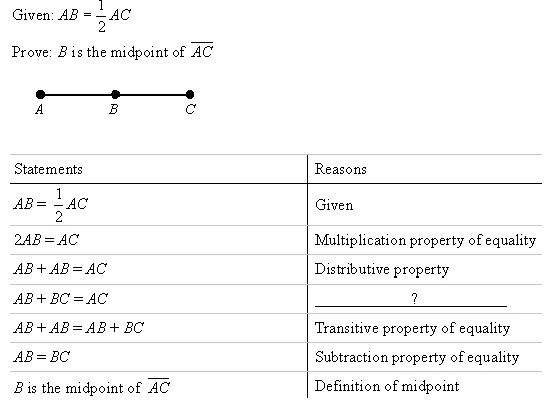
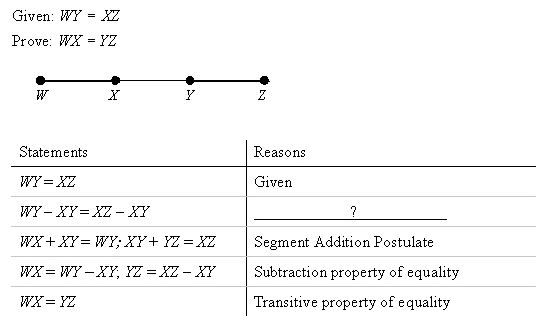
What is the missing statement in the proof?
Addition property
Segment Addition Postulate
Substitution property
Transitive property
Which property, definition, postulate, or theorem justifies the following statement?
MN≅MN
Reflexive Property of Congruence
Symmetric Property of Congruence
Transitive Property of Congruence
Segment Congruences Property


Supply the second reason.
Linear Pair Postulate
Alternate Interior Angles Theorem
Vertical Angles Theorem
Corresponding Angles Postulate
Which property, definition, postulate, or theorem justifies the following statement?
If CD+EF=HI and EF=MN , then CD+MN=HI .
Transitive Property of Equality
Addition Property of Equality
Segment Addition Postulate
Substitution Property


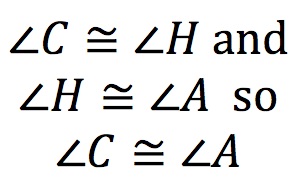
Which property justifies the next step?
Definition of congruent segments
Segment addition postulate
Transitive Property
Definition of equality


Reflexive Property
Substitution Property
Transitive Property
Symmetric Property


What is the justification?
Definition of congruence
Reflexive Property of Congruence
Segment Addition Postulate
Definition of Midpoint

What is the justification?
Segment Addition Postulate
Definition of Midpoint
Addition Property of Equality
Complement Theorem

What is the justification?
Transitive Property of Equality
Subtraction Property of Equality
Division Property of Equality
Substitution Property of Equality

Multiplication Property of Equality
Segment Addition Postulate
Definition of Midpoint
Symmetric Property of Congruence

What is the justification?
Definition of Congruence
Segment Addition Postulate
Transitive Property of Congruence
Definition of Midpoint