wayground logo

Free Printable Worksheets

Font size

S
M
L
XL
Worksheets

Newton's Laws of Motion

Total questions: 25

Worksheet time: 28mins

Name
Class
Date
1.
What is Newton's First Law known as? The Law of
a)
Friction
b)
Mass
c)
Inertia
d)
Gravity
2.
What is Newton's First Law
a)
F=ma
b)
Every action has an equal and opposite reaction
c)
An object at rest stays at rest, an object in motion stays in motion. 
d)
Friction 
3.
The tendency of an object to resist a change in its motion
a)
acceleration
b)
inertia
c)
mass
d)
frame of reference
4.
What kind(s) of objects have inertia?
a)
all objects with mass
b)
only objects at rest
c)
only objects in motion
d)
only objects whose motion is being changed
5.
If one object has twice as much mass as another object, it also has twice as much...
a)
inertia
b)
velocity
c)
acceleration due to gravity
d)
DO NOT PUSH ME
6.
Which type of force(s) will cause a change in an object's motion?
a)
gravity
b)
zero net force
c)
balanced forces
d)
unbalanced forces
7.
The law of inertia (Newton’s First Law) applies
a)
to both moving and nonmoving objects
b)
only to moving objects
c)
only to objects that are not moving
8.
Why is the net force 0 in the image?
a)
Because the elephants are the same size
b)
Because they are both pulling the same amount of force in opposite directions
c)
Because they are elephants
d)
Because they are pulling away from each other.
9.
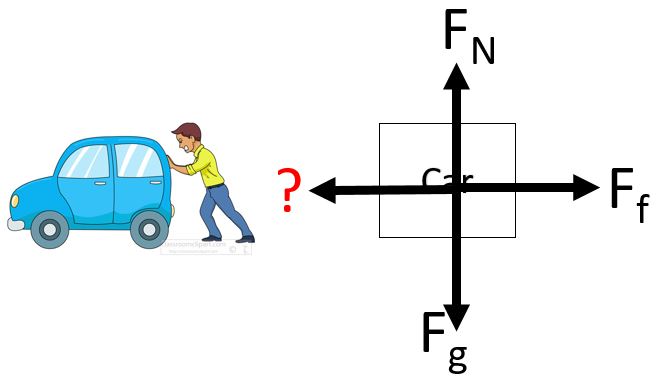
Name the missing force...
a)
applied force
b)
weight force
c)
tension force
d)
drag
10.

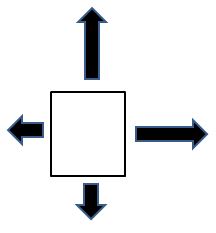
This object would be moving (pick all that are correct):

a)

up

b)

down

c)

left

d)

right

11.
If there are two forces going in the same direction how would you find the net force?
a)
Subtract
b)
Add
c)
Neither
d)
Multiply
12.
8 N to the left , and 4 N to the right. Find the net force. Is this balanced?
a)
12 N Right  No
b)
4 N Left  No
c)
12 N Right  Yes
d)
4 N Left  Yes
13.
Force pair that has a net force of zero.
a)
Balanced force
b)
Unbalanced force
14.
Which one is balanced?
a)
top
b)
bottom
c)
both
d)
neither
15.
What is the magnitude (size) and direction of the net force?
a)
15 N to the left
b)
15 N to the right
c)
1 N to the left
d)
1 N to the right
16.

A force is defined as a ____ or a ____

(a)  

17.

For this question, refer to the image to the left...

The larger the ___________ of an object, the greater the ____________ needed to change the direction or the speed.

a)

mass / tow truck

b)

suitcases / force

c)

mass / force

d)

windows / force

18.

List the three (3) possibilities that an object might demonstrate when subjected to an unbalanced force or caused to accelerate:

(You must choose 3 answers)

a)

Speed Up

b)

Leave Our Atmosphere

c)

Slow Down

d)

Levitate In The Air

e)

Change Direction

19.

What unit is Force measured in?

a)

Nanograms

b)

Newtons

c)

Kilograms

d)

meters per second

20.

What is the formula for the 2nd law of motion?

a)

a = lw

b)

F = mama

c)

F = ma

d)

F = llama

21.

Why is it harder to push a van filled with bowling balls than it is to push a van with basketballs?

a)

The mass of the car is greater than the mass of the basketballs

b)

The mass of the bowling balls is greater than the mass of the basketballs

c)

The van with the basketballs is bigger than the van with the bowling balls

d)

It should be equally as hard to push the two vans

22.
You pull a wagon with your younger sister in it. Which of these would accelerate the rate at which you can pull the wagon?
a)
pull the wagon with less force
b)
Pull the wagon with more force
c)
Have your sister push down on the wagon
d)
Put another of your siblings in the wagon
23.

If the man pushes with an equal amount of force, which object will accelerate more?

a)

Car because it has more mass

b)

Lawnmower because it has less mass

c)

Car because it has less mass

d)

Lawnmower because it has more mass

24.

According to __________, the acceleration of an object is equal to the net force acting on the object divided by the object's mass.

a)

Newton's Second Law

b)

Newton's Third Law

c)

Newton's First Law

d)

Marvin the Martian's Earthlings Can't Dance Law

25.
The scientist who is most famous for developing the Laws of Motion is _____.
a)
Albert Einstein
b)
Stephen Hawking
c)
Sir Isaac Newton
d)
Galileo Galilei